
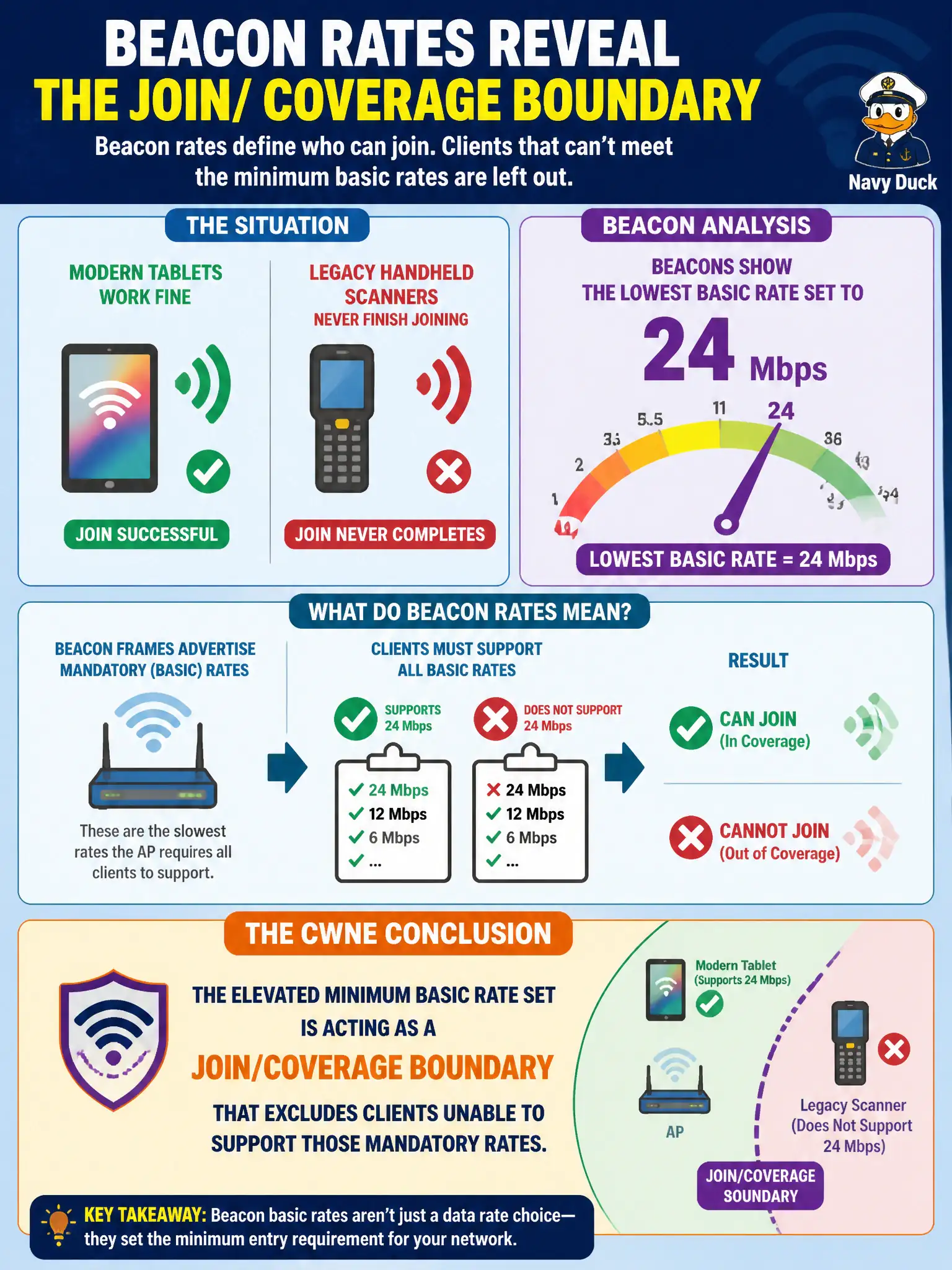
A county warehouse SSID works for modern tablets but legacy handheld scanners never finish joining. Beacons show the lowest basic rate set to 24 Mbps. What should the CWNE conclude from that Beacon rates analysis?
Select an answer to reveal the explanation.
Short Explanation
Basic rates are the club's mandatory dress code in the Beacon. Jack them too high and the old scanners can't meet the door policy even when the fancy tablets stroll right in. Tune that floor for the clients you still have to support.
Full Explanation
The BSS basic rate set in Beacons defines rates every station must support to join and to decode mandatory management and control traffic. When a county warehouse SSID admits modern tablets but legacy handheld scanners never finish joining, and Beacons show the lowest basic rate at 24 Mbps, the elevated minimum basic rate is acting as a join and coverage boundary that excludes clients unable to support those mandatory rates. Higher-capability devices thrive while older scanners fail at the door policy encoded in the Beacon.
Raising the minimum basic rate further to 54 Mbps to force scanners onto 5 GHz fails by concept: that tightens the boundary even more and does not create a band migration path for devices that cannot meet the mandatory rates. Disabling all Beacons and relying only on Probe Responses fails by concept: Beacons remain fundamental to BSS advertisement and basic-rate signaling; removing them does not erase rate requirements and breaks normal discovery. Claiming basic rates only affect multicast video codecs and never influence association fails by concept: basic rates gate join eligibility and management/control decode, not merely codec choice.
Exam caveat: Aggressive basic-rate floors can look like a performance win for airtime, but CWNE analysis treats them as coverage and client-admission controls that must match the municipal device inventory—especially warehouses that still depend on legacy scanners.
Operational check: Capture Beacons on the warehouse SSID, list supported versus basic rates, identify the minimum basic rate, and compare it to the scanners' documented PHY rate capabilities before changing RF power or blaming RF holes alone.