
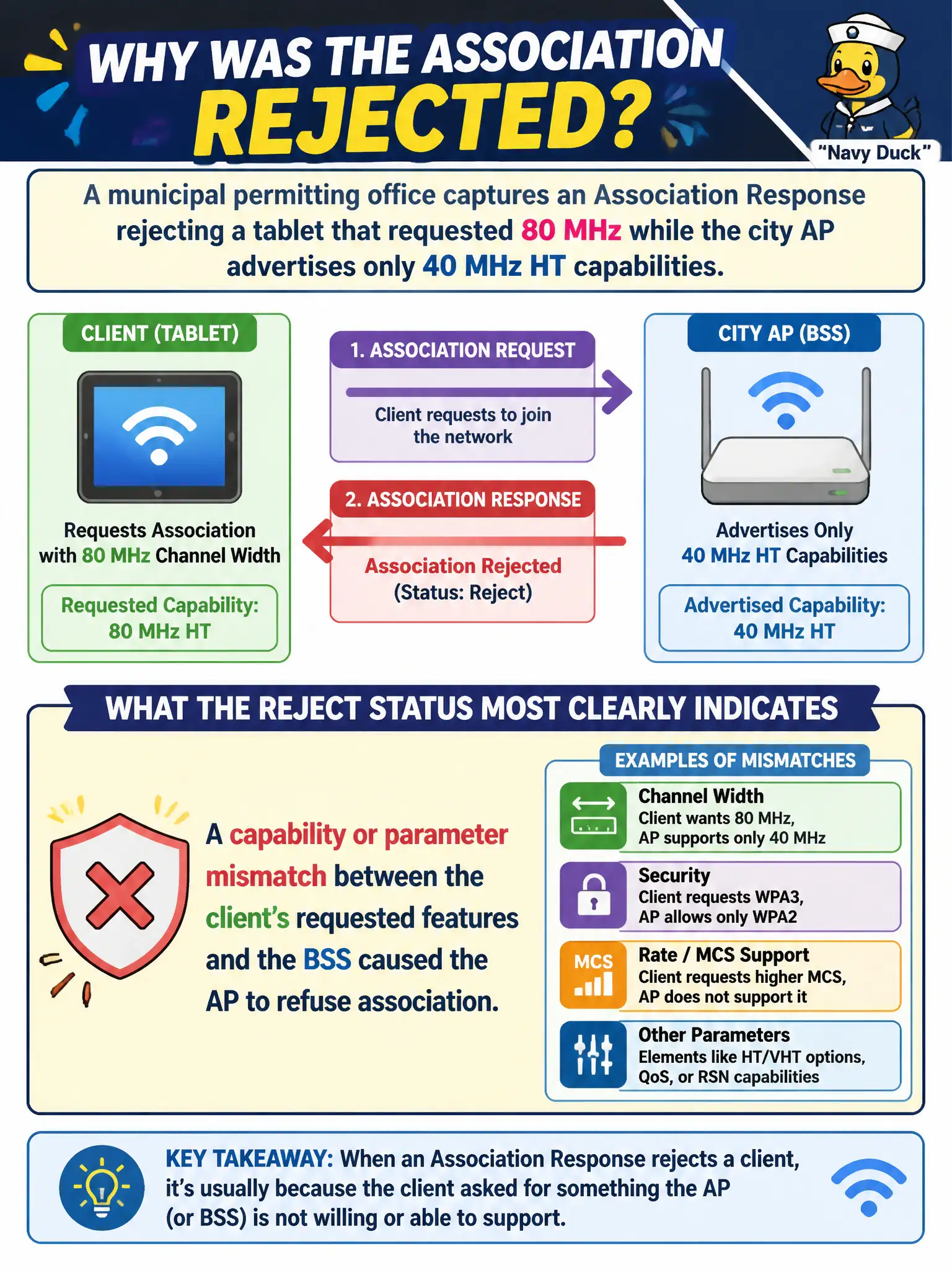
A municipal permitting office captures an Association Response rejecting a tablet that requested 80 MHz while the city AP advertises only 40 MHz HT capabilities. What does that Association Response status most clearly indicate?
Select an answer to reveal the explanation.
Short Explanation
Think of association like a club membership form—if the tablet asks for an 80 MHz lounge the AP doesn't offer, the door stays shut. That reject status is the AP saying "your capabilities don't match this BSS," not DHCP or RADIUS yet. Fix the width/security mismatch first.
Full Explanation
Association Response status codes report the outcome of the 802.11 association exchange before enterprise authentication or Layer-3 addressing begin. In a municipal permitting office where a tablet requests 80 MHz while the city AP advertises only 40 MHz HT capabilities, a reject status most clearly indicates a capability or parameter mismatch—channel width, security/RSN parameters, or other operational features the BSS will not grant. The AP is refusing membership because the client's Association Request does not align with what Beacons and Probe Responses offer, not because an IP lease or RADIUS decision already failed.
Assuming a DHCP lease expired mid-handshake fails by concept: DHCP occurs after successful association (and typically after EAP/keying on enterprise SSIDs), so Layer-3 addressing cannot explain an Association Response reject. Claiming RADIUS revoked a user certificate during the 4-way handshake after association succeeded also fails by concept: that sequence places authentication and keying after association success, whereas this symptom is an association-stage refusal. Treating Beacon interval drift as a universal reject of every HT/VHT client fails by concept: Beacon interval affects advertisement cadence and power-save timing, not a blanket Association Response policy against wide-channel clients.
Exam caveat: CWNE protocol items expect you to map failure symptoms to the correct stage of the join state machine—association status versus EAPOL versus DHCP—rather than leaping to later-layer causes when the capture already shows an Association Response reject.
Operational check: Decode the Association Response status code, then diff the client's Association Request IEs (channel width, HT/VHT/HE capabilities, RSN) against the AP's Beacon/Probe Response capabilities on the permitting-office BSS and remediate the mismatch before chasing RADIUS or DHCP.