
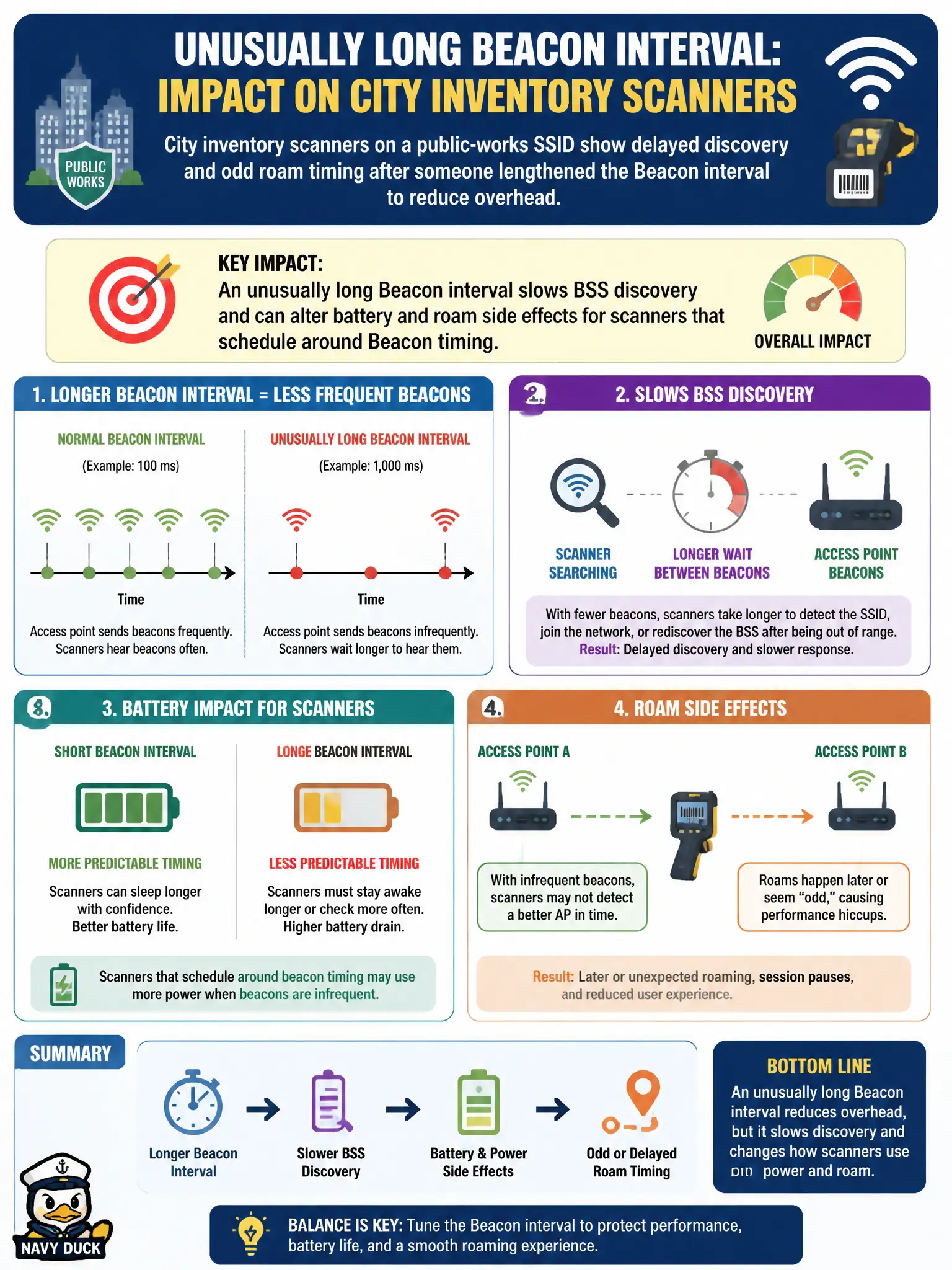
City inventory scanners on a public-works SSID show delayed discovery and odd roam timing after someone lengthened the Beacon interval to reduce overhead. What impact should the analyst attribute to that unusually long Beacon interval?
Select an answer to reveal the explanation.
Short Explanation
Beacons are the AP's heartbeat. Stretch the gap too far and sleepy scanners wake up late to the party—discovery drags and roam timing gets weird. Overhead savings aren't free when handhelds live on that cadence.
Full Explanation
Beacon interval governs how often clients hear BSS advertisements used for discovery, synchronization, and power-save scheduling, including DTIM-related delivery. On a public-works SSID, lengthening the Beacon interval to reduce overhead can slow BSS discovery and alter battery and roam side effects for city inventory scanners that schedule wake periods around Beacon timing. The airtime savings are real, but so are delayed discovery and odd roam timing when handhelds live on that cadence.
Claiming longer Beacon intervals always improve WPA3 SAE timing fails by concept: SAE and Beacon interval are separate concerns; stretching Beacons does not optimize SAE and can harm discovery. Saying Beacon interval only changes TIM bitmap size and cannot affect discovery or power-save wake patterns fails by concept: interval directly sets advertisement periodicity that clients use for discovery and sleep scheduling. Asserting that Beacon interval replaces DTIM entirely so lengthening eliminates all buffered multicast fails by concept: DTIM remains a distinct delivery cadence related to, but not replaced by, the Beacon interval parameter.
Exam caveat: Overhead knobs on municipal IoT and scanner SSIDs are not free performance levers; CWNE items often pair Beacon/DTIM timing with client battery and roam symptoms rather than treating interval as a pure capacity win.
Operational check: Note the configured Beacon interval and DTIM period, time discovery and roam events for a representative public-works scanner, then compare behavior after restoring a standard interval (for example ~100 TU) while watching airtime and join latency.