
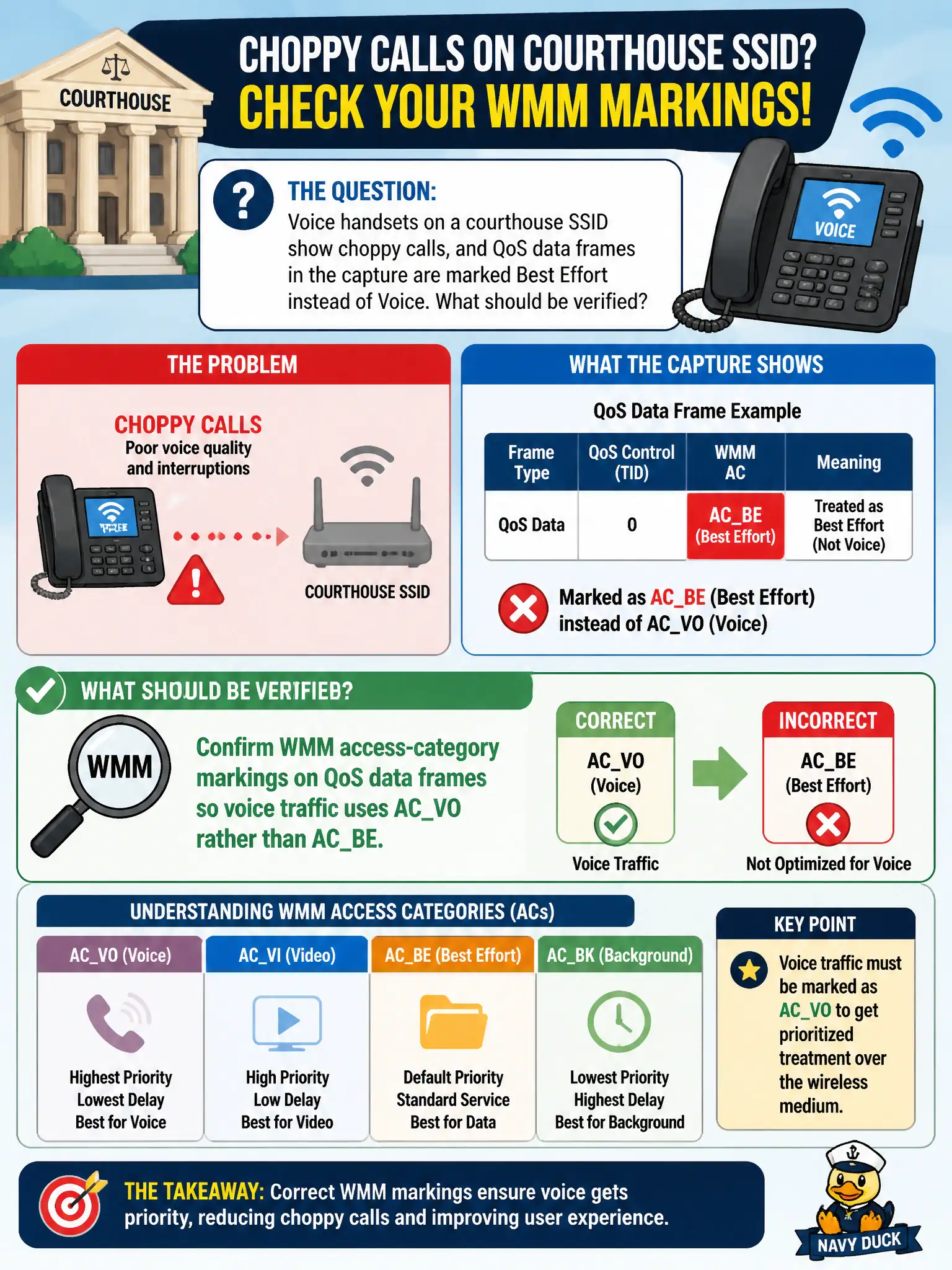
Voice handsets on a courthouse SSID show choppy calls, and QoS data frames in the capture are marked Best Effort instead of Voice. What should be verified?
Select an answer to reveal the explanation.
Short Explanation
If courtroom voice packets wear the 'ordinary mail' Best Effort sticker instead of the 'priority' Voice sticker, they wait in the slow line even when the radio is loud and clear. Check the WMM access category on the QoS data frames.
Full Explanation
Voice handsets on a courthouse SSID with choppy calls whose QoS data frames are marked Best Effort instead of Voice need verification that WMM access-category markings on QoS data frames use AC_VO rather than AC_BE. Mis-marked voice waits in the wrong EDCA queue despite strong RSSI. Expert triage checks UP/AC tags on the air before blaming only RF.
Claiming voice must always use AC_BK so background queues clear first during trials inverts priority and harms voice. Saying WMM markings exist only in Beacons and that data frames never carry access categories is false for QoS data. Asserting that high RSSI makes AC tags irrelevant and that DSCP alone controls the air ignores that Wi-Fi contention uses EDCA ACs on the medium.
Exam caveat: end-to-end QoS includes air AC markings, not only wired DSCP. Operational check: capture courthouse voice calls, confirm QoS Control/TID maps to AC_VO, fix client or AP QoS profiles if frames are AC_BE, and retest choppiness under load. Verify the handset QoS marking path from app → OS → driver → AP so AC_BE marking is fixed at the true source, not only patched on the WLAN profile. Cross-check wired DSCP at the switch mirror only after air AC_VO is confirmed; both layers must align for courthouse voice acceptance.