
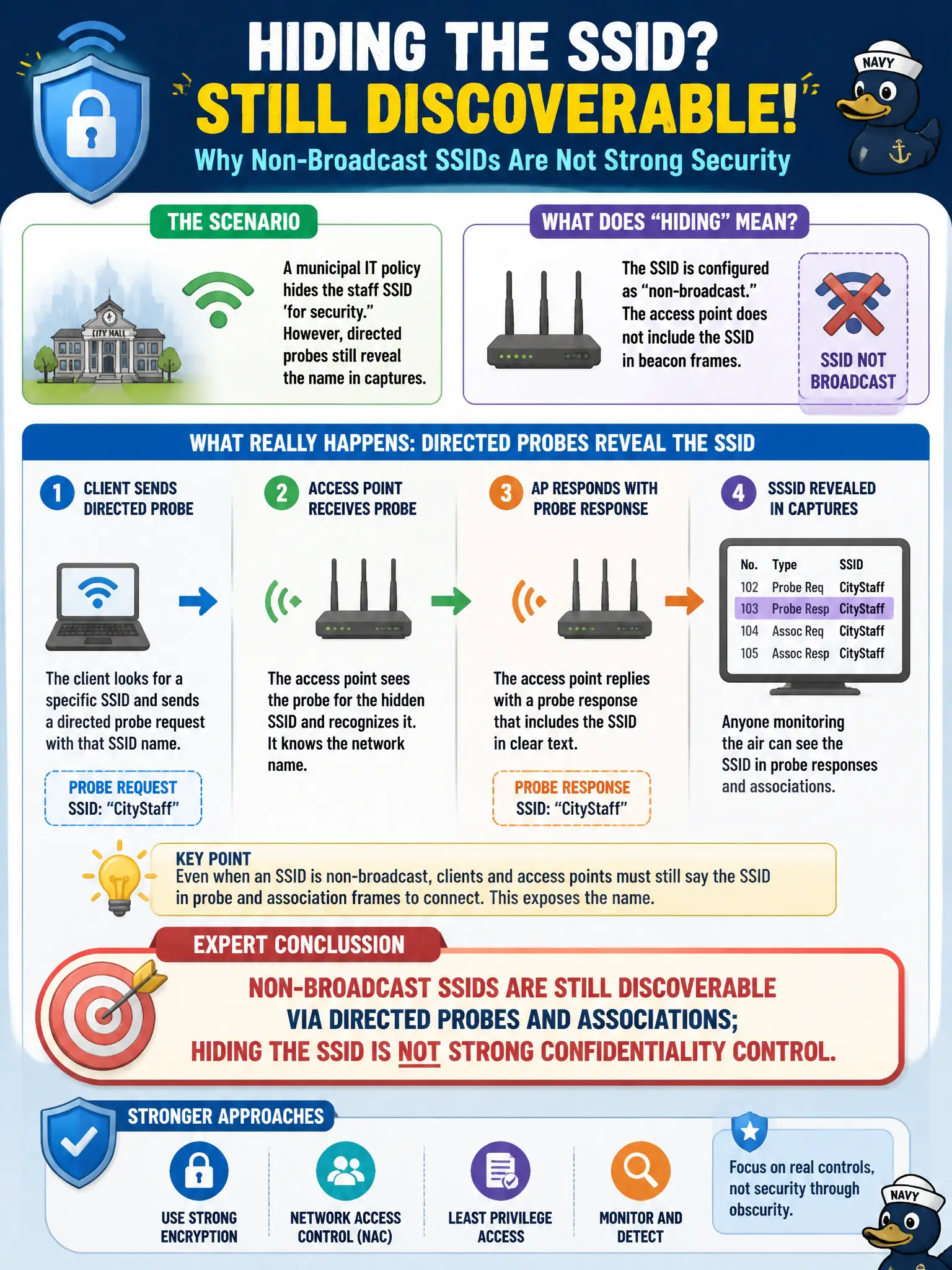
A municipal IT policy hides the staff SSID 'for security,' yet directed probes still reveal the name in captures. What expert conclusion follows?
Select an answer to reveal the explanation.
Short Explanation
Hiding the SSID is like taking the shop sign down but still answering when someone knocks and says the secret name—probes and joins spill it anyway. Don’t trade real encryption and 802.1X for a blank Beacon field.
Full Explanation
A municipal IT policy that hides the staff SSID “for security” still leaks the name via directed probes and associations in captures; non-broadcast SSIDs are discoverable and hiding is not strong confidentiality control. Expert conclusion: use WPA3/802.1X (and related controls) for real security rather than blank Beacon SSIDs. Civic security policy should not trade encryption for obscurity.
Claiming hidden SSIDs encrypt all management frames with GCMP so probes can never expose the name overstates what hiding does. Saying directed probes become illegal once Beacon SSIDs are blank and that analyzers forge names is incorrect. Asserting that hiding an SSID replaces the need for WPA3 and 802.1X on civic networks is a dangerous policy error.
Exam caveat: SSID hiding is obscurity, not confidentiality—do not credit it as a compensating control on exams or in city policy. Operational check: capture directed probes/associations to the “hidden” staff SSID, demonstrate the name in clear in the pcap to stakeholders, and prioritize proper AKM/802.1X instead of relying on non-broadcast Beacons. Replace “hide SSID” language in the municipal security standard with requirements for WPA3-Enterprise/802.1X and management-frame protection where supported.