
A mixed BSS at a community center still allows legacy rates and captures show protection overhead inflating airtime. What should the analyst conclude?
Select an answer to reveal the explanation.
Short Explanation
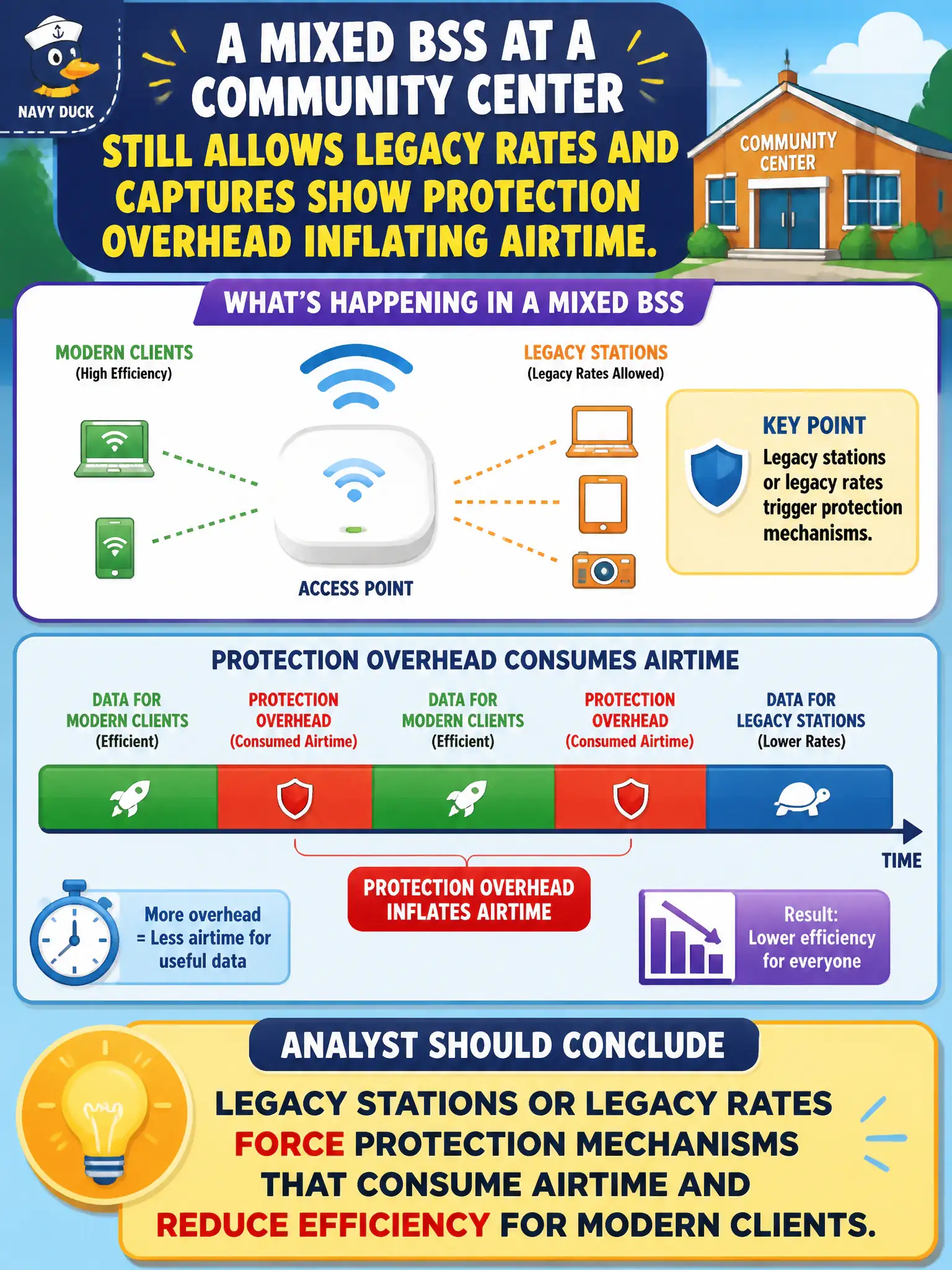
One old slow dancer on the floor and everyone else has to do the careful 'watch out' steps—that’s protection mode. If the community center still advertises legacy rates, expect extra RTS/CTS or similar overhead stealing airtime from modern clients.
Full Explanation
A mixed BSS at a community center that still allows legacy rates, with captures showing protection overhead inflating airtime, means legacy stations or legacy rates force protection mechanisms that consume airtime and reduce efficiency for modern clients. RTS/CTS or other protection raises overhead so OFDM clients do not collide destructively with legacy PHYs. Expert conclusion: prune legacy rates when the client mix allows, or accept the airtime tax consciously.
Claiming protection frames increase MCS for every client and therefore always raise throughput reverses the overhead effect. Saying legacy rates in Beacons are ignored by all clients manufactured after 2012 is false—advertised basics still shape behavior. Asserting protection overhead only appears on wired SPAN ports, never on wireless captures, denies over-the-air visibility of RTS/CTS and peers.
Exam caveat: legacy rate plans are capacity decisions for mixed civic venues. Operational check: inventory community-center client PHYs, review Beacon basic/supported rates, measure protection frame airtime, and raise minimum rates or segment legacy devices if modern clients dominate. If a few legacy scanners still need low rates, consider a dedicated low-rate SSID/VLAN rather than taxing the entire community-center BSS with protection.