
Sticky handhelds on a fire-station voice SSID show choppy audio while captures reveal aggressive power-save with TIM/APSD buffering behavior. What is the expert takeaway?
Select an answer to reveal the explanation.
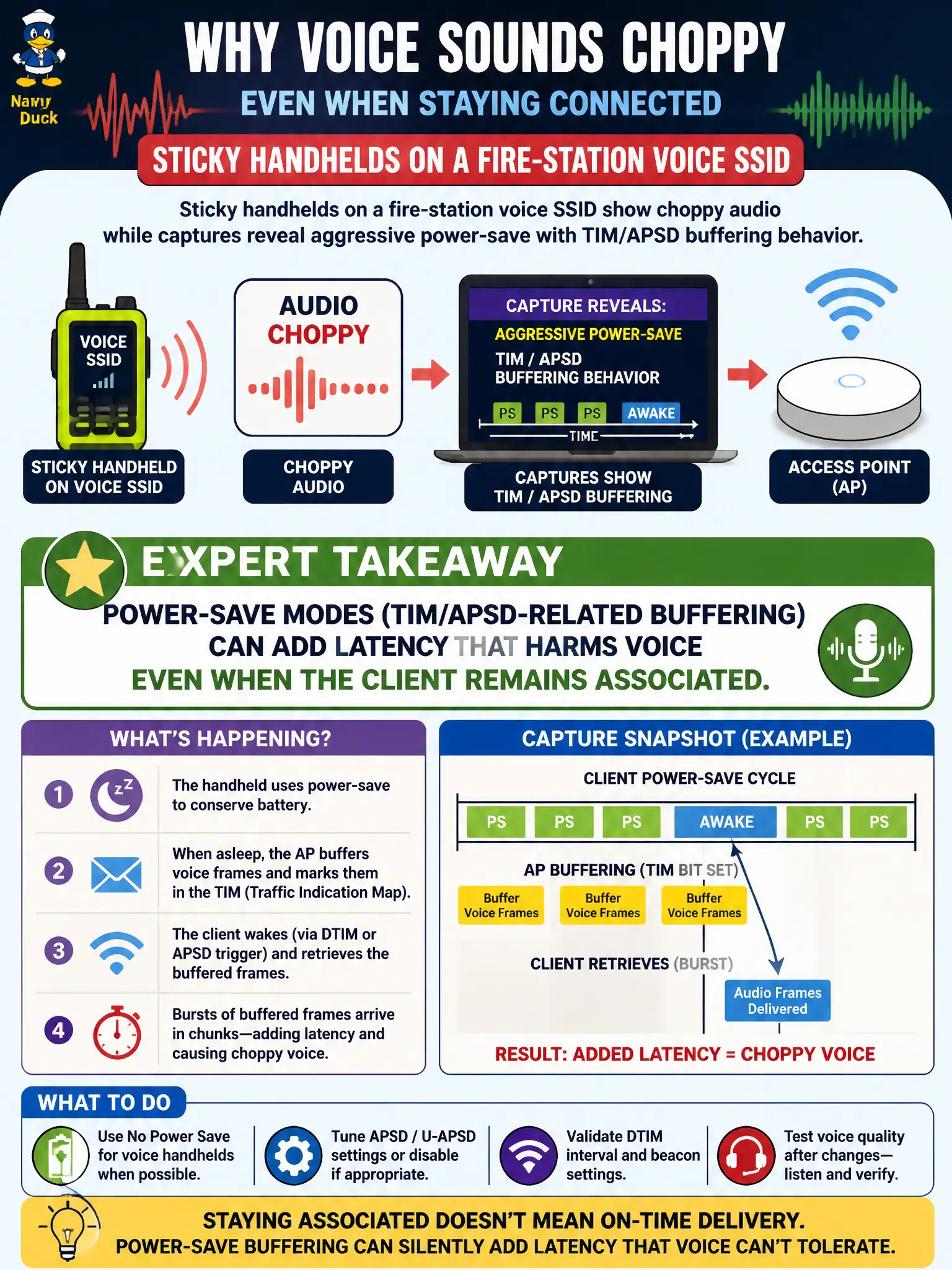
Short Explanation
Power-save is great for battery life—like a handheld dozing between pages—but voice hates waiting for the wake-up bell. When TIM/APSD buffering shows up beside choppy audio, the sleep schedule is a suspect, not just the far sticky AP.
Full Explanation
Sticky handhelds on a fire-station voice SSID with choppy audio while captures show aggressive power-save with TIM/APSD buffering indicate that power-save modes can add latency that harms voice even when the client remains associated. Buffered delivery waiting on TIM/APSD wakeups delays time-sensitive voice frames. Expert takeaway: tune or disable aggressive power-save on voice handsets rather than abandoning WMM.
Claiming TIM bits only affect guest captive portals and cannot influence voice latency ignores TIM’s role in power-save delivery. Saying APSD always disables retries so choppy audio must be DNS-only invents an Ack policy and skips RF/PS latency. Concluding that voice chop with power-save present means the SSID must abandon WMM removes QoS instead of fixing sleep latency.
Exam caveat: voice and deep power-save often conflict on civic public-safety handhelds. Operational check: compare choppy versus clear calls’ TIM/APSD buffering indicators, set voice handsets to a voice-appropriate PS profile, and confirm latency/jitter improve without removing WMM. Coordinate with the fire-station device owner so PS profiles are set in MDM, not only advised verbally after one choppy shift.