
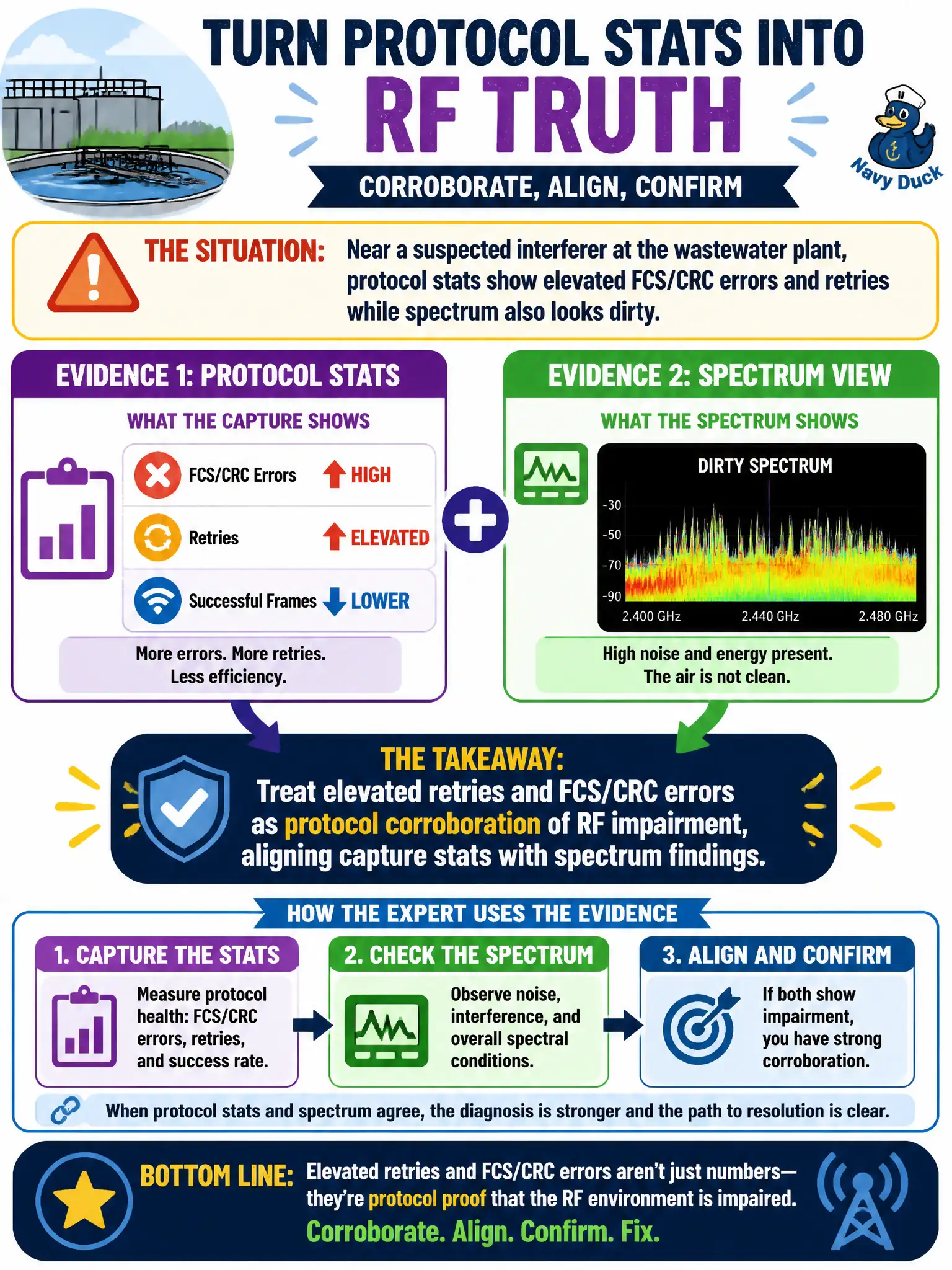
Near a suspected interferer at the wastewater plant, protocol stats show elevated FCS/CRC errors and retries while spectrum also looks dirty. How should the expert use that evidence?
Select an answer to reveal the explanation.
Short Explanation
When spectrum says 'noise' and the capture says 'retries and bad FCS,' they’re telling the same story in two dialects. At the plant, use those protocol stats as courtroom corroboration for the interferer—not as a reason to ignore RF.
Full Explanation
Near a suspected interferer at the wastewater plant, elevated FCS/CRC errors and retries in protocol stats alongside dirty spectrum should be treated as protocol corroboration of RF impairment. Align capture stats with spectrum findings: noise and collisions produce retries and bad FCS on the air. Expert practice uses both tools as mutually reinforcing evidence, not as competing stories.
Claiming CRC errors only indicate misconfigured VLANs so spectrum views are irrelevant relocates an RF error metric to Layer-2 switching. Saying retries prove successful A-MPDU every time and contradict any interferer theory ignores that retries signal delivery difficulty. Asserting FCS failures mean the sniffer license expired and never reflect over-the-air problems dismisses a core protocol health signal.
Exam caveat: spectrum + FCS/retries triangulation is standard CWNE interferer proof in industrial civic sites. Operational check: record spectrum dirtiness and protocol retry/FCS counters at the same plant location/time, remediate the interferer, and show both metrics improve together before closing. Bundle the paired spectrum and FCS/retry charts into the wastewater plant RF incident report template for repeatable industrial triage.