
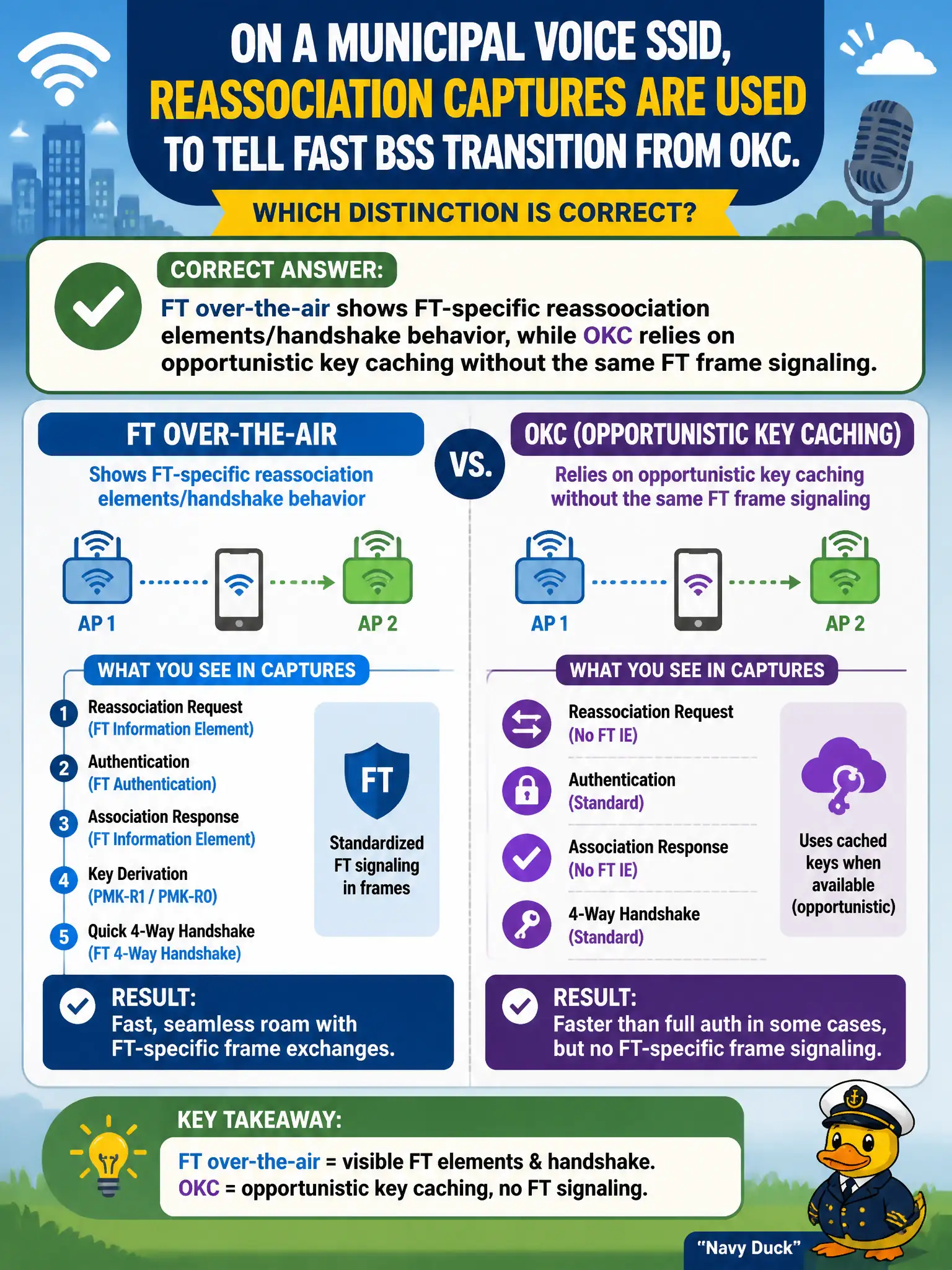
On a municipal voice SSID, reassociation captures are used to tell Fast BSS Transition from OKC. Which distinction is correct?
Select an answer to reveal the explanation.
Short Explanation
FT is the express lane with labeled tickets in the reassociation paperwork; OKC is more like the guard already remembering your badge from the last checkpoint. On voice captures, look for FT’s explicit signaling versus OKC’s quieter key-cache roam.
Full Explanation
On a municipal voice SSID, reassociation captures distinguish Fast BSS Transition from OKC by FT-specific reassociation elements and handshake behavior versus OKC’s opportunistic key caching without the same FT frame signaling. Both aim to reduce full EAP on roam, but their air signatures differ. Expert voice WLAN validation names the mechanism from the capture, not from marketing checkboxes alone.
Claiming OKC always uses SAE commit frames while FT never touches key material during roam mixes WPA3 SAE with roam keying models incorrectly. Saying FT and OKC are indistinguishable because both disable all reassociation frames is false—reassociation remains central and FT adds specific IEs. Asserting voice SSIDs cannot use either FT or OKC and must run full EAP every roam ignores standard fast-roam tools for civic voice.
Exam caveat: FT ≠ OKC; learn the frame tells for voice acceptance tests. Operational check: roam a handset across two voice APs, inspect reassociation for FT IEs versus OKC behavior without FT signaling, and record which mechanism the municipal voice profile actually uses. Store golden FT and OKC roam pcaps for the voice SSID so future firmware changes can be regression-tested against the municipal fast-roam standard.