
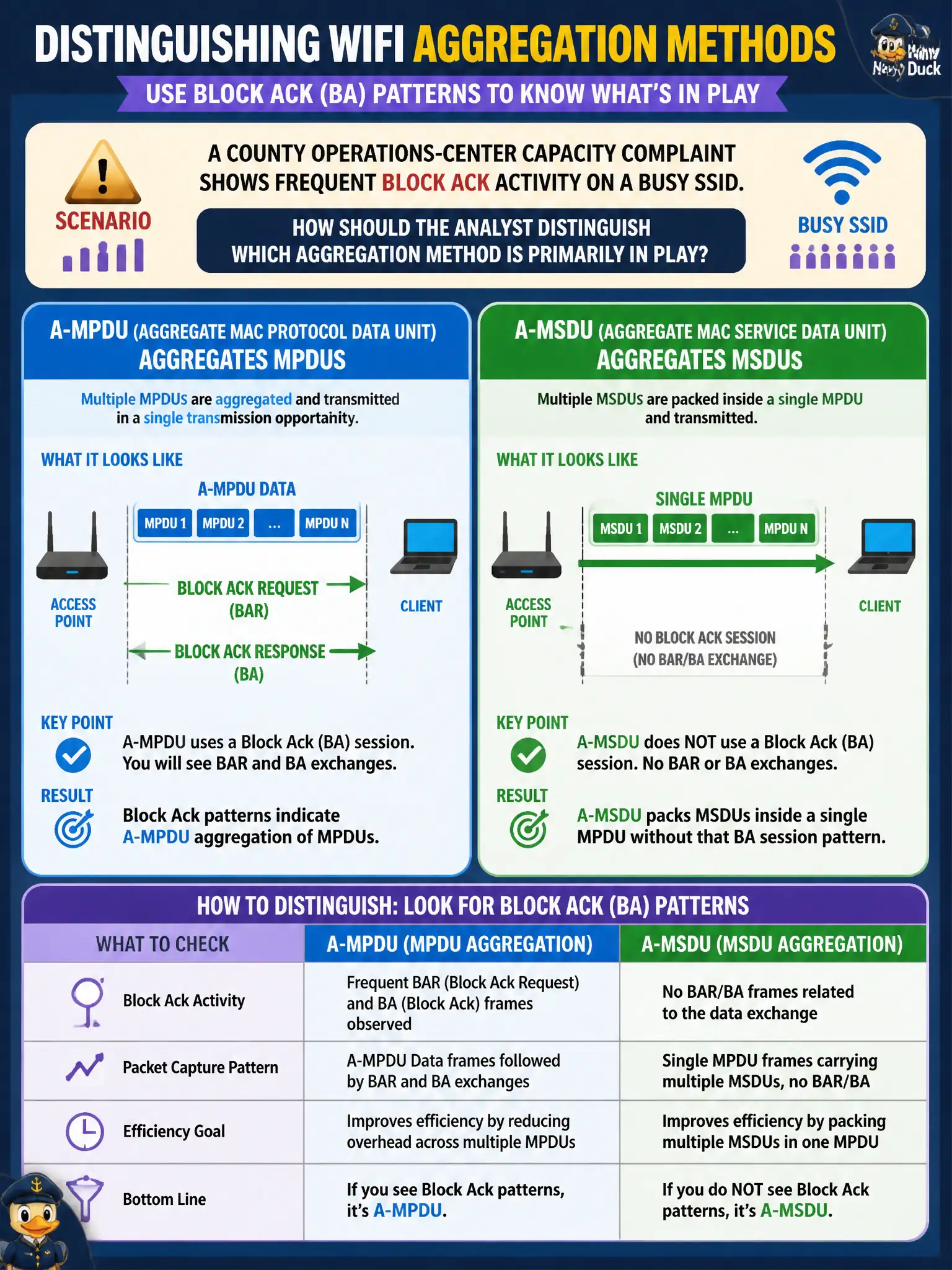
A county operations-center capacity complaint shows frequent Block Ack activity on a busy SSID. How should the analyst distinguish which aggregation method is primarily in play?
Select an answer to reveal the explanation.
Short Explanation
Picture packing county mail: A-MSDU is stuffing several letters into one envelope; A-MPDU is bundling several envelopes onto one truck with a signed delivery checklist—the Block Ack. When you see that checklist pattern, you’re looking at A-MPDU in the wild.
Full Explanation
A county operations-center capacity complaint with frequent Block Ack activity on a busy SSID should be read as evidence of A-MPDU aggregation of MPDUs using a Block Ack session. A-MSDU, by contrast, packs MSDUs inside a single MPDU and does not present the same BA session pattern as the primary aggregation indicator. Expert analysts distinguish aggregation methods from acknowledgment behavior in captures rather than treating all aggregation as identical.
Claiming Block Ack proves only A-MSDU is active because A-MPDU never uses acknowledgments reverses how A-MPDU relies on BA. Saying any Block Ack means protection mode is forced on and aggregation must be disabled citywide confuses protection with aggregation efficiency. Asserting A-MPDU and A-MSDU are identical in captures and only RSSI distinguishes them abandons protocol evidence.
Exam caveat: BA sessions ↔ A-MPDU; know both aggregation types for capacity discussions in civic NOCs. Operational check: filter the busy SSID capture for Block Ack Request/BA frames, confirm A-MPDU aggregates in the decode, and compare throughput with BA enabled versus a controlled BA-disabled test only in the lab—not as a citywide disable. When capacity complaints persist despite BA activity, measure aggregate size and failure rates next—BA presence is necessary evidence, not proof of perfect efficiency.