
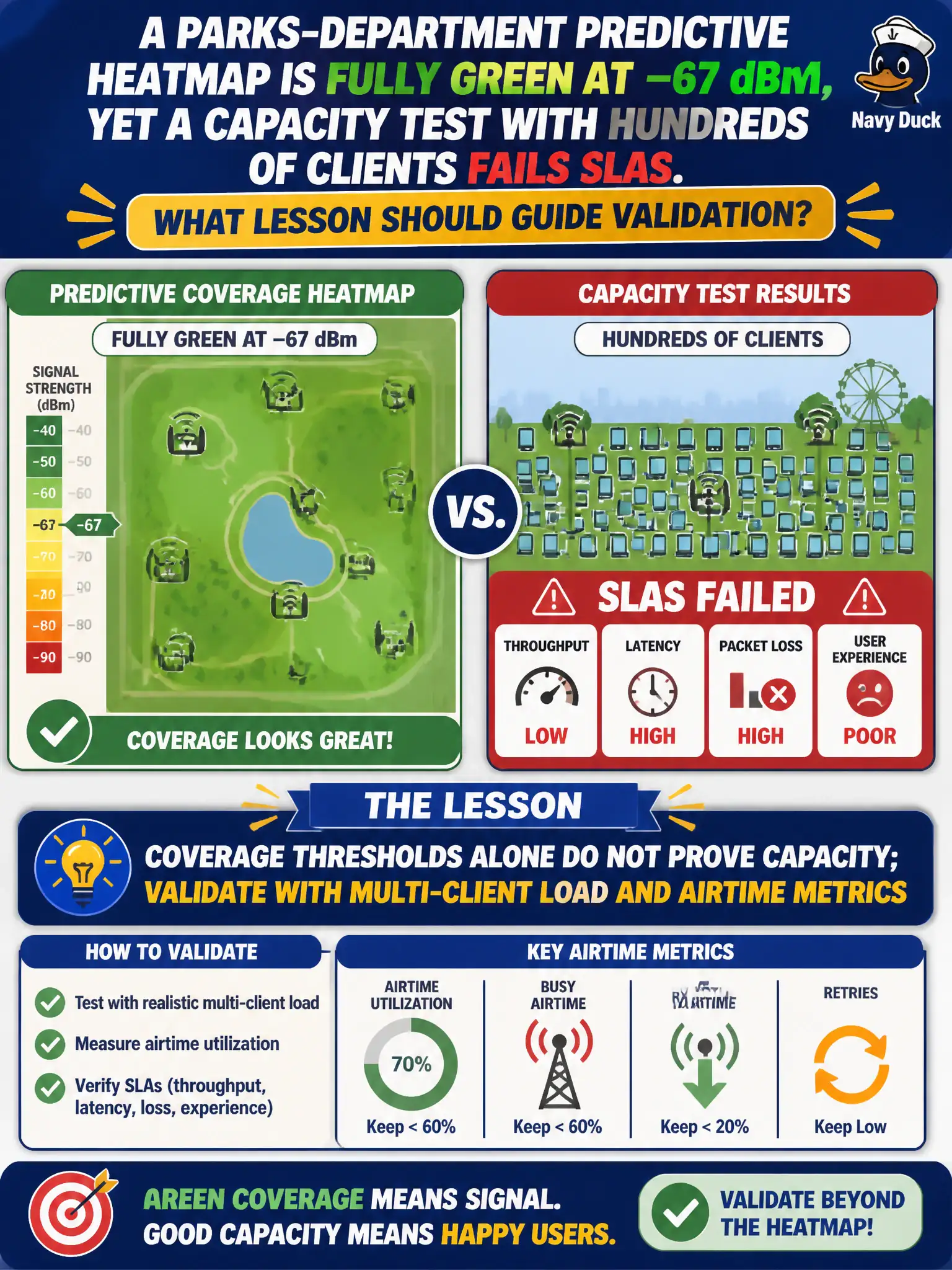
A parks-department predictive heatmap is fully green at −67 dBm, yet a capacity test with hundreds of clients fails SLAs. What lesson should guide validation?
Select an answer to reveal the explanation.
Short Explanation
Green paint on the map means you can hear the AP—not that a stadium of clients will fit. Run real multi-client load tests; coverage is not capacity.
Full Explanation
A parks-department predictive heatmap that is fully green at −67 dBm can still fail a capacity test with hundreds of clients because coverage thresholds alone do not prove capacity; validate with multi-client load and airtime metrics. Green coverage heatmaps do not always prove capacity readiness. Claiming capacity testing is unnecessary if SNR exceeds 25 dB anywhere ignores contention. Treating failed capacity tests as a mandate to disable DFS citywide may be unrelated to the failure root cause. Exam caveat: separate coverage acceptance from capacity acceptance in municipal projects. Operational check: run a controlled multi-client test in the park venue, compare airtime and app SLAs to the green heatmap story, and adjust AP density before public events. In municipal WLAN and IoT operations, record the chosen control and the rejected alternatives in the change ticket so on-call staff understand which failure modes were avoided for city services. Re-validate after the next maintenance window that the same control still holds under the current platform code, device mix, and civic event calendar used by the wireless team. Keep RF, capacity, security, and QoS evidence attached to the municipal runbook entry for auditors and future CWNE-level reviews.