
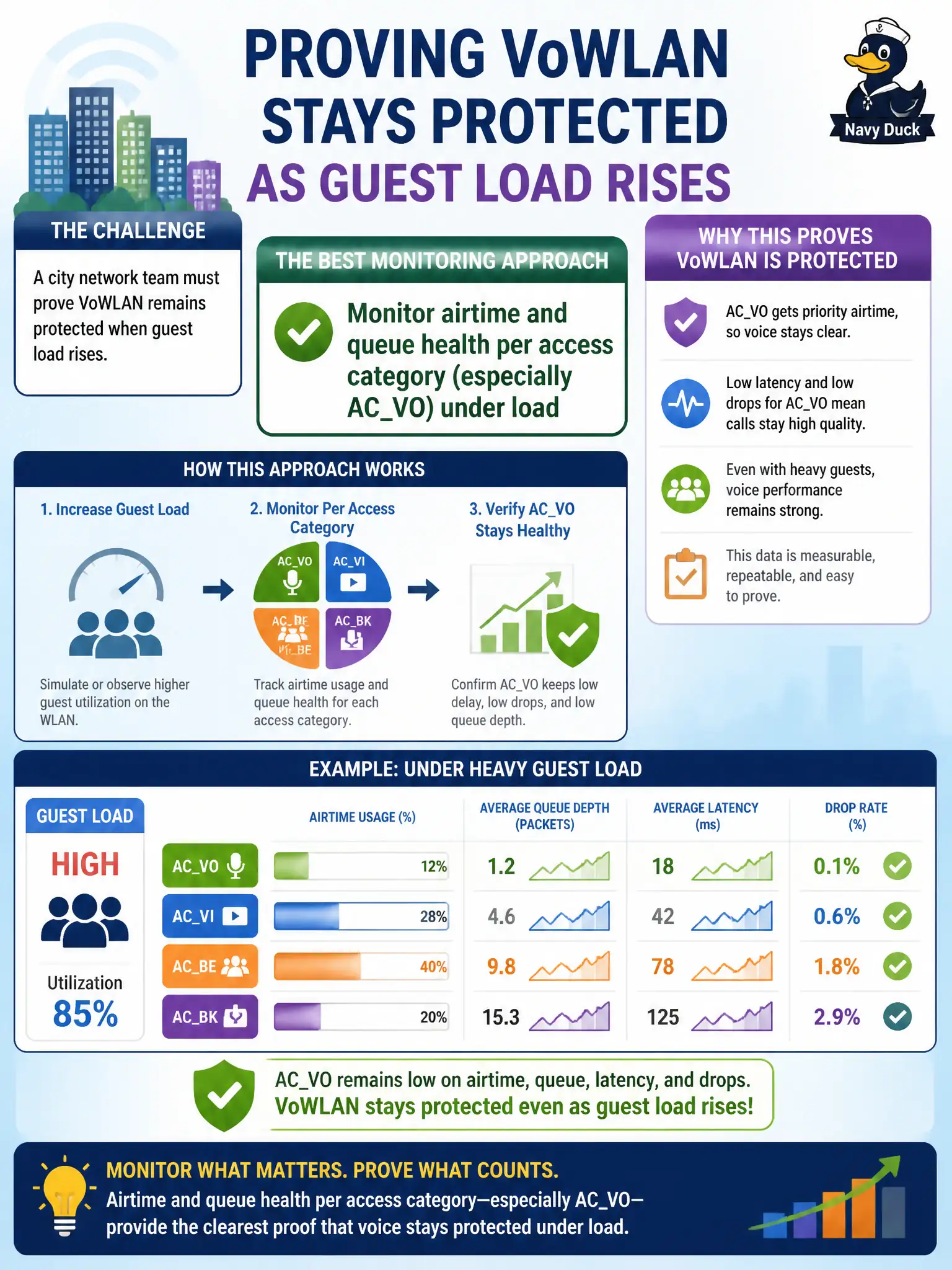
A city network team must prove VoWLAN remains protected when guest load rises. Which monitoring approach best supports that proof?
Select an answer to reveal the explanation.
Short Explanation
Want proof the ambulance still gets through? Watch airtime and queues per WMM class—especially voice—while the guest traffic climbs.
Full Explanation
To prove VoWLAN remains protected when guest load rises, monitor airtime and queue health per access category—especially AC_VO—under load, not only blunt system counters. Watching only aggregate AP CPU percentage can miss voice queue starvation while CPU looks fine. Tracking DHCP pool exhaustion exclusively addresses addressing, not voice airtime defense. Counting SSIDs on neighboring courthouse networks is inventory curiosity, not proof of local AC_VO protection. Exam caveat: QoS proof requires per-AC metrics under intentional guest load. Operational check: generate guest bulk beside voice test calls, chart AC_VO airtime and drops, and archive the municipal evidence pack for change approval. In municipal WLAN and IoT operations, record the chosen control and the rejected alternatives in the change ticket so on-call staff understand which failure modes were avoided for city services. Re-validate after the next maintenance window that the same control still holds under the current platform code, device mix, and civic event calendar used by the wireless team. Keep RF, capacity, security, and QoS evidence attached to the municipal runbook entry for auditors and future CWNE-level reviews.