
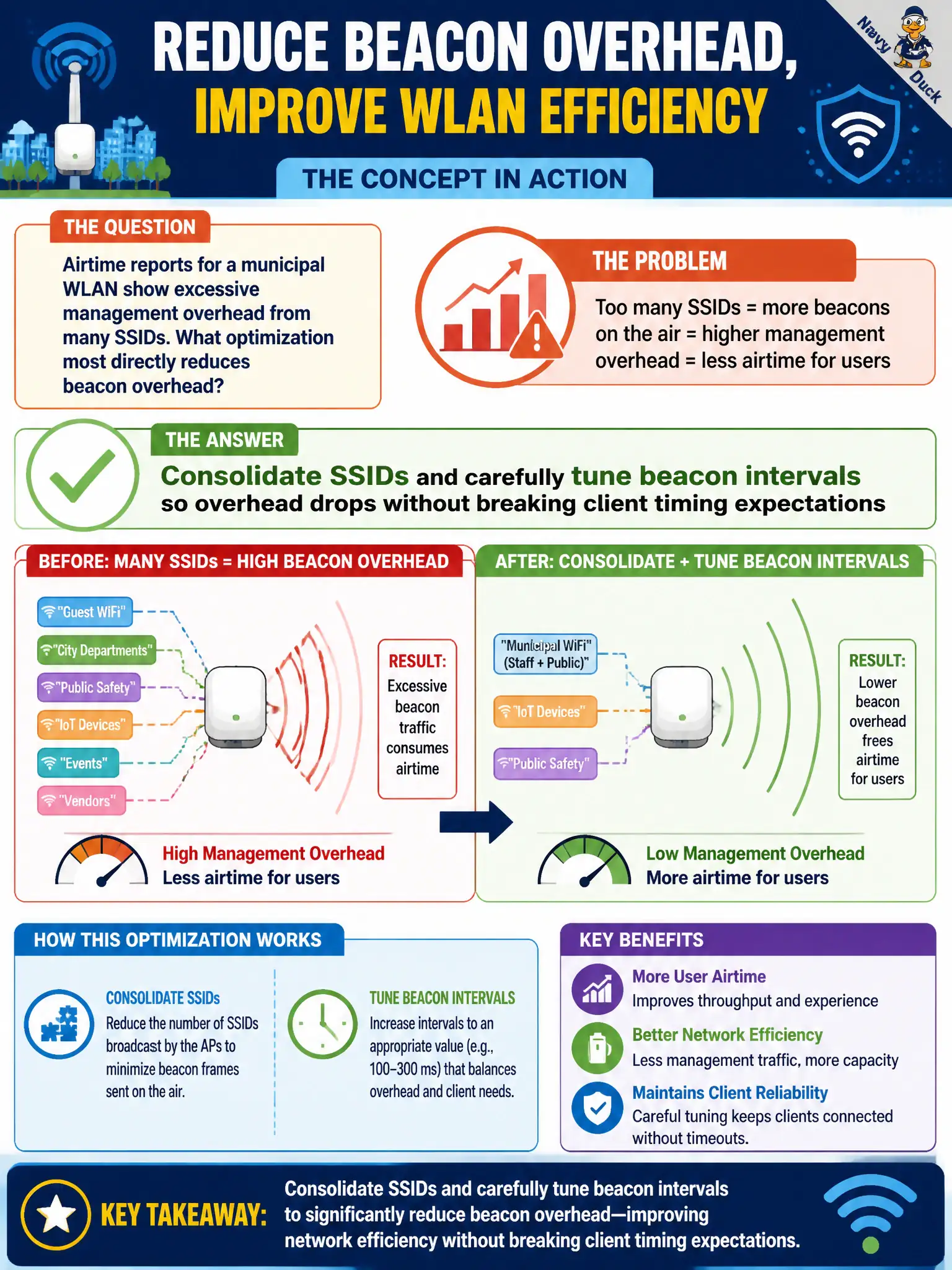
Airtime reports for a municipal WLAN show excessive management overhead from many SSIDs. What optimization most directly reduces beacon overhead?
Select an answer to reveal the explanation.
Short Explanation
Beacons are like PA announcements—fine in moderation, painful every few seconds on ten channels. Merge SSIDs and nudge intervals thoughtfully so the PA stops shouting.
Full Explanation
Excessive management overhead from many SSIDs on a municipal WLAN is most directly reduced by consolidating SSIDs and carefully tuning beacon intervals so overhead drops without breaking client timing expectations. Increasing every SSID’s beacon interval to the maximum without reviewing client needs can break VoWLAN timing and roaming assumptions. Converting all SSIDs to mesh backhaul to eliminate beacons misunderstands BSS beaconing. Advertising unique SSIDs on every AP radio for isolation explodes overhead. Exam caveat: beacon airtime scales with SSIDs × radios × interval choices. Operational check: cut unused SSIDs, set beacon intervals per design, measure management airtime before and after, and confirm civic clients still roam and authenticate cleanly. In municipal WLAN and IoT operations, record the chosen control and the rejected alternatives in the change ticket so on-call staff understand which failure modes were avoided for city services. Re-validate after the next maintenance window that the same control still holds under the current platform code, device mix, and civic event calendar used by the wireless team. Keep RF, capacity, security, and QoS evidence attached to the municipal runbook entry for auditors and future CWNE-level reviews.