
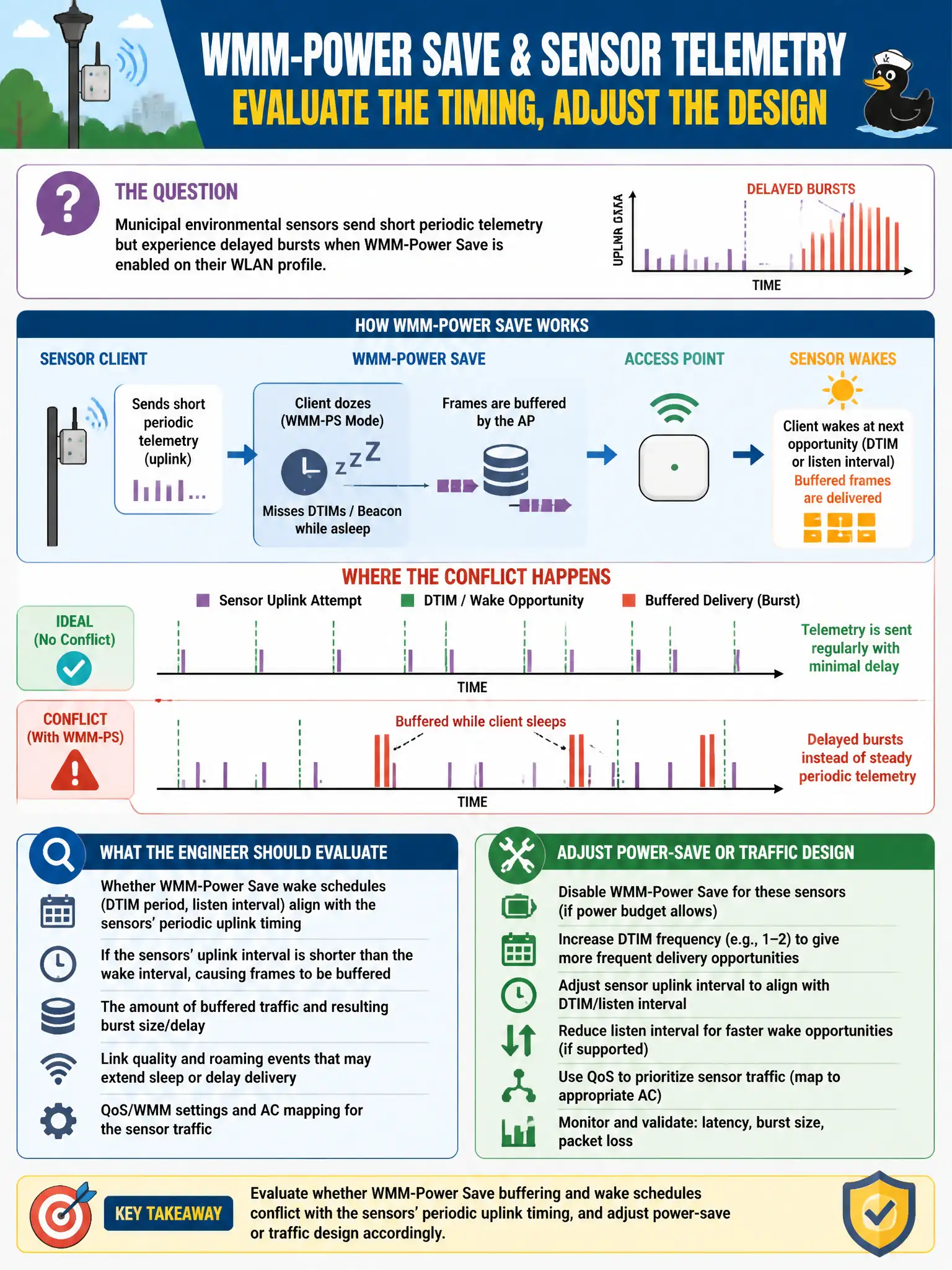
Municipal environmental sensors send short periodic telemetry but experience delayed bursts when WMM-Power Save is enabled on their WLAN profile. What should the engineer evaluate?
Select an answer to reveal the explanation.
Short Explanation
Sleepy sensors miss their alarm clock when power-save buffers hold the mail. Match WMM-PS behavior to the telemetry schedule—or change how they sleep—so short uplinks leave on time.
Full Explanation
Municipal environmental sensors sending short periodic telemetry can experience delayed bursts when WMM-Power Save buffering and wake schedules conflict with uplink timing. Adjust power-save behavior or traffic design so telemetry meets freshness goals without abandoning battery constraints. Permanently disabling all encryption is unrelated to power-save timing and harms security. Doubling beacon interval alone does not guarantee on-time telemetry and may worsen timing. Moving sensors to the scavenger access category forces lower priority rather than immediate delivery. Exam caveat: power-save and IoT duty cycles interact—validate latency with the actual sensor profile. Operational check: capture uplink delay with PS enabled versus tuned settings, align wake schedules with civic telemetry SLOs, and document the IoT WLAN power-save profile. In municipal WLAN and IoT operations, record the chosen control and the rejected alternatives in the change ticket so on-call staff understand which failure modes were avoided for city services. Re-validate after the next maintenance window that the same control still holds under the current platform code, device mix, and civic event calendar used by the wireless team.