
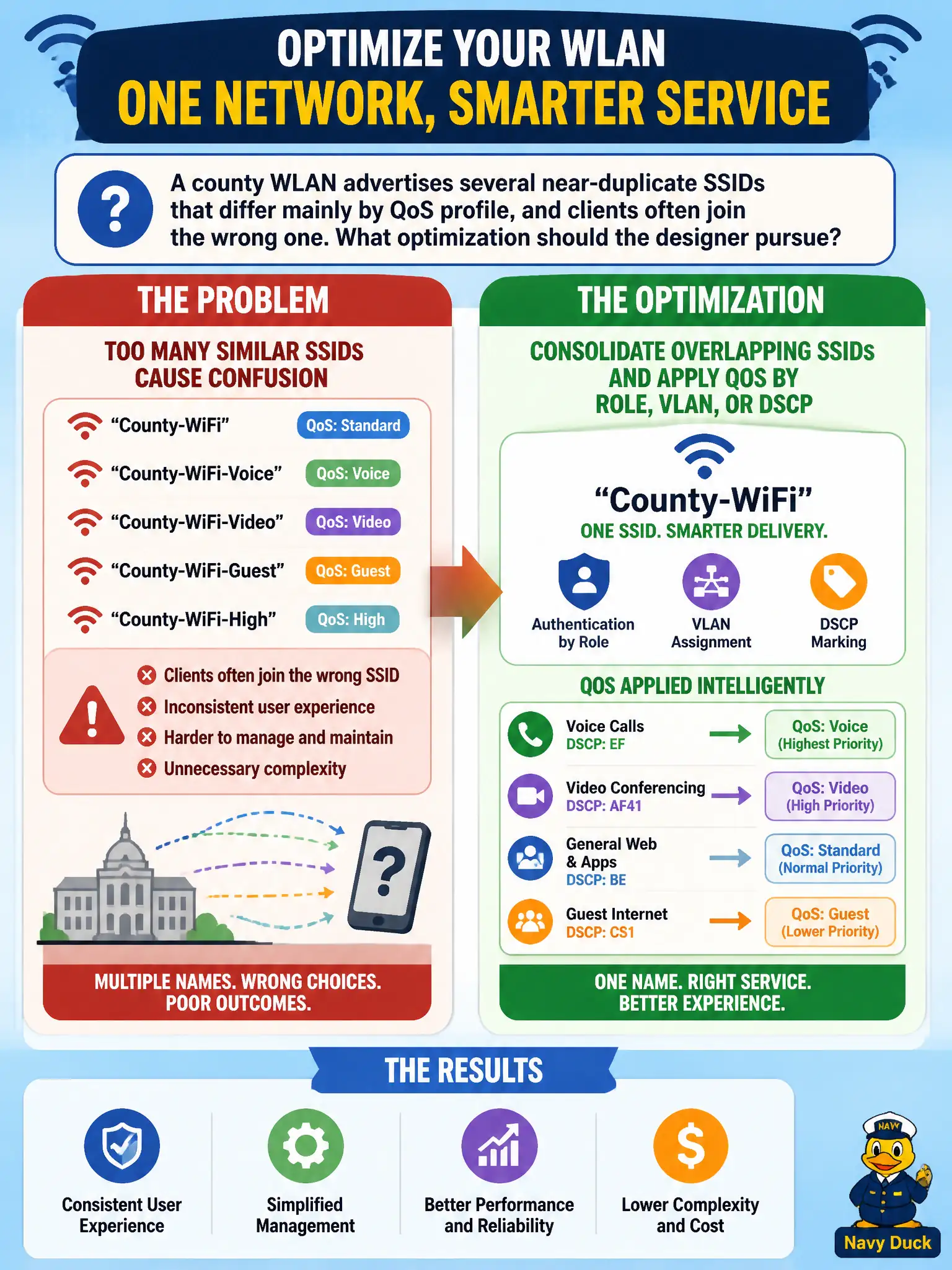
A county WLAN advertises several near-duplicate SSIDs that differ mainly by QoS profile, and clients often join the wrong one. What optimization should the designer pursue?
Select an answer to reveal the explanation.
Short Explanation
Too many look-alike SSIDs are like six almost-identical bus routes—riders board the wrong one and the radio pays beacon tax. Collapse the sprawl and tag QoS by role or DSCP.
Full Explanation
When a county WLAN advertises several near-duplicate SSIDs that differ mainly by QoS profile and clients join the wrong one, consolidate overlapping SSIDs and apply QoS by role, VLAN, or DSCP rather than proliferating similar network names. Fewer SSIDs also reduce beacon overhead. Adding one more SSID per department increases confusion and management airtime. Disabling beacons on all but one SSID while keeping associations active breaks discovery and is not a sound design pattern. Setting every SSID to open authentication to reduce probe overhead weakens municipal security and does not fix SSID sprawl. Exam caveat: SSID count is both a UX and an airtime decision—prefer identity-based QoS over name proliferation. Operational check: inventory SSIDs, merge near-duplicates, map roles to VLANs and DSCP, and verify clients land on the correct municipal profile after consolidation. In municipal WLAN and IoT operations, record the chosen control and the rejected alternatives in the change ticket so on-call staff understand which failure modes were avoided for city services. Re-validate after the next maintenance window that the same control still holds under the current platform code, device mix, and civic event calendar used by the wireless team.