
Spectrum at a municipal garage shows high duty cycle on the working channel, yet 802.11 retry counters stay low. What performance impact is still likely?
Select an answer to reveal the explanation.
Short Explanation
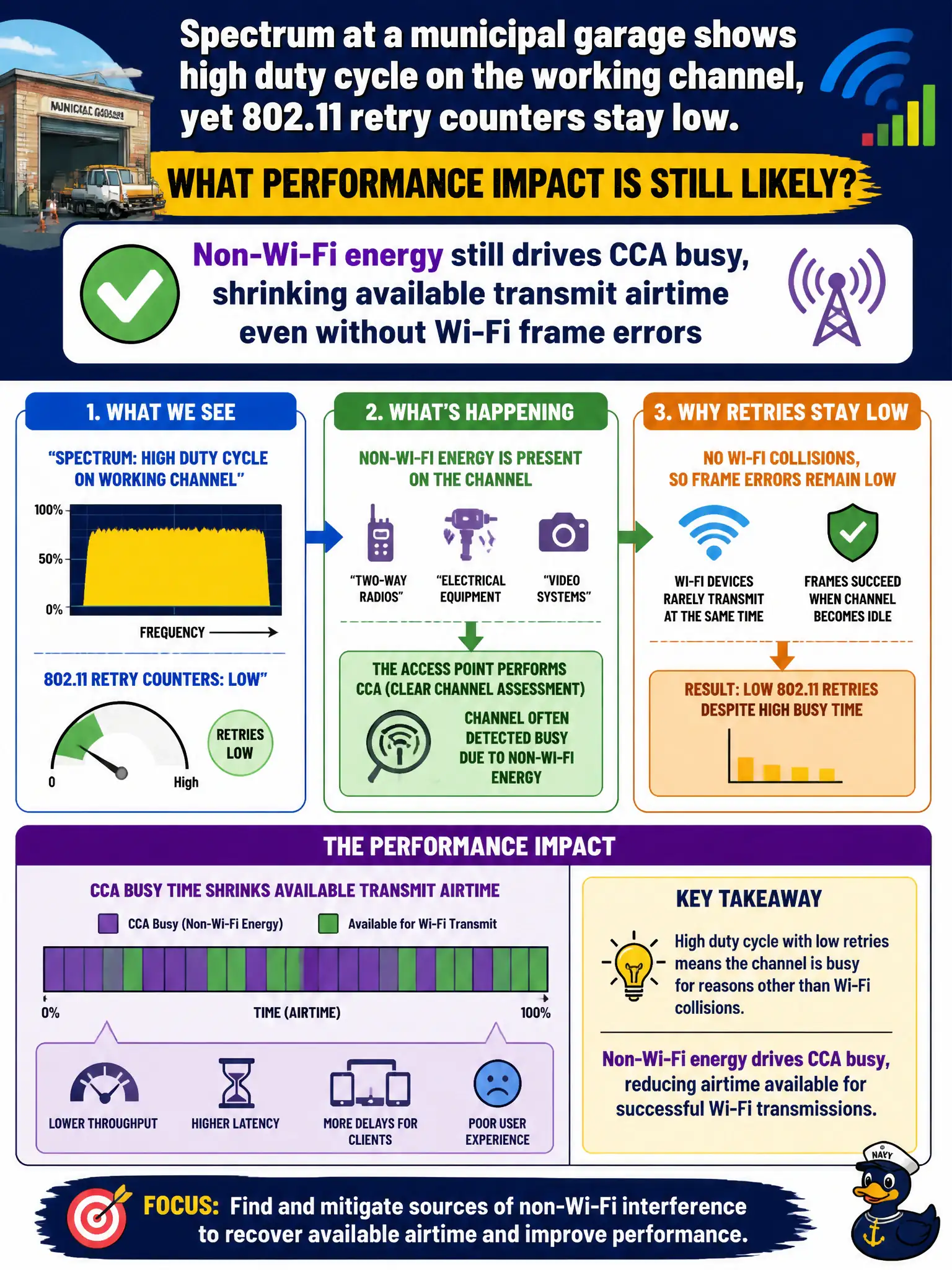
The medium can be busy even when Wi-Fi frames look clean—like cars waiting at a light for a parade that is not in their lane. Non-Wi-Fi energy trips CCA and steals airtime.
Full Explanation
High spectrum duty cycle on a municipal garage channel with low 802.11 retry counters still implies non-Wi-Fi energy driving CCA busy, shrinking available transmit airtime even without Wi-Fi frame errors. Throughput and latency suffer from less clear-channel time. Claiming none of this matters because only Wi-Fi CRC errors reduce throughput ignores CCA deferral. Expecting clients to automatically double channel width to escape the energy is not how width selection works and can worsen interference. Treating high duty cycle as always a rogue AP that must be deauthenticated may miss microwaves, engines, or other non-Wi-Fi sources common in garages. Exam caveat: busy medium from non-Wi-Fi is a capacity tax without raising 802.11 FCS error counters. Operational check: use spectrum views to classify the energy, mitigate the source or change channels, and confirm airtime and garage app performance recover for civic fleets. In municipal WLAN and IoT operations, record the chosen control and the rejected alternatives in the change ticket so on-call staff understand which failure modes were avoided for city services. Re-validate after the next maintenance window that the same control still holds under the current platform code, device mix, and civic event calendar used by the wireless team.