
After a city WLAN team changes channel widths and minimum rates, how should they validate that optimization actually helped?
Select an answer to reveal the explanation.
Short Explanation
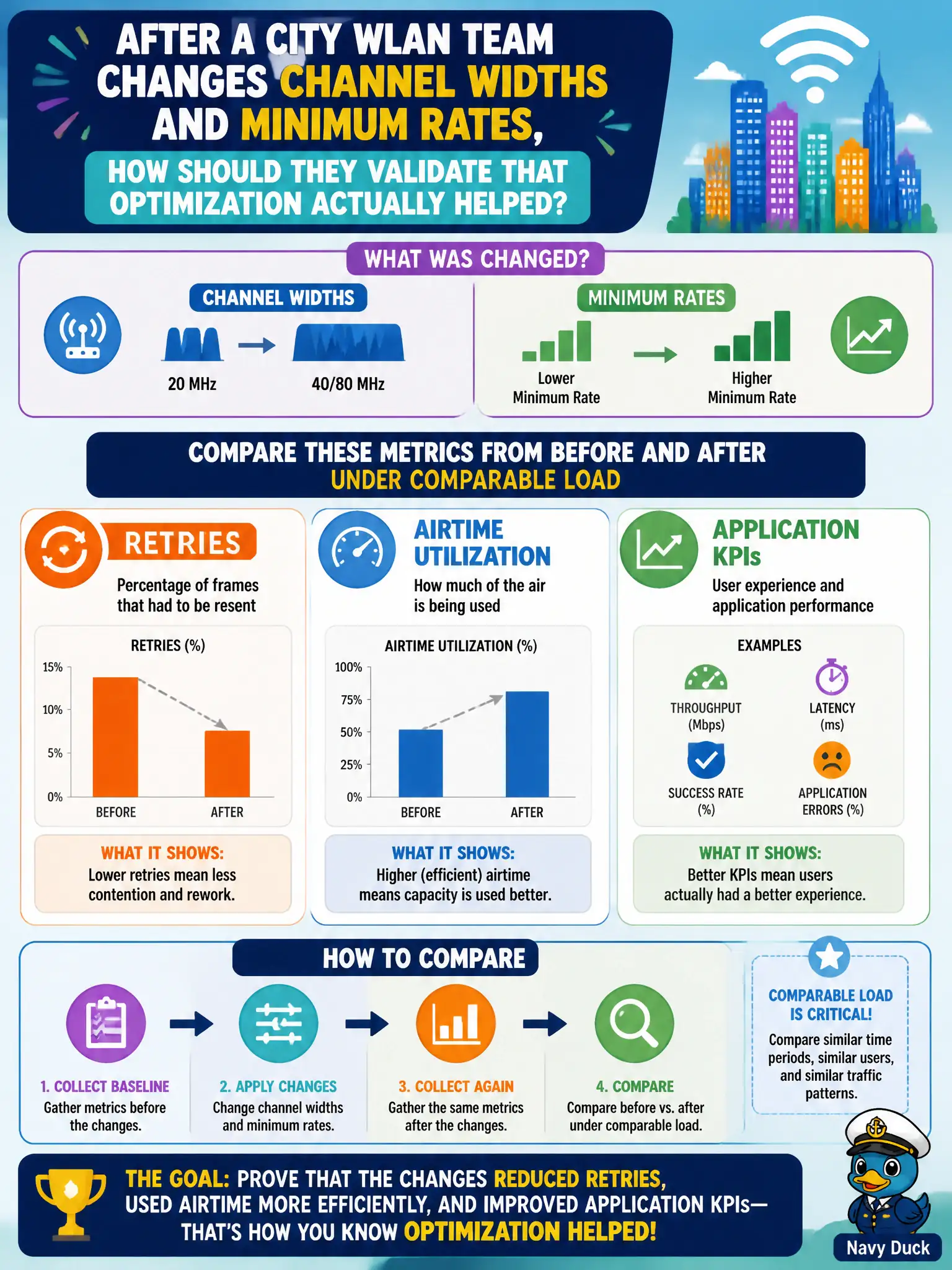
Tuning without a before/after photo is guessing. Grab retries, airtime, and app KPIs under similar load—then you know the dial turns actually helped.
Full Explanation
After a municipal WLAN change, validate by comparing retries, airtime utilization, and application KPIs from before and after under comparable load—not by anecdotes alone. Assuming success if no help-desk tickets arrive for one week misses silent degradation and under-reporting. Relying solely on a new predictive heatmap without on-air metrics confuses prediction with measured experience. Replacing all APs so configuration changes cannot be the cause is wasteful and destroys experimental control. Exam caveat: change validation needs paired metrics under similar client load windows. Operational check: store pre-change baselines for civic peak hours, re-measure the same KPIs post-change, and only then close the municipal change record. In municipal WLAN operations, record the chosen control and the rejected alternatives in the change ticket so on-call staff understand which failure modes were avoided for city services. Re-validate after the next maintenance window that the same control still holds under the current controller code, client mix, and civic event calendar used by the wireless team. Keep spectrum, capacity, and QoS evidence attached to the municipal runbook entry for auditors and future CWNE-level reviews.