
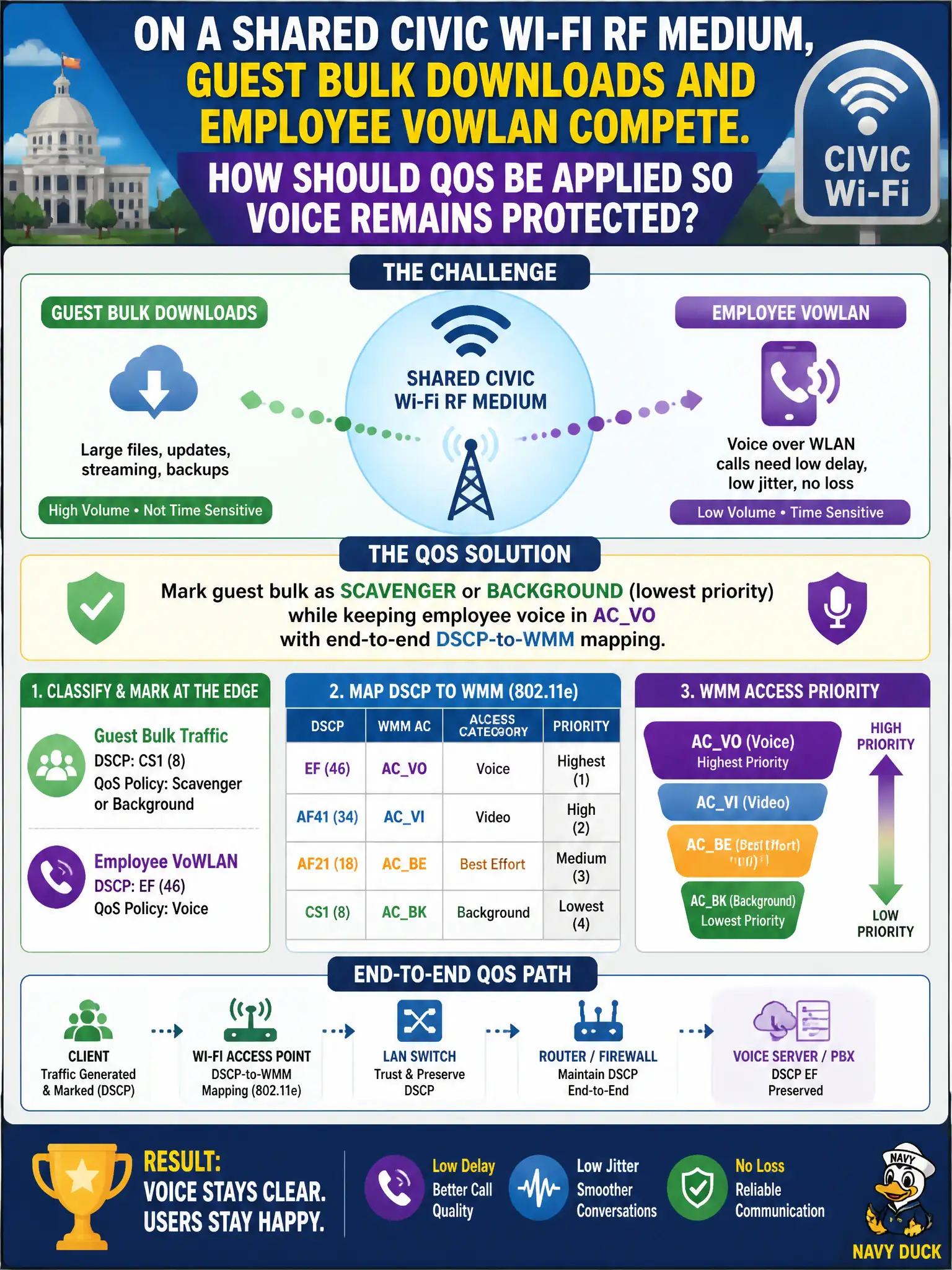
On a shared civic Wi-Fi RF medium, guest bulk downloads and employee VoWLAN compete. How should QoS be applied so voice remains protected?
Select an answer to reveal the explanation.
Short Explanation
Guests bingeing big files are the slow moving truck; voice is the ambulance. Park the truck in the scavenger lane and keep the ambulance in AC_VO with DSCP mapped all the way through.
Full Explanation
When guest bulk transfers compete with employee voice on municipal airtime, mark guest bulk as scavenger or background at lowest priority while keeping employee voice in AC_VO with correct DSCP to WMM mapping so voice retains contention advantage. Mapping guest bulk into AC_VO so transfers finish before voice starts inverts priorities and endangers softphones. Disabling EDCA to rely on TCP fairness alone between guest and voice abandons 802.11 QoS needed for real-time traffic. Giving guest SSIDs identical WMM parameters to the voice SSID for fairness erases the intentional priority municipal voice requires. Exam caveat: fairness between SSIDs is a policy choice—voice protection is not the same as equal EDCA. Operational check: generate guest bulk load beside an employee test call, confirm scavenger versus AC_VO behavior on air, and lock guest QoS profiles used at civic public counters. In municipal WLAN operations, record the chosen control and the rejected alternatives in the change ticket so on-call staff understand which failure modes were avoided for city services. Re-validate after the next maintenance window that the same control still holds under the current controller code, client mix, and civic event calendar used by the wireless team.