
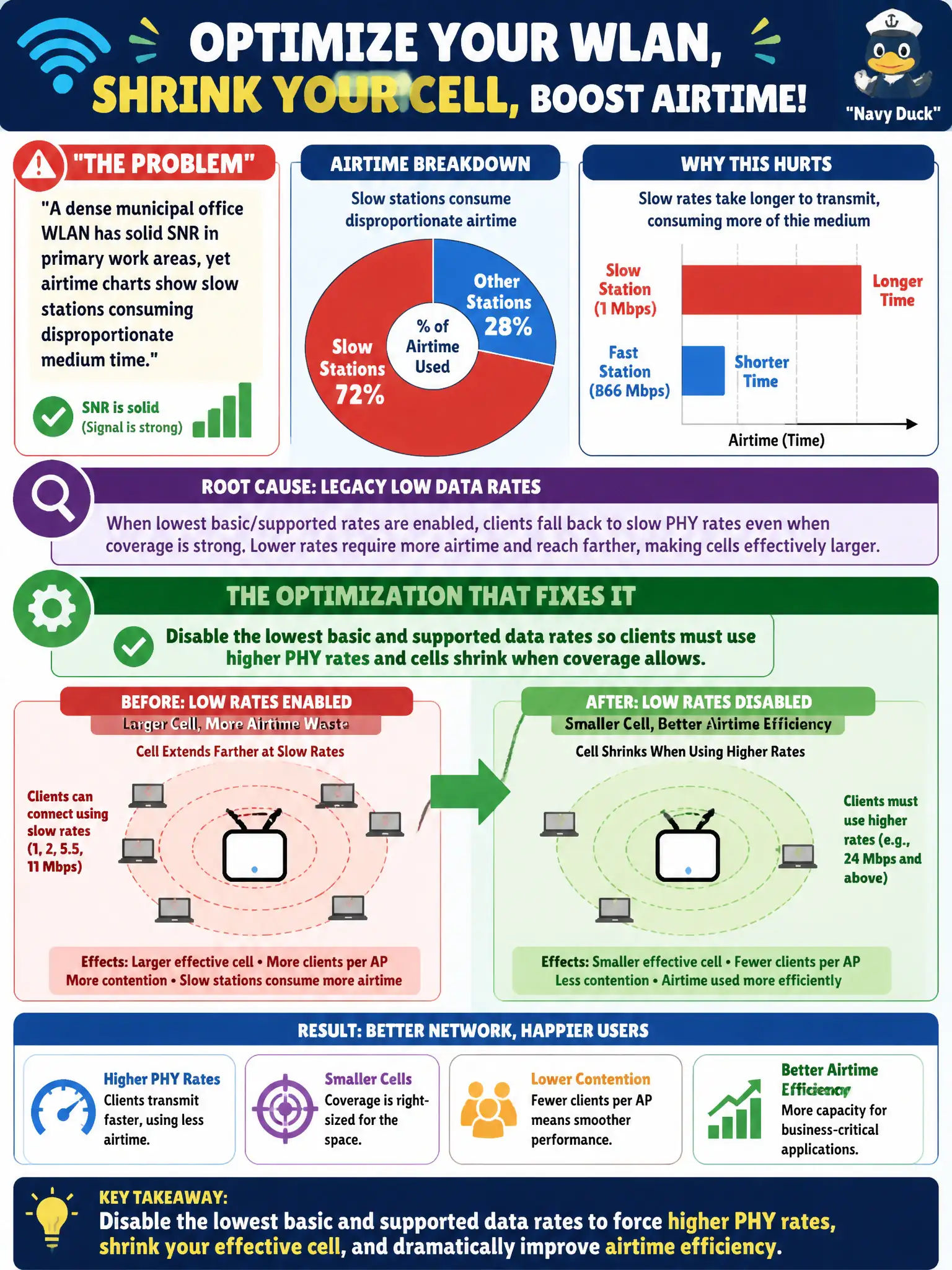
A dense municipal office WLAN has solid SNR in primary work areas, yet airtime charts show slow stations consuming disproportionate medium time. What optimization most directly shrinks effective cell size and improves airtime efficiency?
Select an answer to reveal the explanation.
Short Explanation
Leaving 1 and 2 Mbps on is like keeping the slow lane open on a crowded bridge—one crawler eats everyone's time. Raise the minimum rates when coverage allows so stations speak faster and the cell edge pulls in.
Full Explanation
To shrink cells and raise efficiency in a dense municipal office, disable the lowest basic and supported data rates so clients must use higher PHY rates and do not associate from far away at costly low MCS. Enabling legacy 1 and 2 Mbps rates so distant clients still associate enlarges cells and airtime tax—the opposite of high-density practice. Widening every BSS to 160 MHz to raise peak PHY regardless of CCI typically worsens reuse in offices. Removing WMM so low-rate frames no longer use EDCA queues does not fix low-rate associations and harms QoS. Exam caveat: minimum data rates are a cell-sizing and airtime tool—coordinate with coverage surveys. Operational check: raise minimum rates stepwise on a permitting floor, verify sticky far associations drop while required coverage holds, and document the municipal rate set used for dense civic spaces. In municipal WLAN operations, record the chosen control and the rejected alternatives in the change ticket so on-call staff understand which failure modes were avoided for city services. Re-validate after the next maintenance window that the same control still holds under the current controller code, client mix, and civic event calendar used by the wireless team.