
County VoWLAN handsets clip during hallway moves between civic-center APs. Which measurement best proves whether roam latency violates the voice budget?
Select an answer to reveal the explanation.
Short Explanation
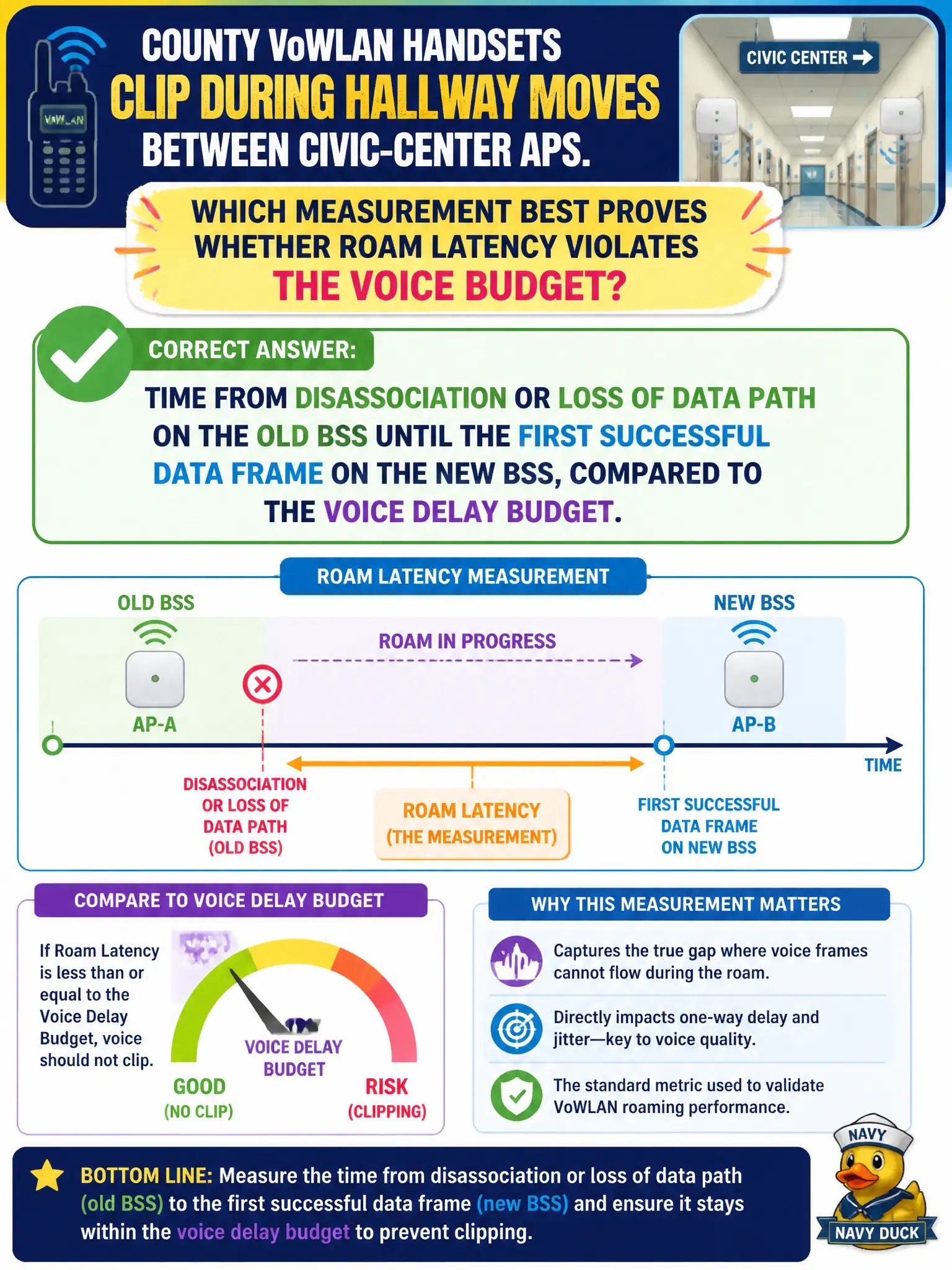
Voice hates long pit stops between APs. Clock the gap from losing the old BSS until data flows on the new one, then stack that against the voice delay budget—if the stop is too long, the call stutters.
Full Explanation
Roam latency for municipal voice should be measured as time from disassociation or loss of data path on the old BSS until the first successful data frame on the new BSS—the gap that produces audible loss. Average beacon interval of the destination AP alone is not roam latency. DHCP lease duration on the voice VLAN affects addressing lifetimes, not the instantaneous roam data-path gap unless a full DHCP cycle is wrongly forced. Peak MCS while the handset is stationary at a desk describes link rate, not mobility interruption time. Exam caveat: define roam success with data-plane continuity metrics for VoWLAN, not proxy counters. Operational check: use voice-capable test tools or captures during inspector walk routes, record roam gap distributions, and tune sticky and overlap settings until civic VoWLAN meets the voice service level objective. In municipal WLAN operations, record the chosen control and the rejected alternatives in the change ticket so on-call staff understand which failure modes were avoided for city services. Re-validate after the next maintenance window that the same control still holds under the current controller code, client mix, and civic event calendar used by the wireless team.