
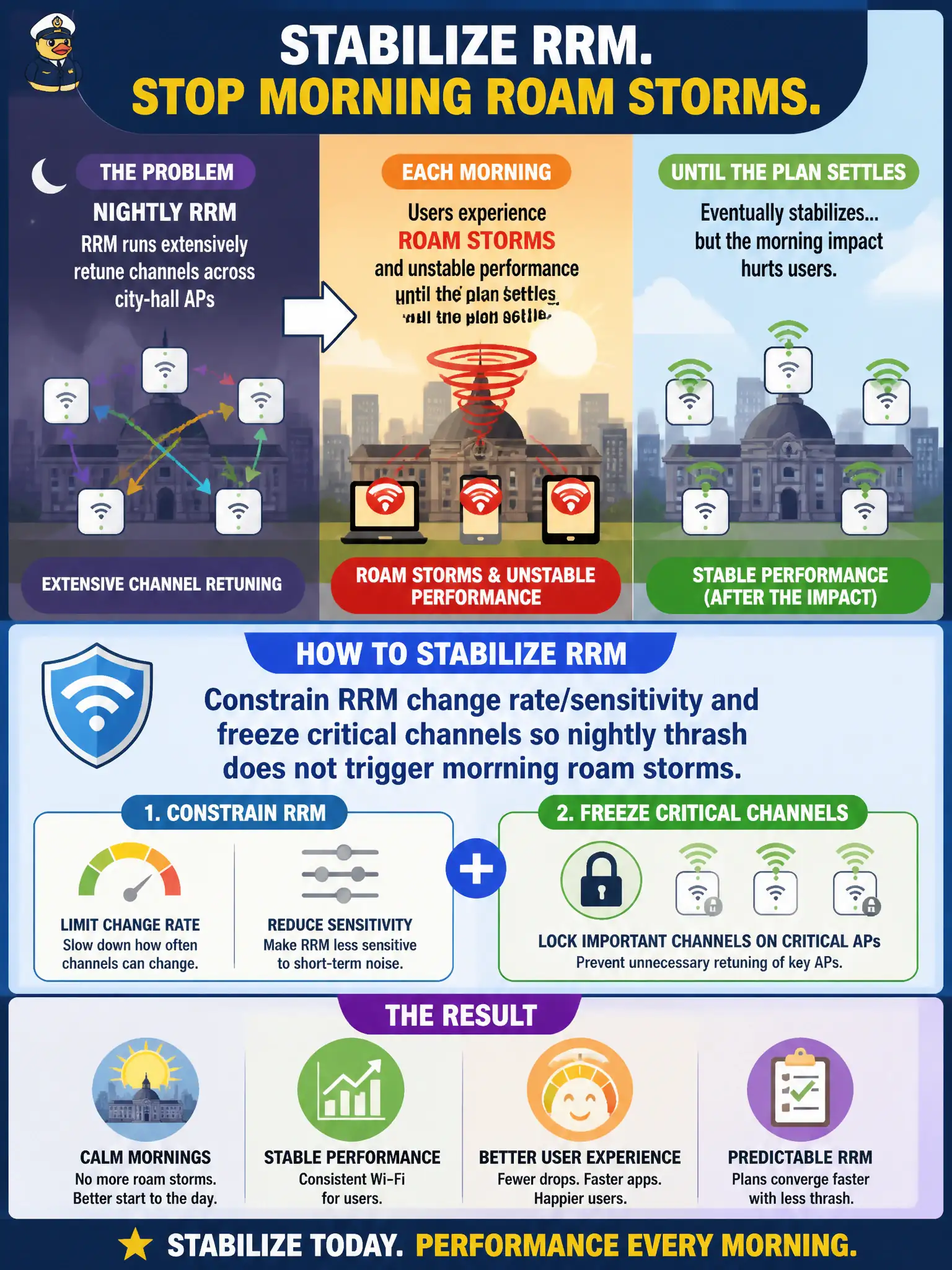
Nightly RRM runs extensively retune channels across city-hall APs; each morning users experience roam storms and unstable performance until the plan settles. How should RRM be stabilized?
Select an answer to reveal the explanation.
Short Explanation
If the street signs move every night, morning drivers get lost—and so do Wi-Fi clients after RRM thrash. Slow down how often channels flip and lock the important ones. Stable RRM beats a “perfect” plan that rearranges itself before coffee.
Full Explanation
Nightly RRM thrash that changes channels under municipal clients can trigger disruptive roam and reassociation storms by morning. Constrain RRM change rate and sensitivity and freeze critical channels so automation does not undo a stable civic RF plan overnight. Allowing unconstrained hourly channel changes during business hours maximizes churn precisely when clerks and public counters need stability. Disabling all monitoring so RRM never sees interference blinds operations to real problems. Setting every AP to the same channel to make RRM trivial maximizes CCI and destroys reuse. Exam caveat: RRM is a tool with hysteresis—unbounded agility becomes an operational outage generator. Operational check: review overnight channel change logs, apply freeze and dampen policies on council and permitting floors, and verify morning client stability metrics for municipal SSIDs. In municipal WLAN operations, record the chosen control and the rejected alternatives in the change ticket so on-call staff understand which failure modes were avoided for city services. Re-validate after the next maintenance window that the same control still holds under the current controller code, client mix, and civic event calendar used by the wireless team.