
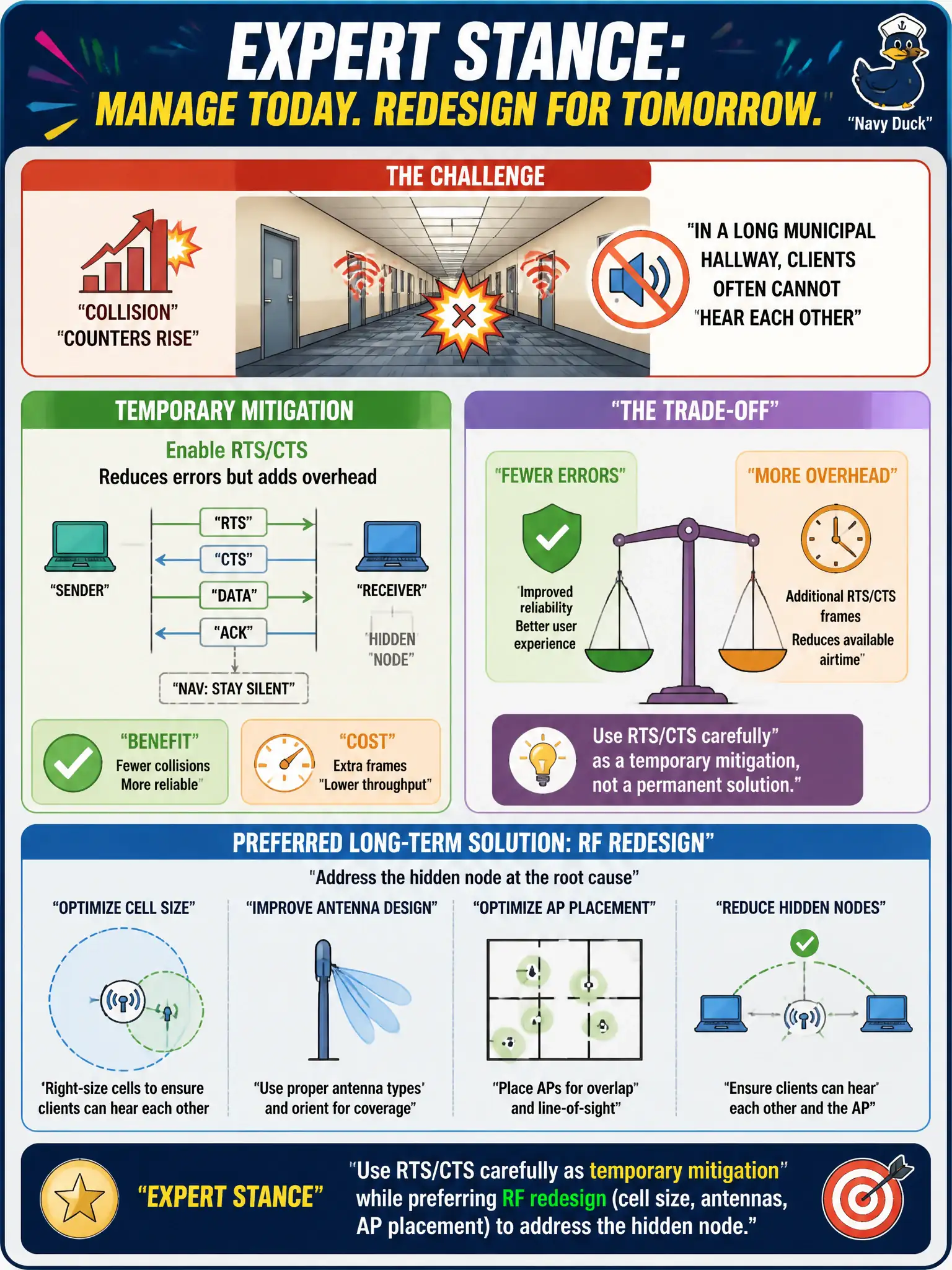
Collision counters rise in a long municipal hallway where clients often cannot hear each other; a temporary enablement of RTS/CTS reduces errors but adds overhead. What is the expert stance?
Select an answer to reveal the explanation.
Short Explanation
RTS/CTS is a traffic whistle that adds its own delay—handy when two cars can’t see each other at the corner. Use it to stop the crashes now, then rebuild the intersection (cells/antennas) so you don’t need the whistle forever.
Full Explanation
Hidden-node pain in long municipal hallways may be temporarily eased with careful RTS/CTS, but the preferred path is RF redesign—cell size, antennas, and AP placement—so carrier sense and geometry reduce hidden stations. RTS/CTS is a tactical mitigation with overhead, not the permanent architecture for every hall. Leaving RTS/CTS on forever as the preferred permanent design accepts perpetual overhead instead of fixing placement. Disabling carrier sense so hidden nodes transmit freely maximizes collisions. Converting the hallway to a single maximum-power omni AP tries to brute-force coverage while recreating large contention domains and often worsening fairness. Exam caveat: RTS/CTS trades overhead for collision reduction—use judiciously while correcting RF design. Operational check: map hidden-node evidence with captures, trial RTS thresholds if needed, then reposition or add APs or antennas and remove unnecessary RTS once municipal hallway performance stabilizes. In municipal WLAN operations, record the chosen control and the rejected alternatives in the change ticket so on-call staff understand which failure modes were avoided for city services. Re-validate after the next maintenance window that the same control still holds under the current controller code, client mix, and civic event calendar used by the wireless team.