
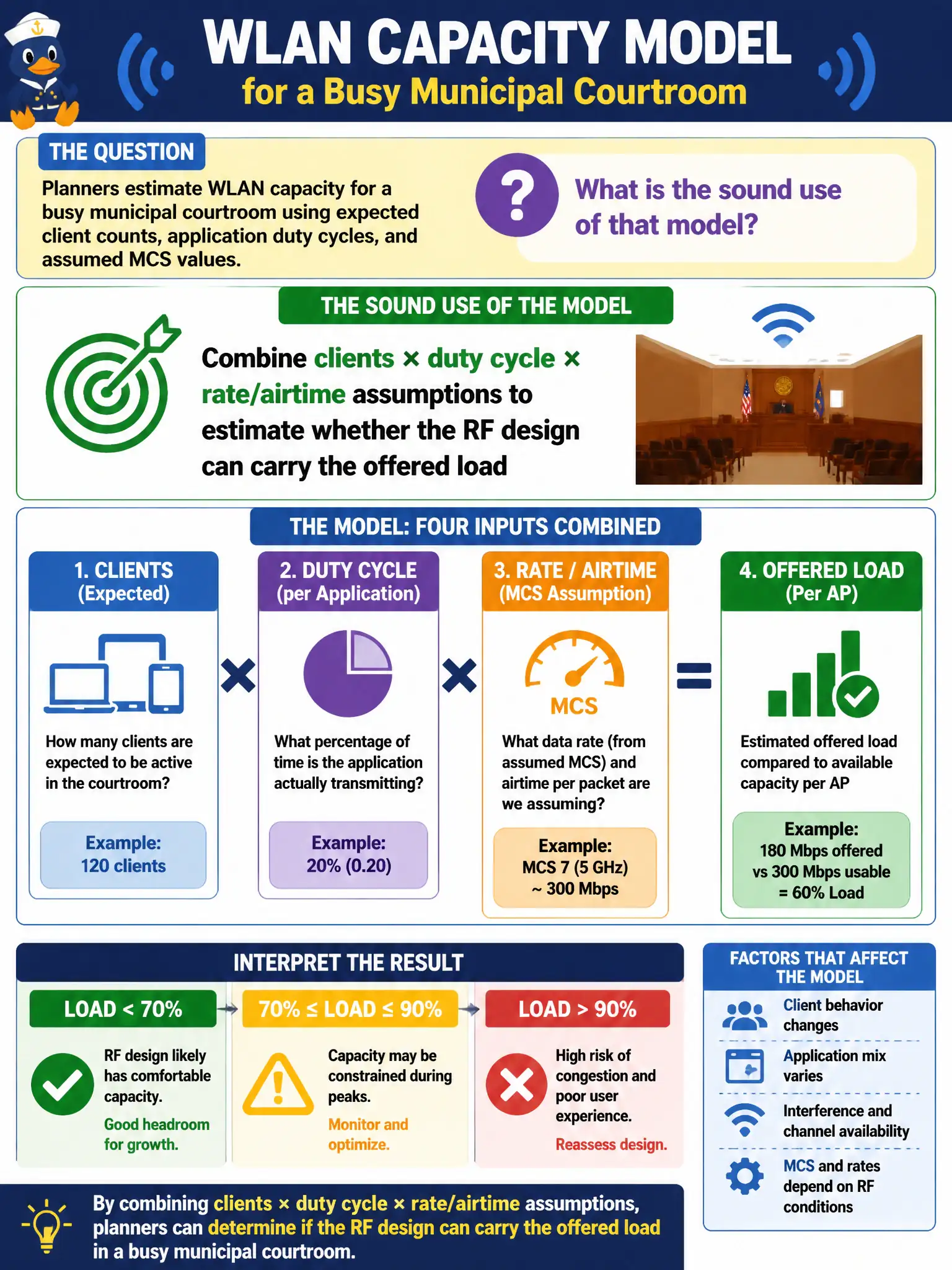
Planners estimate WLAN capacity for a busy municipal courtroom using expected client counts, application duty cycles, and assumed MCS values. What is the sound use of that model?
Select an answer to reveal the explanation.
Short Explanation
Courtroom Wi-Fi math is seats × how chatty the apps are × how fast each talker can speak on RF. That clients × duty cycle × MCS style model tells you if one AP in the doorway is a fantasy. Capacity planning beats hope.
Full Explanation
Courtroom or council capacity planning should combine clients, duty cycle, and rate or airtime assumptions to estimate whether the RF design can carry the offered load—not merely note that an AP exists near the door. That model-driven approach is how CWNE-level municipal designs avoid surprise failure during packed hearings. Treating client count alone as sufficient if any AP is inside the doorway ignores airtime, MCS, and contention. Ignoring MCS assumptions because stone walls somehow do not affect rate selection denies basic RF reality in historic civic buildings. Using only marketing PHY maxima without duty-cycle inputs overstates capacity and misleads stakeholders. Exam caveat: capacity is an airtime budget problem; client count without duty cycle and rate is incomplete. Operational check: build a simple airtime estimate for peak courtroom occupancy, validate with a load test using representative devices and apps, and adjust AP density or channel width before the next high-profile civic session. In municipal WLAN operations, record the chosen control and the rejected alternatives in the change ticket so on-call staff understand which failure modes were avoided for city services. Re-validate after the next maintenance window that the same control still holds under the current controller code, client mix, and civic event calendar used by the wireless team.