
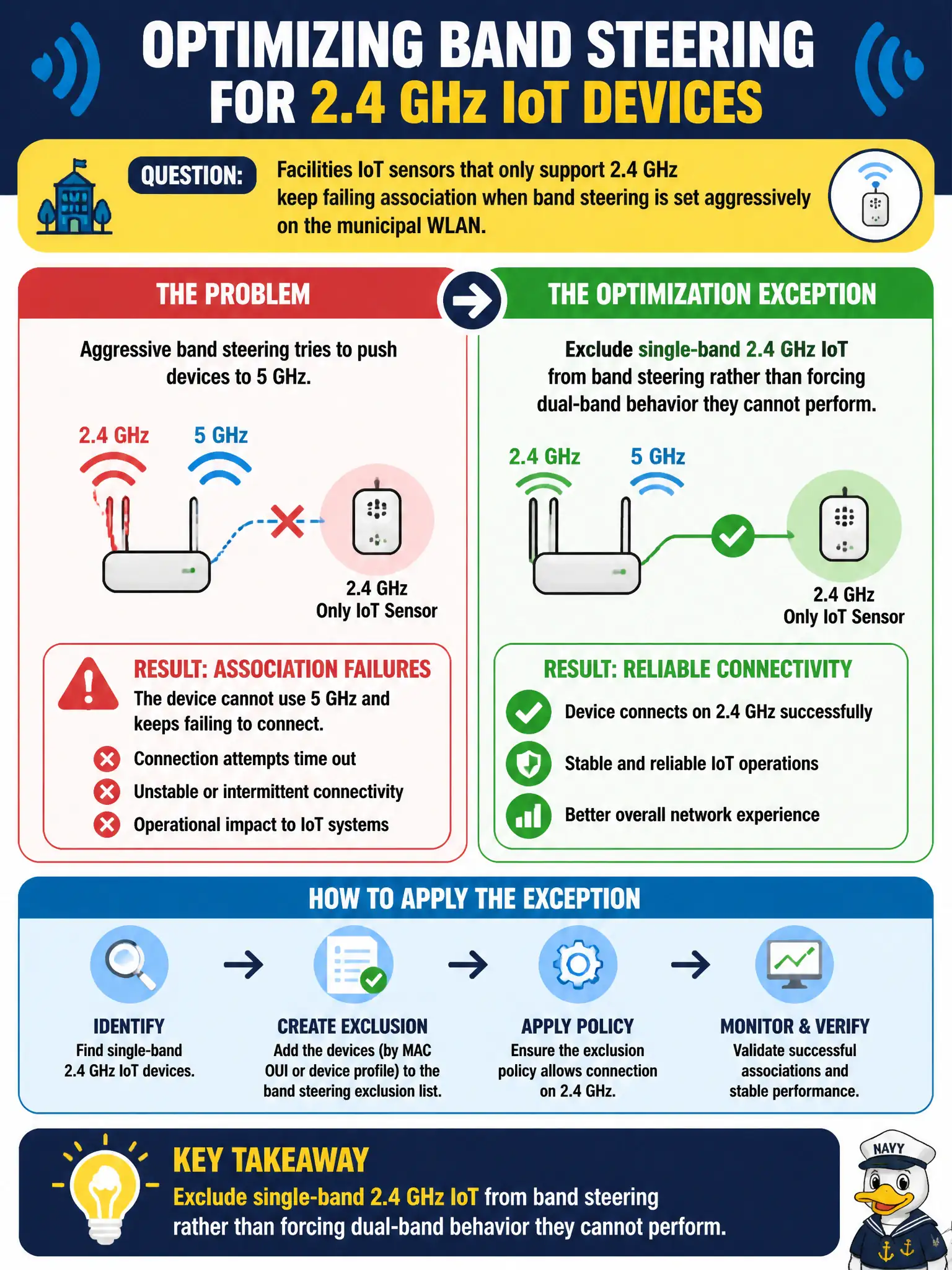
Facilities IoT sensors that only support 2.4 GHz keep failing association when band steering is set aggressively on the municipal WLAN. What optimization exception should be applied?
Select an answer to reveal the explanation.
Short Explanation
You can’t steer a one-speed bicycle onto the freeway HOV lane. 2.4-only IoT isn’t dual-band, so aggressive steering just breaks joins. Exempt those sensors and steer the phones instead.
Full Explanation
Band steering helps dual-band municipal clients move to 5 GHz, but single-band 2.4 GHz IoT sensors cannot follow dual-band steering logic. Exclude those sensors from aggressive band steering rather than forcing behavior they cannot perform, preserving both IoT stability and steering benefits for phones and laptops. Forcing sensors onto 6 GHz with WPA3-Enterprise only ignores device radio and EAP limitations common in constrained IoT. Raising steering strength until every sensor appears on 5 GHz simply breaks association for 2.4-only devices. Disabling the 2.4 GHz radio building-wide to simplify the plan strands 2.4-only facilities IoT and many legacy endpoints. Exam caveat: steering policies must be client-capability aware—IoT exceptions are normal in civic buildings. Operational check: inventory 2.4-only sensors, place them on an IoT SSID exempt from steering, verify dual-band staff clients still steer to 5 GHz, and document the split for municipal facilities operations. In municipal WLAN operations, record the chosen control and the rejected alternatives in the change ticket so on-call staff understand which failure modes were avoided for city services. Re-validate after the next maintenance window that the same control still holds under the current controller code, client mix, and civic event calendar used by the wireless team.