
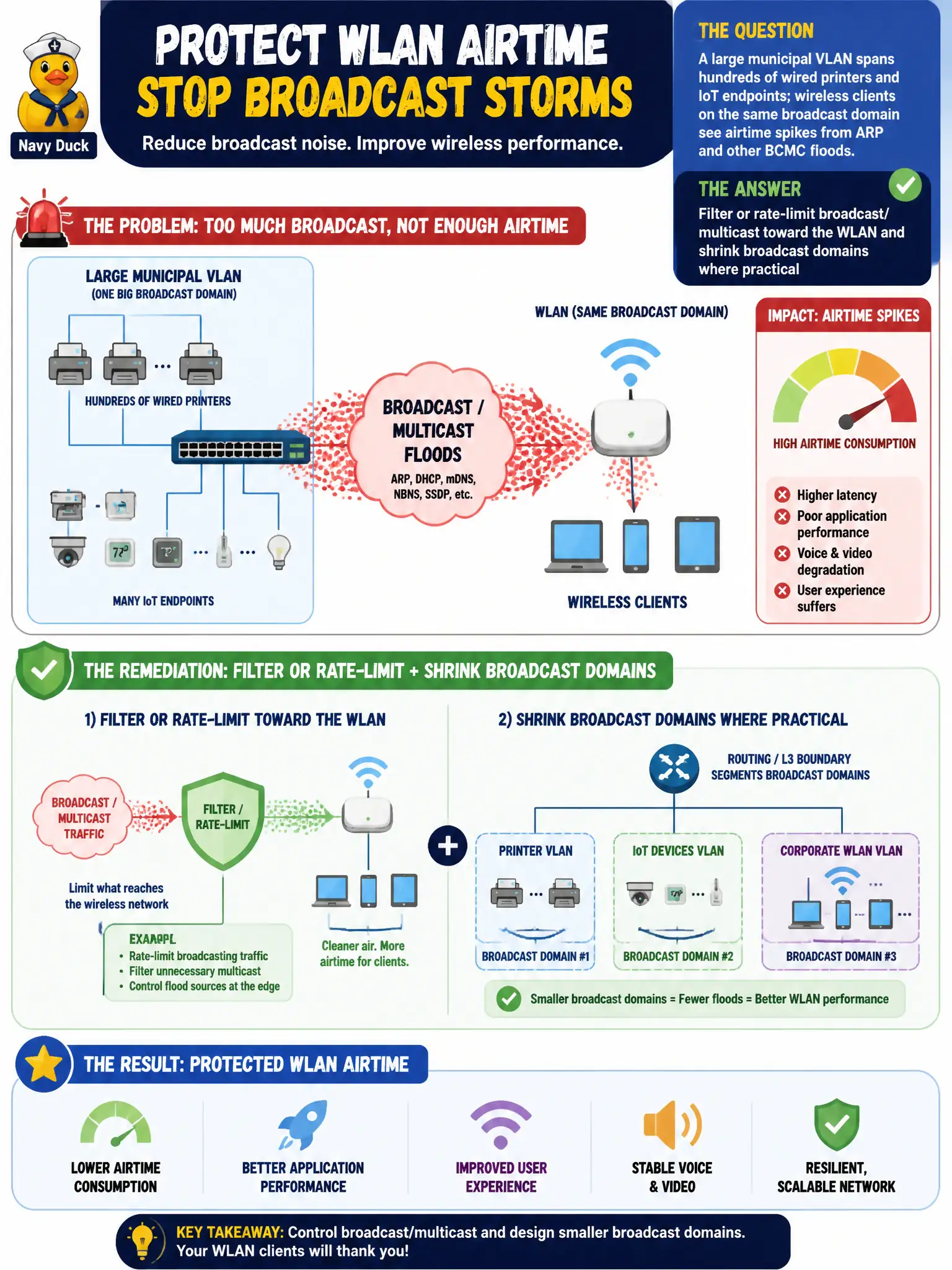
A large municipal VLAN spans hundreds of wired printers and IoT endpoints; wireless clients on the same broadcast domain see airtime spikes from ARP and other BCMC floods. Which remediation best protects WLAN airtime?
Select an answer to reveal the explanation.
Short Explanation
Broadcasts on Wi-Fi are like the PA system reading every memo out loud—everyone stops to listen. Huge VLANs dump ARP and friends onto scarce airtime. Rate-limit or filter BCMC to the WLAN and keep broadcast domains smaller.
Full Explanation
When a large municipal VLAN spans hundreds of wired printers and IoT endpoints, wireless clients in the same broadcast domain can lose airtime to ARP and other BCMC floods. The best remediation filters or rate-limits broadcast/multicast toward the WLAN and shrinks broadcast domains where practical so wired chatter does not monopolize scarce RF. Increasing AP beacon power so BCMC finishes faster misunderstands both beacon function and BCMC cost; louder beacons do not stop broadcast storms. Disabling all client DHCP to stop broadcasts permanently breaks addressing and is not a WLAN airtime strategy. Forcing every printer onto 160 MHz Wi-Fi channels neither solves wired BCMC domains nor is realistic for printers, and wide channels worsen reuse. Exam caveat: BCMC on wireless is an airtime multiplier—architecture (VLAN size, mDNS/ARP controls, directed multicast) matters as much as RF. Operational check: measure BCMC airtime on affected APs, apply rate limits/filters and VLAN segmentation for printers/IoT, then re-check client goodput in the municipal office during peak print/IoT chatter. Printer and IoT BCMC storms often worsen after departmental VLAN merges intended as administrative convenience; reclaiming smaller broadcast domains is therefore both a network and a WLAN performance control. Track BCMC airtime as a standing KPI for civic office floors that share wired IoT with staff Wi-Fi.