
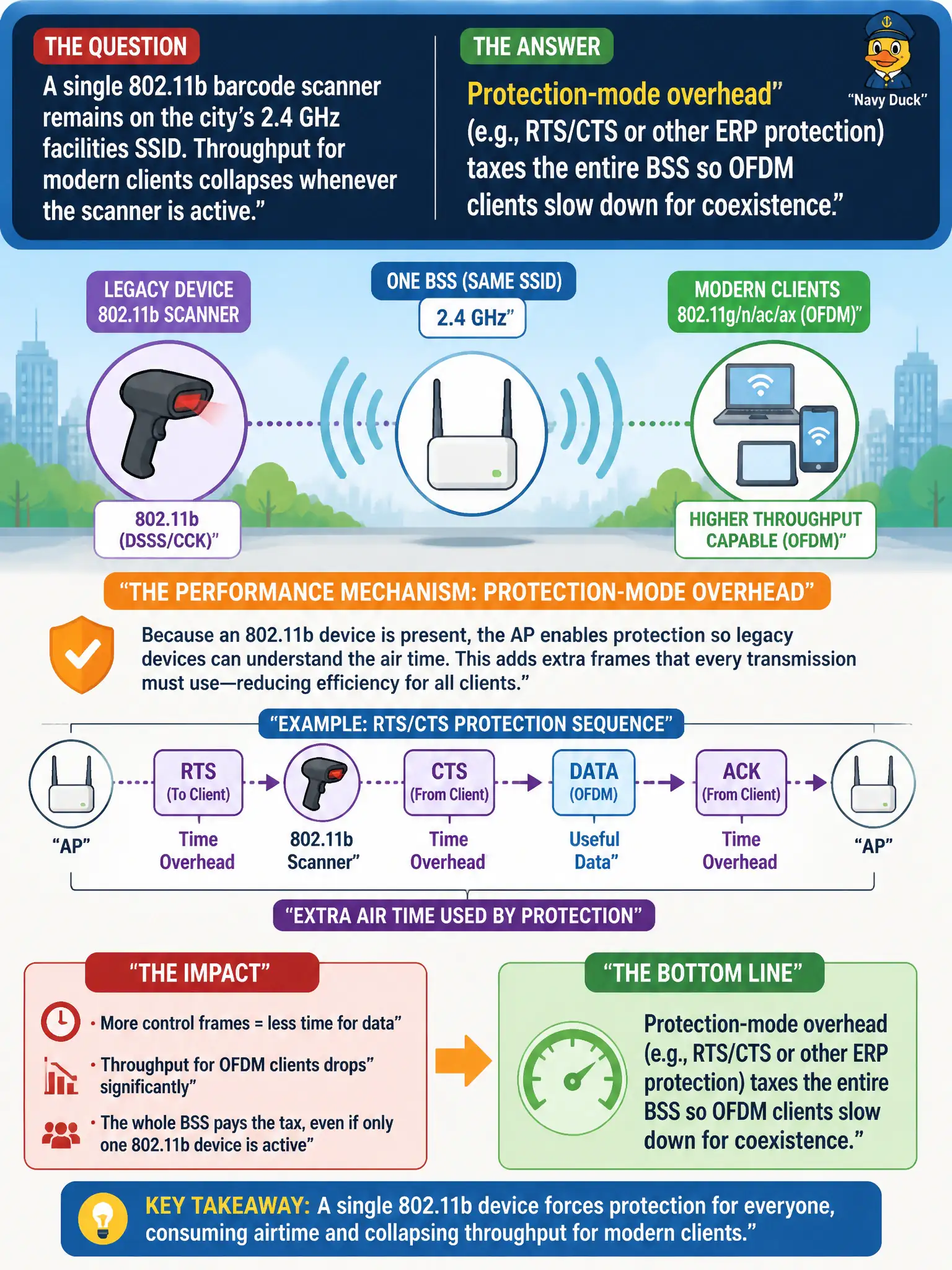
A single 802.11b barcode scanner remains on the city’s 2.4 GHz facilities SSID. Throughput for modern clients collapses whenever the scanner is active. What performance mechanism explains most of that loss?
Select an answer to reveal the explanation.
Short Explanation
One old bicycle on a bike path can force everyone else to ride single-file. An 802.11b holdout triggers protection so modern clients announce themselves the slow way. That tax hits the whole 2.4 GHz BSS—retire or isolate the legacy scanner.
Full Explanation
A single 802.11b barcode scanner on the city’s 2.4 GHz facilities SSID can collapse modern client throughput because ERP protection mechanisms (such as RTS/CTS or other protection overhead) tax the entire BSS so OFDM clients slow down to coexist with the legacy station. The performance mechanism is protection-mode airtime overhead, not mysterious Layer-3 exhaustion. DHCP renewals from one scanner exhausting a VLAN pool would present as address shortages, not as BSS-wide OFDM slowdowns synchronized with scanner activity. Claiming WPA3-Enterprise cannot encrypt 802.11b frames and therefore the AP drops all other traffic misstates security negotiation and is not the usual throughput-collapse mechanism. OFDMA trigger frames forcing every HE client to wait for DSSS beacons confuses generations and is not the classic 802.11b coexistence penalty. Exam caveat: one legacy client can impose BSS-wide protection costs—isolate or upgrade legacy IoT on municipal facilities SSIDs. Operational check: reproduce the slowdown with the scanner active versus idle, confirm protection indicators in captures, then move the scanner to a constrained legacy SSID or replace it so modern facilities clients regain airtime.