
A city warehouse Wi-Fi 6 deployment supports many handheld scanners and softphones exchanging frequent small frames under load. Which HE feature most directly improves efficiency for that traffic pattern?
Select an answer to reveal the explanation.
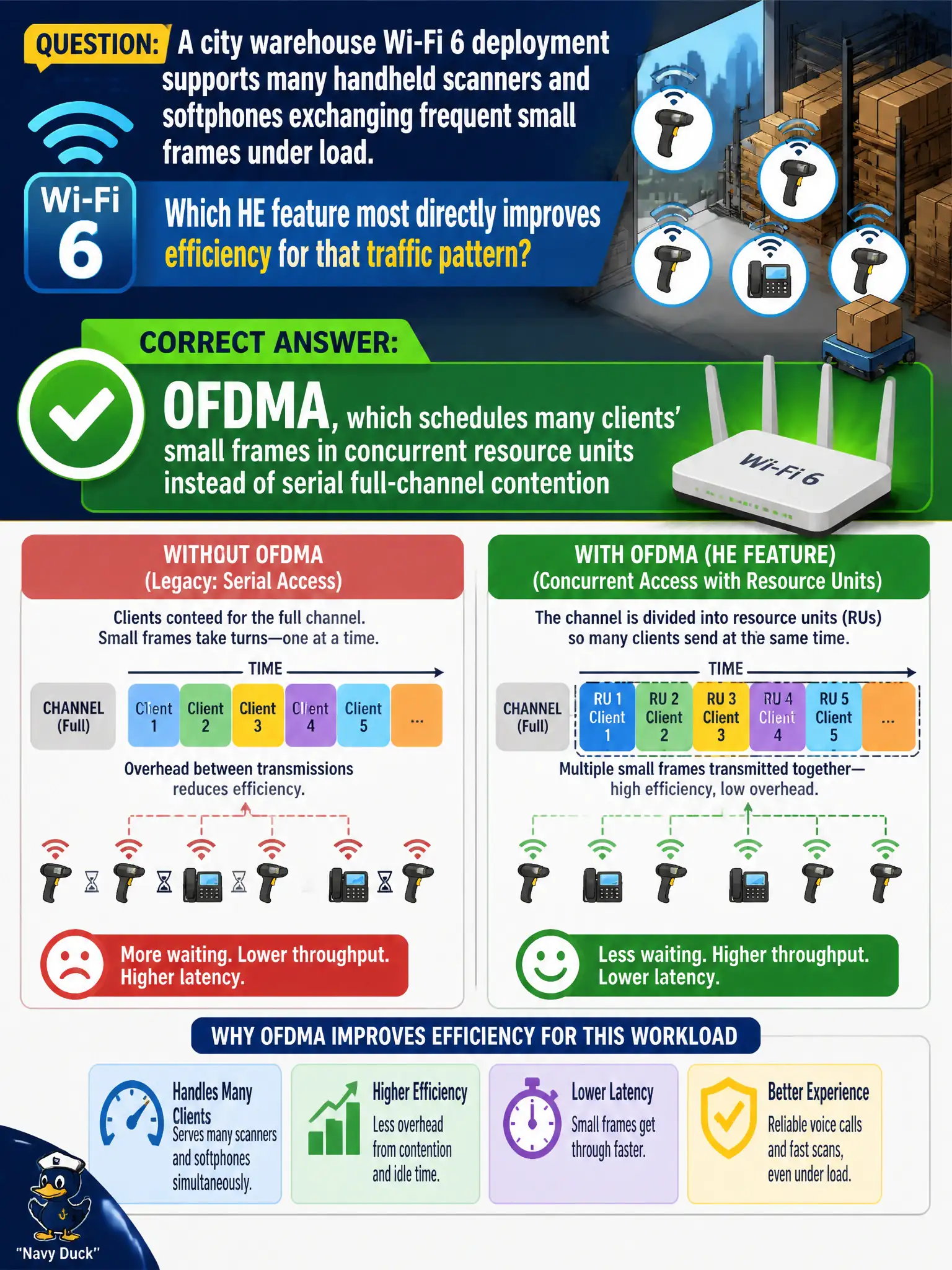
Short Explanation
Lots of tiny scanner beeps used to wait in one long line for the whole channel. OFDMA splits the channel into mini-lanes so many small frames ride together. That’s why Wi-Fi 6 helps dense low-rate IoT/voice loads.
Full Explanation
In a city warehouse Wi-Fi 6 deployment with many handheld scanners and softphones exchanging frequent small frames under load, OFDMA most directly improves efficiency by scheduling many clients’ small frames in concurrent resource units instead of forcing serial full-channel contention for each short PDU. That matches warehouse telemetry and voice/signaling patterns better than chasing legacy range modes. Enabling legacy DSSS-only mode for maximum range reintroduces inefficiency and protection costs unsuitable for a modern HE warehouse design. Disabling MU features so every frame uses a full-width SU PPDU throws away the scheduler gains Wi-Fi 6 was chosen for under multi-client small-frame load. Mandating 160 MHz bonding on every handheld often reduces reuse in industrial spaces and is unnecessary for small payloads. Exam caveat: OFDMA helps multi-user small-frame efficiency; it is not a substitute for RF design, QoS, or adequate AP density. Operational check: compare airtime and latency for scanners/softphones with MU/OFDMA enabled versus constrained SU-only tests during a picking-shift load window, and retain HE features that measurably stabilize municipal warehouse operations. Warehouse HE validation should include mixed scanner barcode bursts and softphone signaling together, because OFDMA gains appear most clearly under concurrent small-frame contention rather than single-client speed tests. Preserve controller MU schedules that prove stable for municipal logistics shifts.