
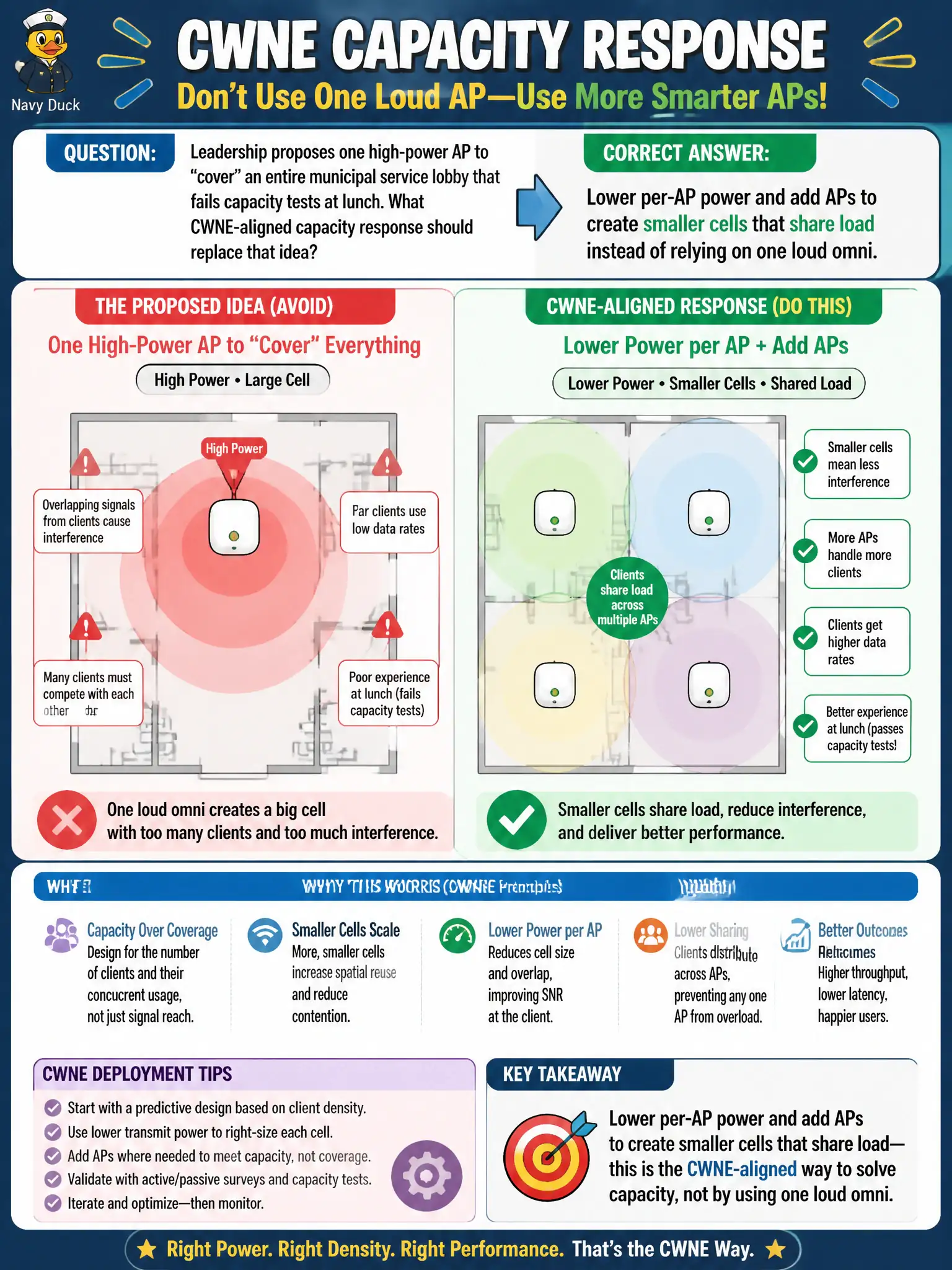
Leadership proposes one high-power AP to “cover” an entire municipal service lobby that fails capacity tests at lunch. What CWNE-aligned capacity response should replace that idea?
Select an answer to reveal the explanation.
Short Explanation
One megaphone in a crowded lobby doesn’t create more conversation time—it just shouts farther. Capacity needs more small cells, not one louder AP. Turn the power down, add APs, and let lunch-hour clients share airtime across neighbors.
Full Explanation
Leadership’s proposal to cover an entire municipal service lobby with one high-power AP fails capacity tests because a single loud cell concentrates clients onto one contention domain. The CWNE-aligned response is to lower per-AP power and add APs to create smaller cells that share load, improving spatial reuse and airtime fairness for lunchtime peaks. Doubling the single AP’s power and disabling neighbors simplifies the RF picture on paper but maximizes contention and eliminates reuse. Replacing Wi-Fi with a single directional bridge aimed at the queue desk abandons multi-client WLAN service design for a PTP-like pattern unsuitable for mixed visitor devices. Turning off 5 GHz so all clients share one larger 2.4 GHz cell worsens density limits and interference exposure. Exam caveat: coverage is not capacity—municipal lobbies need cell sizing for concurrent clients, not merely a green RSSI blob. Operational check: redesign lobby AP count and power for target clients-per-AP, validate during a lunch rush with real permit/payment apps, and brief leadership with before/after capacity metrics rather than power anecdotes. Lobby capacity planning should state a target clients-per-AP and minimum MCS at the queue line, giving leadership a measurable alternative to the one-loud-AP narrative. Include lunch-rush telemetry in the municipal acceptance report so future service-desk expansions reuse the same cell-sizing logic.