
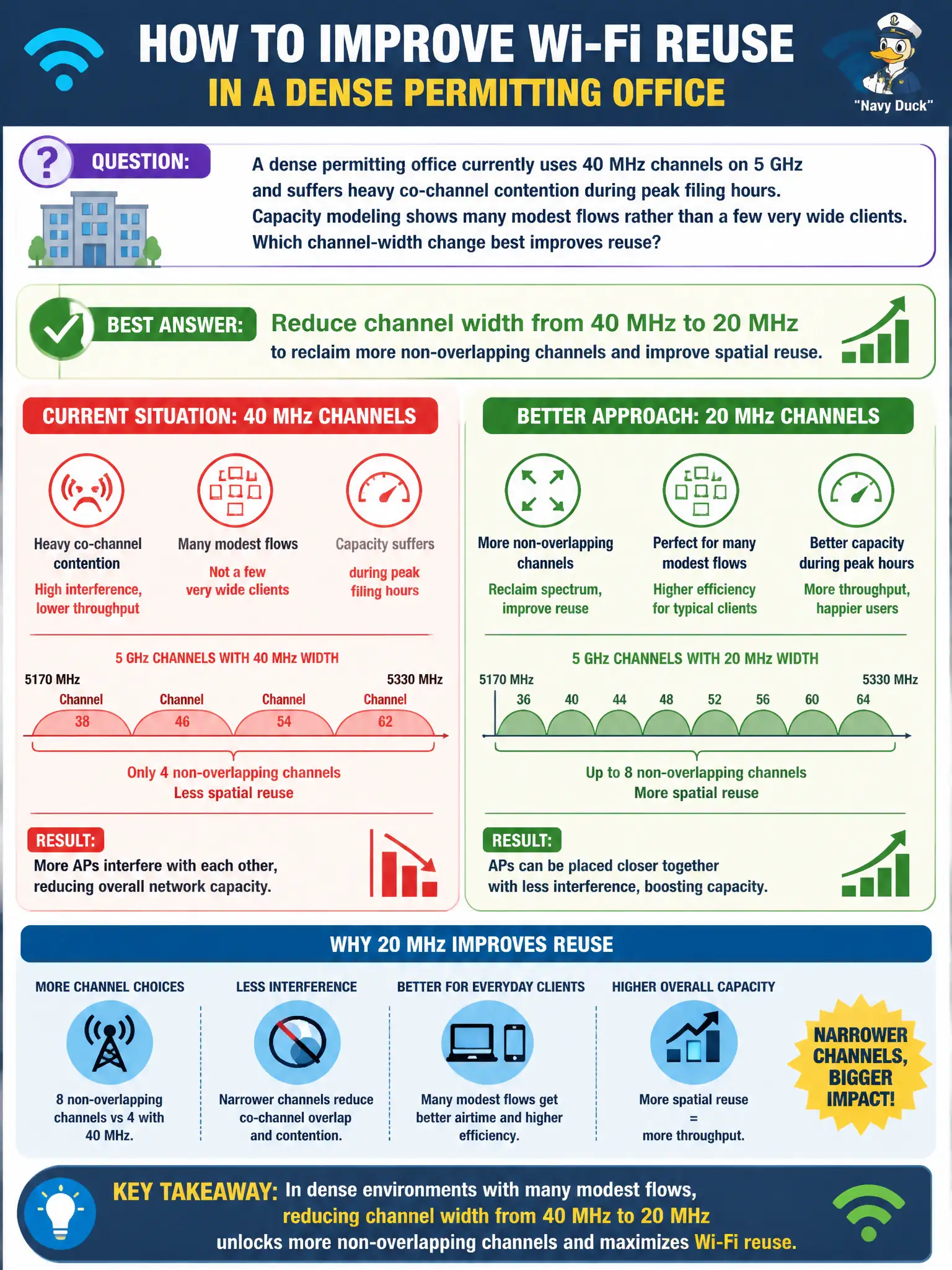
A dense permitting office currently uses 40 MHz channels on 5 GHz and suffers heavy co-channel contention during peak filing hours. Capacity modeling shows many modest flows rather than a few very wide clients. Which channel-width change best improves reuse?
Select an answer to reveal the explanation.
Short Explanation
Wider lanes are great on an empty highway; in a packed downtown they just make bigger collisions. Dropping 40→20 MHz gives the permitting office more separate channels to reuse. More cells talking at once beats one fat channel everyone shares.
Full Explanation
A dense permitting office on 40 MHz 5 GHz channels that suffers heavy co-channel contention during peak filing, with many modest flows rather than a few ultra-wide clients, usually benefits from reducing width to 20 MHz to reclaim more non-overlapping channels and improve spatial reuse. Narrower channels trade peak PHY rate for more concurrent BSS packing—often the winning move for municipal high-density offices. Moving every BSS to 160 MHz typically collapses reuse further and intensifies contention when many APs share limited spectrum. Keeping 40 MHz while disabling RTS/CTS globally does not create additional non-overlapping channels and may worsen collision domains depending on hidden-node conditions. Bonding 2.4 GHz into 40 MHz offload is generally counterproductive: 2.4 GHz already has scarce non-overlapping spectrum and poor density behavior. Exam caveat: channel width is a reuse versus rate trade-off guided by client traffic mix, not a “wider is always faster” rule. Operational check: remodel the permitting floor with 20 MHz plans, compare CCI and throughput for representative filing tablets, and adopt the width that maximizes successful concurrent sessions for public permitting peaks.