
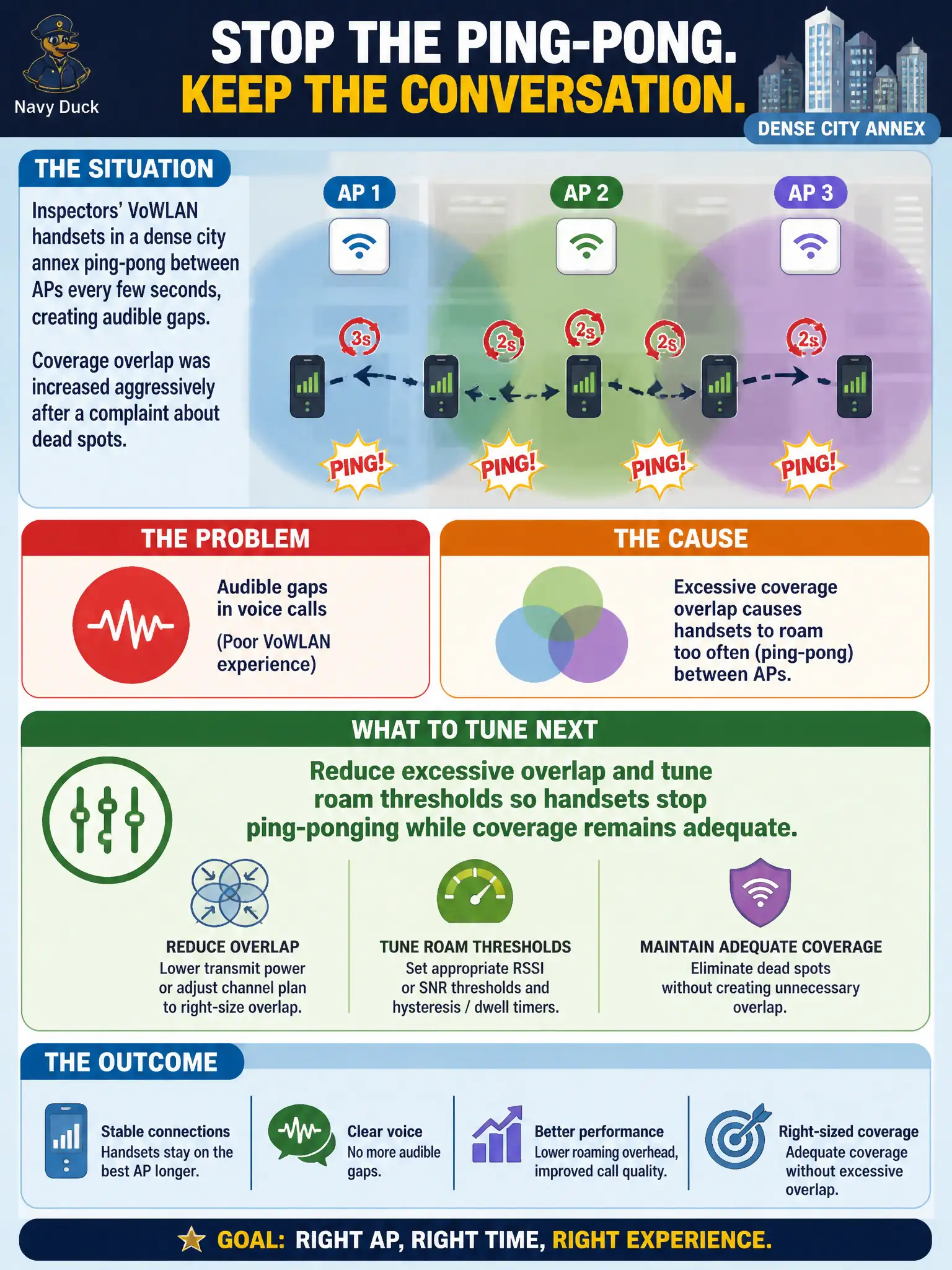
Inspectors’ VoWLAN handsets in a dense city annex ping-pong between APs every few seconds, creating audible gaps. Coverage overlap was increased aggressively after a complaint about dead spots. What should the expert tune next?
Select an answer to reveal the explanation.
Short Explanation
Too little overlap drops calls; too much overlap makes phones play musical chairs. Those rapid AP hops punch holes in voice. Pull the cells back a bit and calm the roam thresholds so inspectors stay put until a real move is needed.
Full Explanation
Inspectors’ VoWLAN handsets that ping-pong every few seconds after overlap was increased aggressively usually suffer from excessive coverage overlap and roam thresholds that are too eager, creating audible gaps. The expert should reduce excessive overlap and tune roam thresholds so handsets stop thrashing while coverage remains adequate for the dense city annex. Adding still more APs on the same channel intensifies CCI and can worsen ping-pong rather than stabilizing association. Disabling voice QoS does not fix roam hysteresis and removes contention priority voice needs. Converting the voice SSID to open authentication shortens some frame exchanges but does not address RF overlap geometry or roam decision logic, and it weakens municipal security posture. Exam caveat: curing dead spots with unlimited overlap often trades coverage complaints for mobility instability—optimize both. Operational check: measure AP-to-AP overlap and handset roam event rates, dial back power/density on the same channel where possible, set roam margins appropriate for voice, and confirm annex walk tests show stable calls for field inspectors. Ping-pong on inspector handsets also spikes control-frame overhead and battery drain, compounding annex voice complaints beyond the audible gaps alone. After overlap reduction, re-check dead-spot edges with a coverage walk so public-works mobility does not regress while stability improves.