
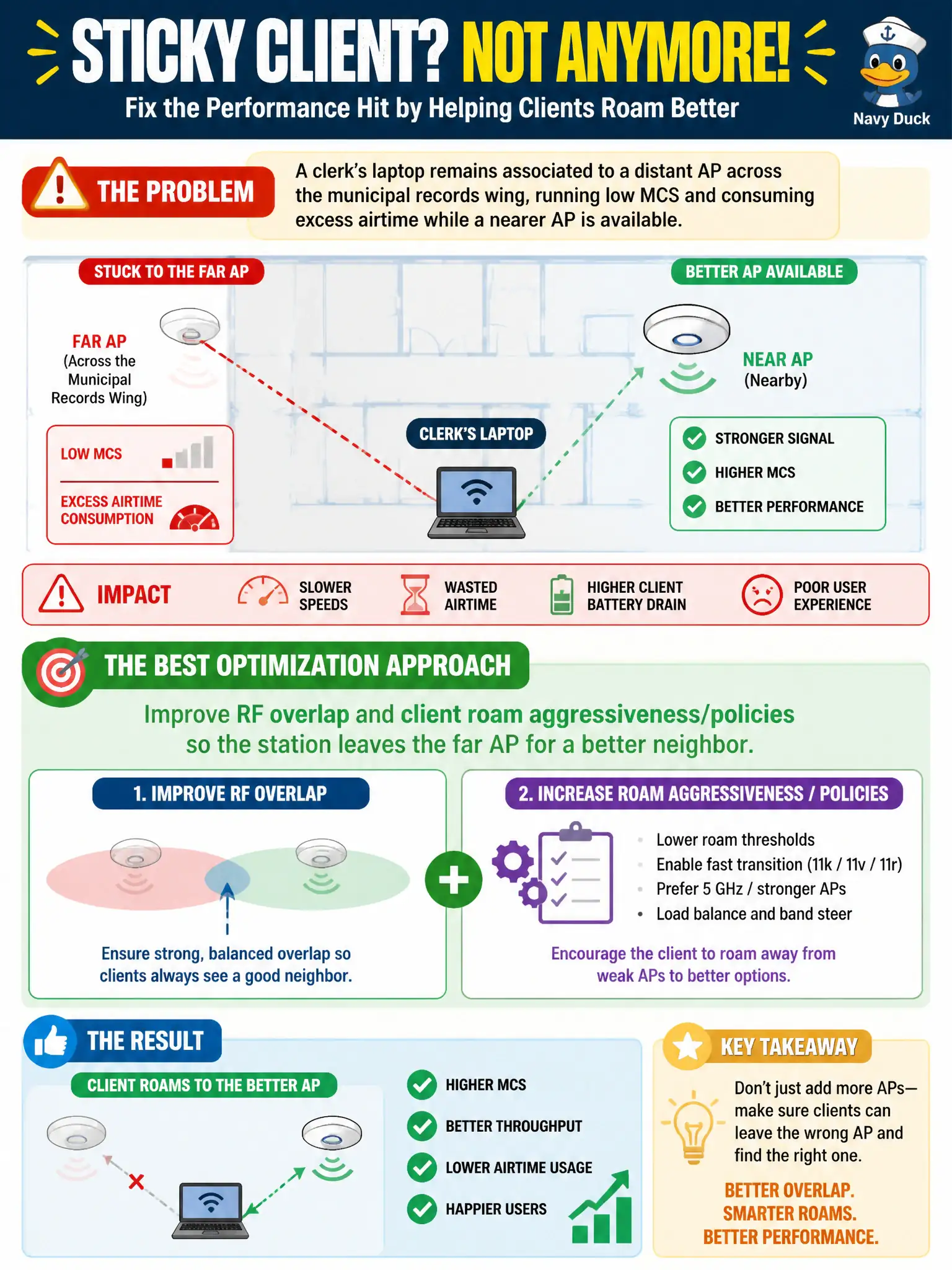
A clerk’s laptop remains associated to a distant AP across the municipal records wing, running low MCS and consuming excess airtime while a nearer AP is available. Which optimization approach best addresses the sticky-client performance hit?
Select an answer to reveal the explanation.
Short Explanation
Sticky clients are like shoppers who won’t leave a crowded register even when the next lane is empty. Low MCS on a far AP burns everyone’s airtime. Nudge roam aggressiveness and fix overlap so the laptop actually moves to the closer AP.
Full Explanation
When a clerk’s laptop remains associated to a distant AP across a municipal records wing at low MCS, the performance hit is sticky-client behavior: excess airtime for that station and everyone sharing the cell. The best optimization improves RF overlap and client roam aggressiveness/policies so the station leaves the far AP for a nearer neighbor with better SNR and MCS. Disabling all roaming and pinning every client to its first AP permanently institutionalizes sticky behavior and worsens airtime fairness. Forcing 2.4 GHz only often enlarges sticky coverage footprints and reduces capacity rather than encouraging a better AP choice. Removing Block Ack agreements to force reassociation is a blunt disruption that harms efficiency without establishing sound roam thresholds or RF design. Exam caveat: sticky clients are jointly an RF-plan and client-roaming-policy problem—not solved by disabling modern MAC efficiency features. Operational check: survey overlap between records-wing APs, tune minimum SNR/roam triggers supported by the client population, and verify the laptop moves to the nearer BSSID with improved MCS during a controlled walk test for civic staff productivity. Sticky low-MCS associations in records areas also inflate retries for nearby clerks sharing the same AP, so correcting roam behavior is a capacity fairness action, not merely a single-laptop preference. Keep a short roam-validation checklist in the municipal WLAN runbook for after furniture or AP moves.