
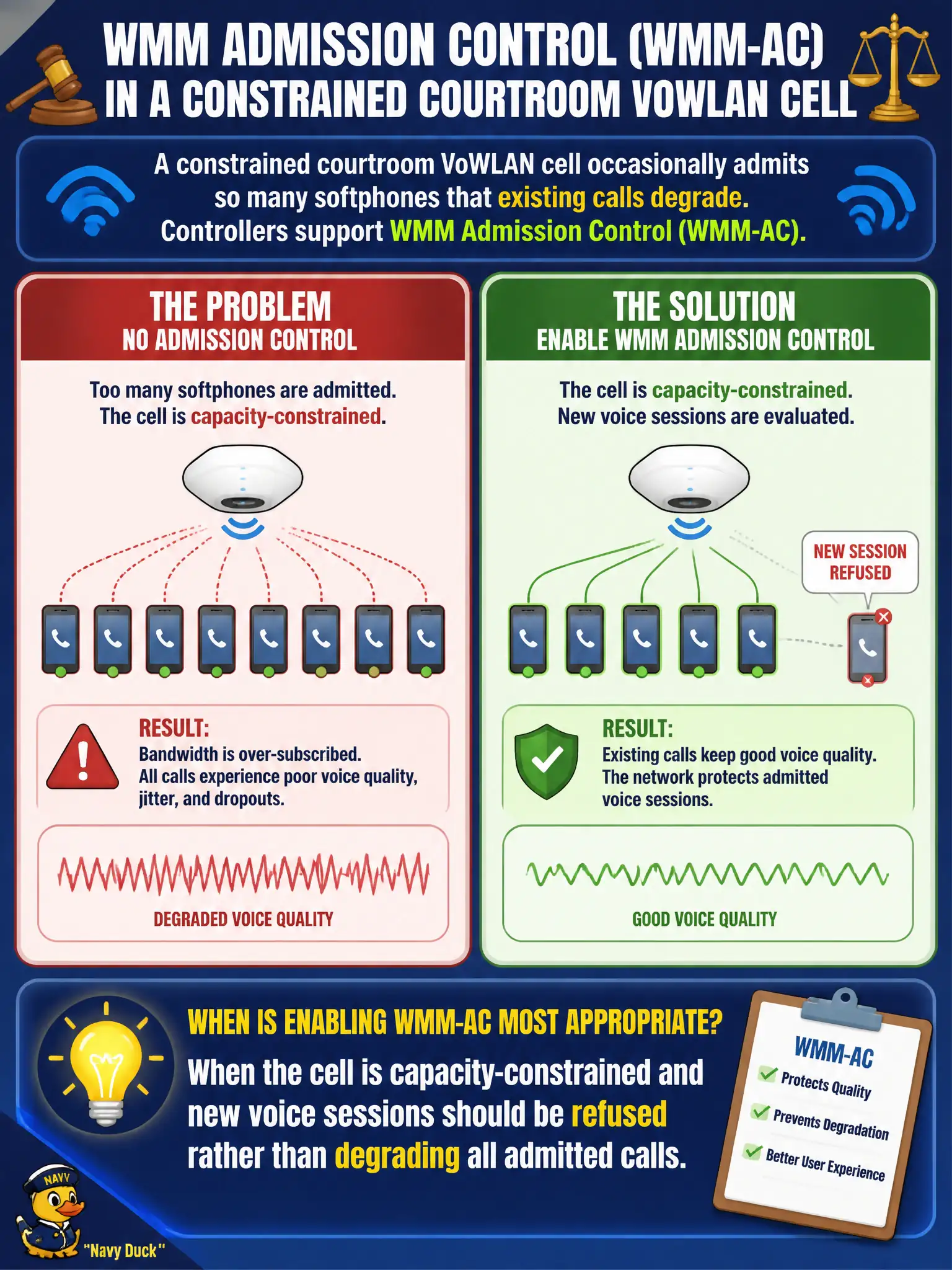
A constrained courtroom VoWLAN cell occasionally admits so many softphones that existing calls degrade. Controllers support WMM Admission Control (WMM-AC). When is enabling it most appropriate?
Select an answer to reveal the explanation.
Short Explanation
Think of WMM-AC like a fire-code occupancy limit for voice. Better to turn away the next softphone than pack the room until every call sounds broken. Use it to protect an already-tight cell—not as a free pass to skip capacity design.
Full Explanation
In a constrained courtroom VoWLAN cell, WMM Admission Control (WMM-AC) is most appropriate when the BSS is capacity-limited and new voice sessions should be refused rather than degrading every already-admitted call. Admission control trades occasional busy treatment for protecting active municipal proceedings from cascading quality collapse. Enabling WMM-AC merely because guest bulk downloads appear on a separate SSID misapplies a voice TSPEC tool to an unrelated SSID/traffic class problem better handled with QoS and capacity isolation. Tying WMM-AC only to DFS radar events confuses spectrum DFS behavior with voice session admission. Using admission control as a substitute for adequate AP density and channel reuse papers over a design shortfall and will still refuse calls without fixing airtime scarcity. Exam caveat: WMM-AC protects admitted calls; it does not create capacity—design density first, then enable admission where policy requires graceful refusal. Operational check: establish voice capacity budgets per courtroom cell, enable WMM-AC with clear busy indicators for clerks, and validate that peak calendar sessions no longer degrade in-progress calls when extra softphones attempt to join.