
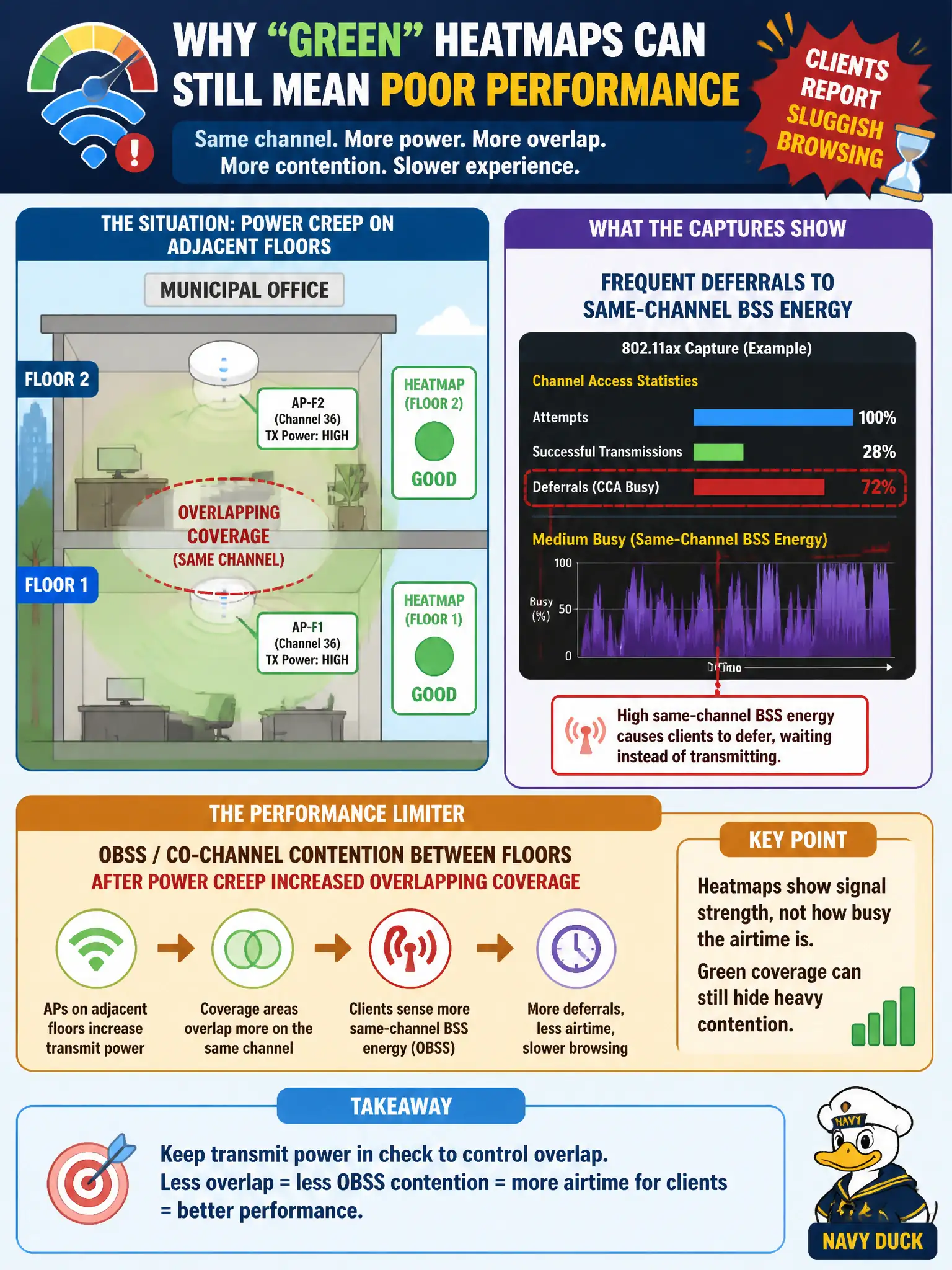
After APs on adjacent floors of a municipal office slowly crept up in transmit power, clients report sluggish browsing even though each floor heatmap still looks green. Captures show frequent deferrals to same-channel BSS energy. What performance limiter is most likely?
Select an answer to reveal the explanation.
Short Explanation
Green heatmaps can hide a noisy neighborhood. When upstairs and downstairs APs get louder on the same channel, they start talking over each other’s clients. That OBSS/co-channel fight steals airtime even when every RSSI patch looks pretty.
Full Explanation
After adjacent-floor APs in a municipal office slowly creep up in transmit power, green heatmaps can coexist with sluggish browsing if same-channel BSS energy forces frequent deferrals—classic OBSS / co-channel contention amplified by power creep that enlarges overlapping coverage between floors. Clients hear foreign BSS energy, defer, and experience higher latency and lower airtime share even though each floor’s predictive coverage plot still looks healthy. Insufficient DHCP pool size would present as address exhaustion or failed association/renewal symptoms, not primarily as deferrals to same-channel BSS energy in captures. Missing captive-portal certificates on guest SSIDs break portal trust and onboarding UX; they do not explain CCA deferral patterns on staff browsing after power increases. Low Ethernet cable category may limit wired uplink speed but would not create the RF deferral signature tied to overlapping co-channel cells. Exam caveat: coverage heatmaps show RSSI geometry, not contention; CCI/OBSS must be validated with spectrum/channel utilization and protocol captures. Operational check: compare channel plans and Tx power across floors, measure airtime busy and retry trends, then reduce power or retune channels so municipal office clients regain fair access without chasing unrelated Layer-3 or cable myths.