
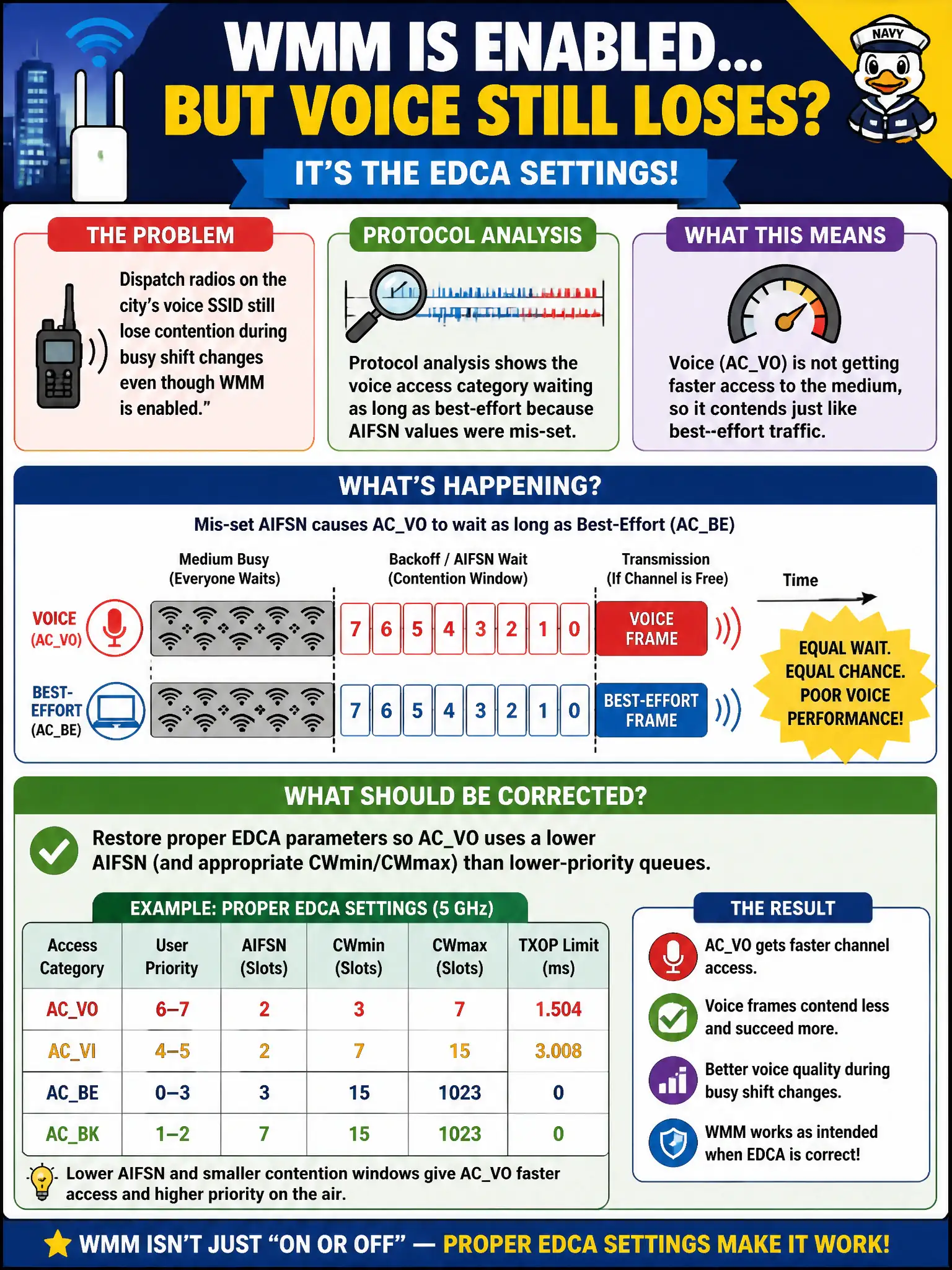
Dispatch radios on the city’s voice SSID still lose contention during busy shift changes even though WMM is enabled. Protocol analysis shows the voice access category waiting as long as best-effort because AIFSN values were mis-set. What should be corrected?
Select an answer to reveal the explanation.
Short Explanation
WMM is only as good as the starting-line gaps. If voice’s AIFSN looks like best-effort’s, the VIP lane isn’t a VIP lane anymore. Put AC_VO back on the short AIFSN/CW settings so dispatch traffic actually wins the medium.
Full Explanation
Dispatch radios on a city’s voice SSID can lose contention during busy shift changes even with WMM nominally enabled if EDCA parameters are wrong—especially if AC_VO uses AIFSN values that leave voice waiting as long as best-effort. Restoring proper EDCA so AC_VO uses a lower AIFSN (and appropriate CWmin/CWmax) than lower-priority queues re-establishes statistically earlier channel access for voice. Disabling EDCA to force DCF-only removes prioritized access categories and typically worsens voice contention under load rather than fixing mis-set AIFSN. Mapping voice into AC_BK inverts priority so background traffic clears first—opposite of public-safety-adjacent dispatch needs. Increasing beacon interval to 1000 ms may slightly reduce beacon airtime but does not correct access-category arbitration and can harm roam/timing behavior for handsets. Exam caveat: “WMM enabled” is necessary but not sufficient—verify actual EDCA parameter sets on AP and client paths. Operational check: confirm AC_VO AIFSN/CW settings against design baselines, capture voice versus BE deferral behavior during a shift-change drill, and document the municipal voice SSID QoS profile so future controller templates do not silently regress.