
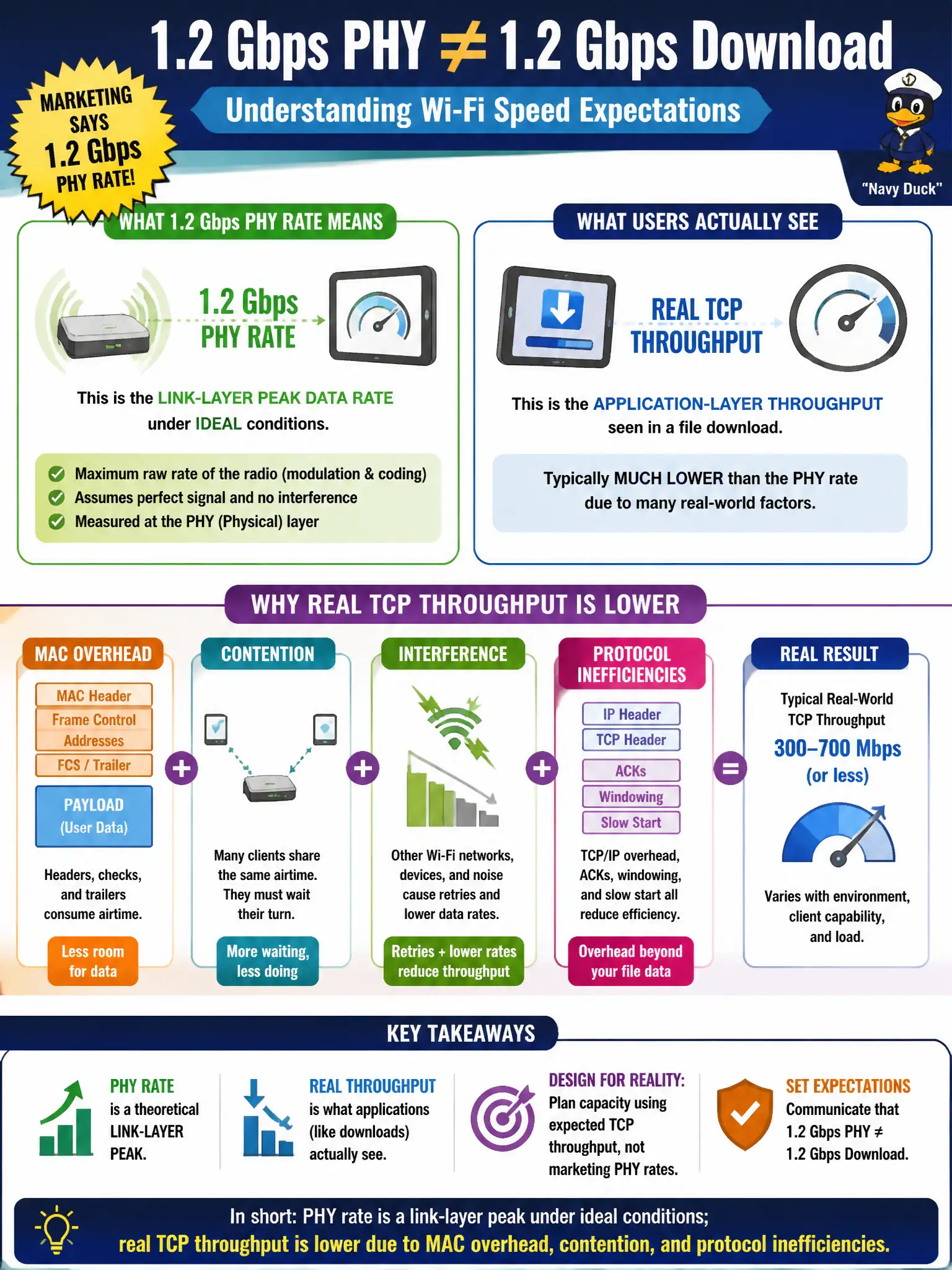
Marketing materials for the civic center Wi-Fi advertise a 1.2 Gbps PHY rate. Stakeholders expect every visitor tablet to see that speed in a file download. What should the CWNE-level explanation emphasize?
Select an answer to reveal the explanation.
Short Explanation
Marketing loves the speedometer’s redline; networks live in traffic. A 1.2 Gbps PHY number is a best-case link rate, not what a crowded civic tablet actually downloads. MAC overhead, ACKs, contention, and TCP keep real goodput well below the sticker.
Full Explanation
Marketing for civic-center Wi-Fi may advertise a 1.2 Gbps PHY rate, but a CWNE-level explanation must emphasize that PHY rate is a link-layer peak under ideal conditions; real TCP throughput is lower because of MAC overhead, contention, aggregation limits, protection, ACK/BA costs, and higher-layer inefficiencies. Stakeholders expecting every visitor tablet to match the advertised PHY number will be disappointed unless expectations are corrected with goodput language and validated tests. Claiming advertised PHY always equals sustained TCP goodput on an idle BSS confuses modulation/coding peaks with application throughput and ignores mandatory protocol overhead even when the medium is quiet. Asserting TCP throughput exceeds PHY rate once aggregation is enabled misunderstands conservation of the bit pipe: aggregation improves efficiency toward the PHY ceiling but does not magically surpass it. Blaming only the city’s ISP circuit while saying tablets ignore PHY rate misses the local wireless bottleneck that often dominates on dense guest floors. Exam caveat: separate PHY rate, MAC goodput, and TCP/app throughput in stakeholder briefings; exam items often test that distinction. Operational check: run controlled downloads and real visitor apps from representative tablets at known RSSI/MCS, compare measured Mbps to advertised PHY, and record the gap in the municipal Wi-Fi service description so council-facing marketing stays accurate.