
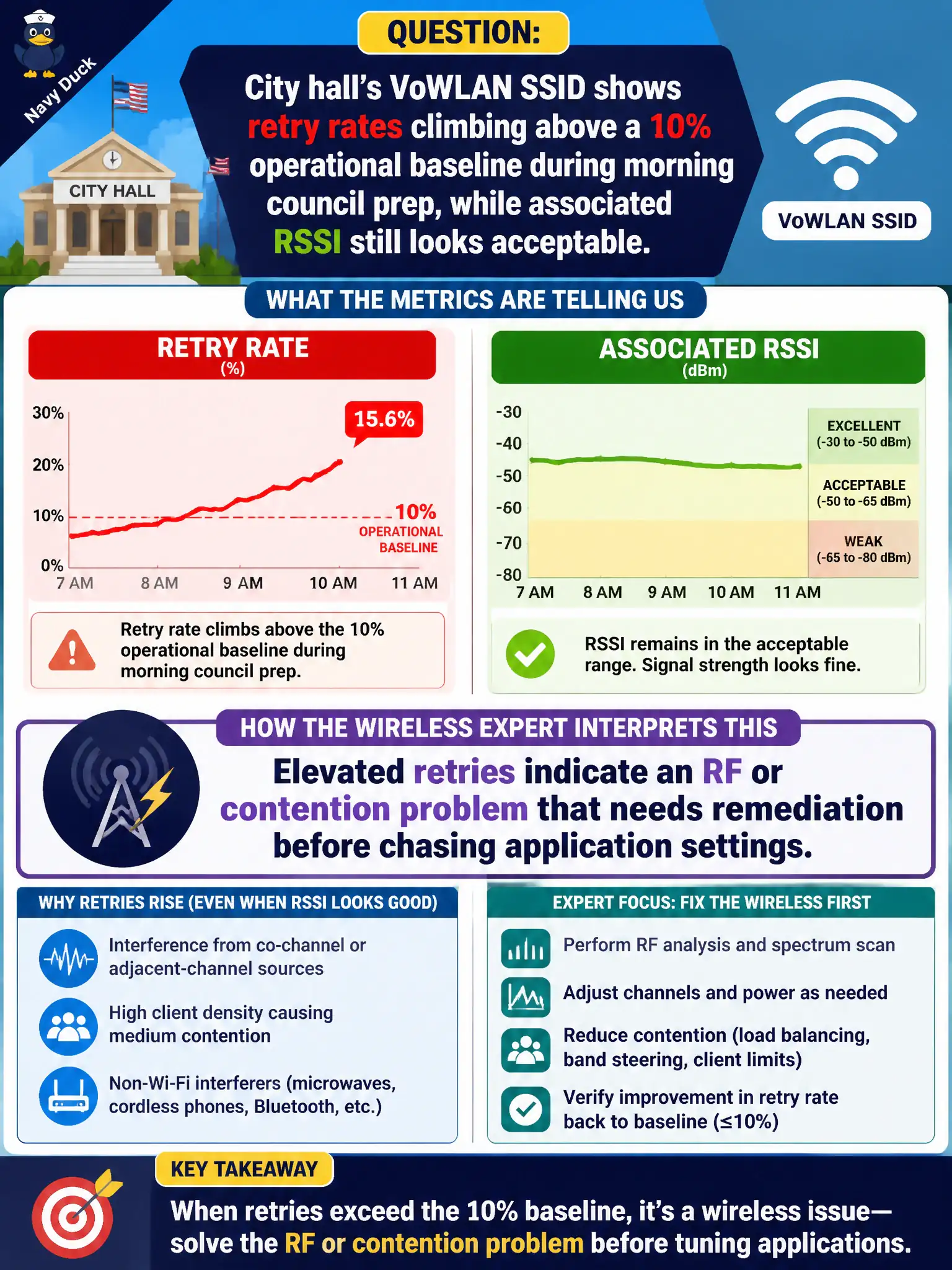
City hall’s VoWLAN SSID shows retry rates climbing above a 10% operational baseline during morning council prep, while associated RSSI still looks acceptable. How should the wireless expert interpret that metric?
Select an answer to reveal the explanation.
Short Explanation
Retries are the WLAN’s early-warning light—like a check-engine lamp that flickers before the car stalls. When voice retries blow past a ~10% baseline, the RF/contention story is already unhealthy. Fix the medium first; don’t start by blaming the softphone settings.
Full Explanation
When city hall’s VoWLAN SSID shows retry rates climbing above a roughly 10% operational baseline while associated RSSI still looks acceptable, the wireless expert should treat elevated retries as evidence of an RF or contention problem that needs remediation before chasing application settings. Retries measure how often frames fail first transmission attempts; they rise with collisions, interference, hidden nodes, OBSS energy, or PHY/MCS mismatch even when mean RSSI appears fine. Ignoring retries because MOS is unmeasured is unsafe for municipal voice: lack of a MOS dashboard does not make airtime waste or jitter acceptable during morning council prep. High retries do not, by themselves, prove RADIUS overload—authentication failures and EAP timing issues present differently from data-plane retry growth after association. Controller license exhaustion affecting AP join counts is a management-plane capacity issue, not the direct meaning of client retry statistics on an already-serving SSID. Exam caveat: RSSI adequacy never absolves poor retry/airtime metrics; CWNE-level triage correlates retries with channel utilization, CCI/ACI, and PHY rates. Operational check: capture retry percentage, channel busy, and MCS distribution on the voice SSID during the same council-prep window, remediate RF/contention first, then re-check softphone quality so civic communications stay reliable.