
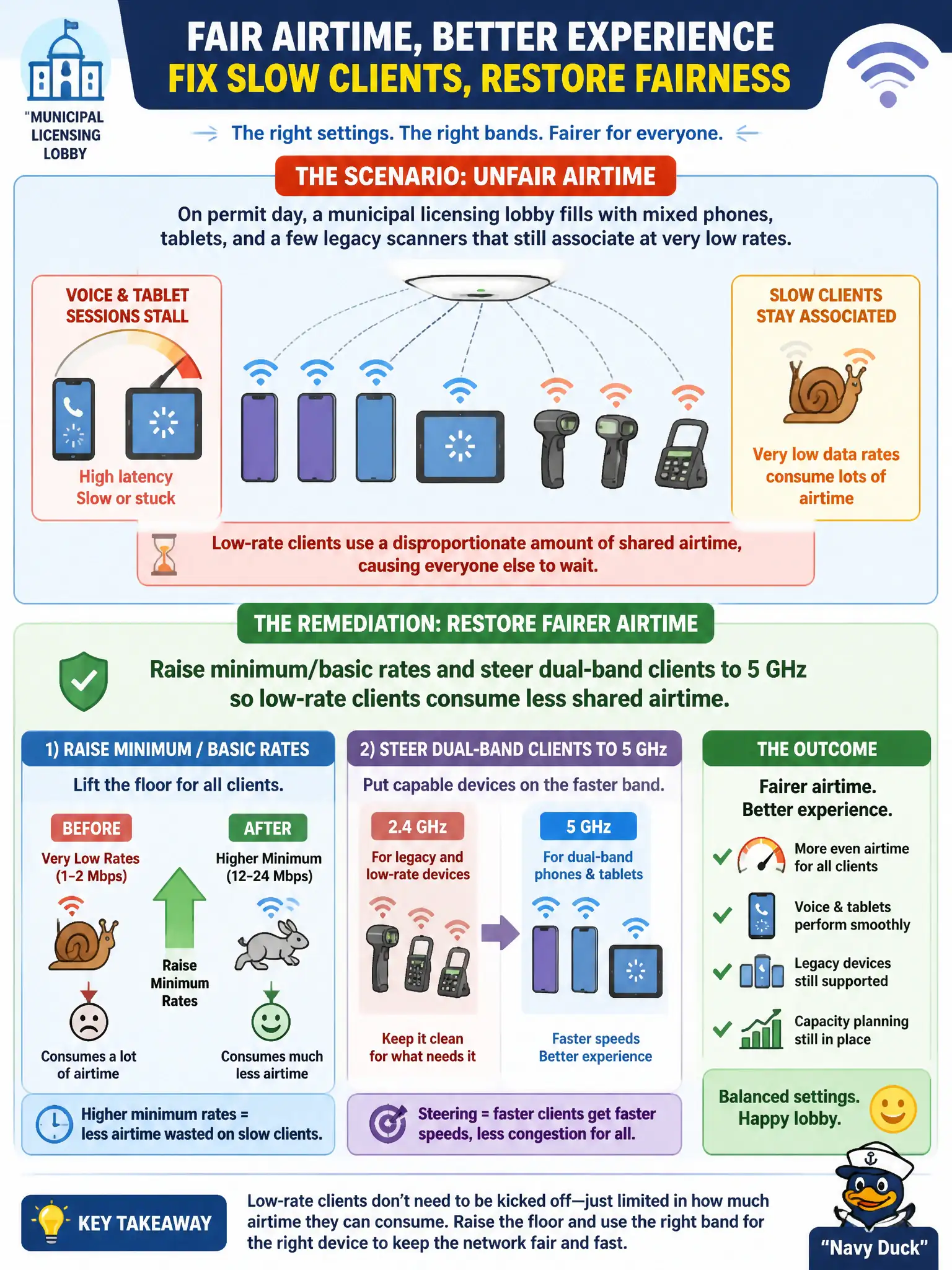
On permit day, a municipal licensing lobby fills with mixed phones, tablets, and a few legacy scanners that still associate at very low rates. Voice and tablet sessions stall while those slow clients stay associated. Which remediation best restores fairer airtime without abandoning capacity planning?
Select an answer to reveal the explanation.
Short Explanation
Picture a single checkout lane where one shopper pays with pennies—everyone else waits. Low-rate clients burn airtime the same way. Raising basic rates and steering capable devices to 5 GHz shrinks that airtime tax so permit-day density stays usable.
Full Explanation
On a permit-day municipal licensing lobby, shared airtime—not raw RSSI—usually decides whether voice and tablet sessions remain usable. Raising minimum and basic rates, and steering capable dual-band clients to 5 GHz, shrinks the fraction of time spent on very low MCS exchanges so legacy scanners and other slow stations stop dominating the medium. That remediation restores fairness while still fitting capacity planning: fewer microseconds per byte for the majority of civic clients, with a deliberate trade-off that may push truly legacy devices onto a constrained SSID or wired path. Raising every AP to maximum transmit power does not cure airtime unfairness; it often enlarges cells, increases co-channel contention, and can leave weak clients associated at still-poor rates while neighbors defer more. Disabling WMM collapses QoS differentiation into one equal queue, which harms voice during density peaks instead of fixing the low-rate tax. Widening every channel to 80 MHz pursues peak PHY rate but typically worsens reuse in a crowded lobby where SNR and available non-overlapping spectrum are already constrained. Exam caveat: airtime fairness and rate controls are capacity tools—they are not substitutes for AP density or a proper channel plan when the floor is simply under-served. Operational check: baseline retries, airtime utilization, and MCS histograms before and after minimum-rate and band-steering changes during a comparable permit-day window, and document any legacy scanners that must be isolated so municipal public-service Wi-Fi remains predictable for clerks and visitors.