
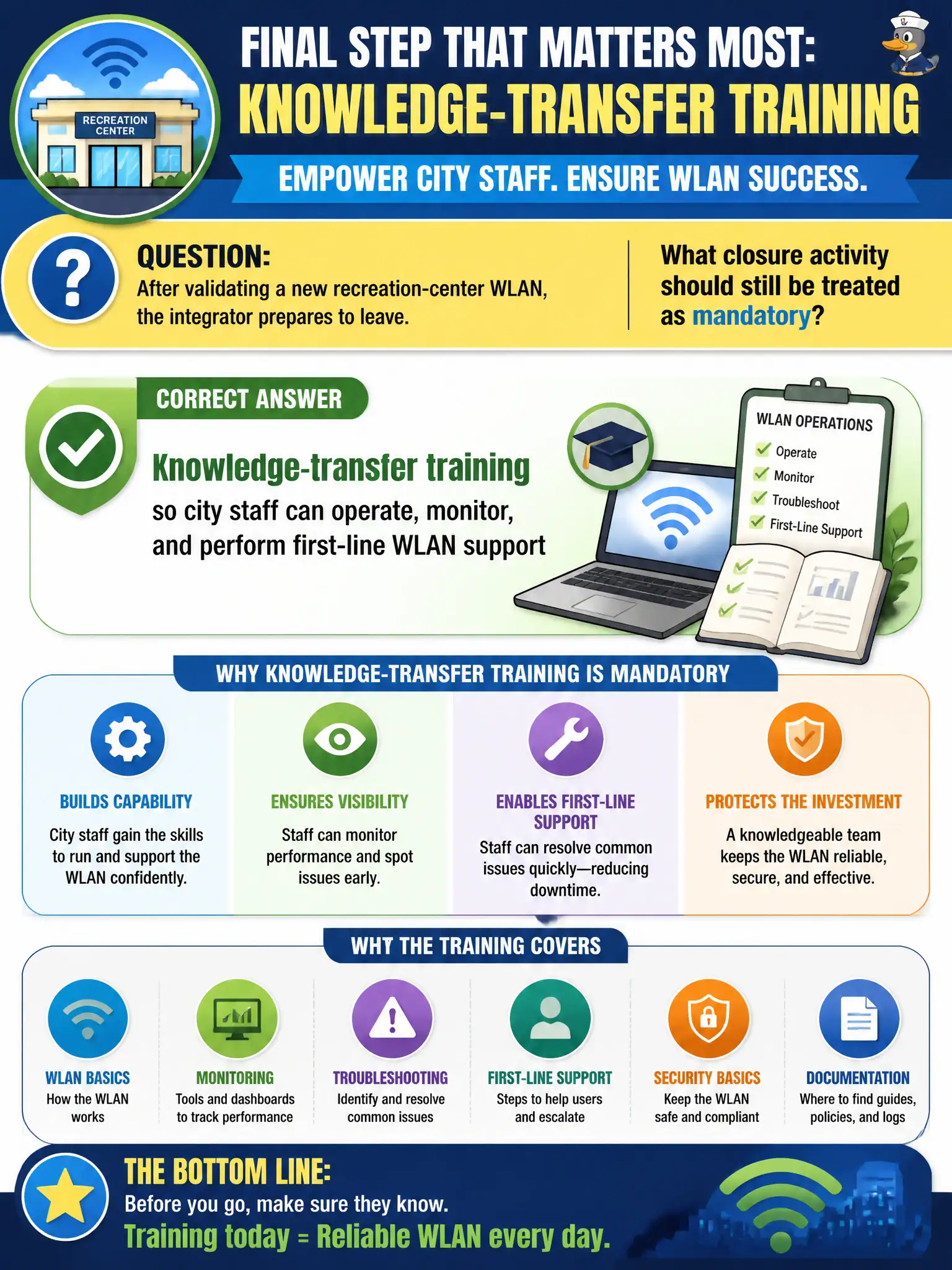
After validating a new recreation-center WLAN, the integrator prepares to leave. What closure activity should still be treated as mandatory?
Select an answer to reveal the explanation.
Short Explanation
If only the contractor knows where the RF skeletons are buried, the city doesn’t own the network yet. Teach staff how to watch it, change it safely, and triage common failures before the truck leaves. A warranty number is not a curriculum.
Full Explanation
After validating a recreation-center WLAN, knowledge-transfer training for city staff remains a mandatory closure activity so operations, monitoring, and first-line support do not vanish with the integrator. Runbooks, tooling walkthroughs, and escalation paths turn a successful install into a sustainable civic service that parks and recreation can actually run. Without that handoff, even a well-designed RF plant becomes a black box when the first festival overload or ticket surge hits.
Deleting design documents to reduce records burden destroys the city’s ability to troubleshoot and audit. Handing over only AP packing slips without operational runbooks is logistics, not enablement. Skipping training because a warranty phone number exists outsources tribal knowledge and slows incident response when citizens are waiting on programs.
Exam caveat: training should cover day-2 tasks (monitoring, common client issues, change basics), not only the original install story. Operational check: complete a recorded knowledge-transfer session with named city owners, confirm they can perform a basic health check and escalate using the runbook, and store design/as-built packages in the city’s controlled repository.