
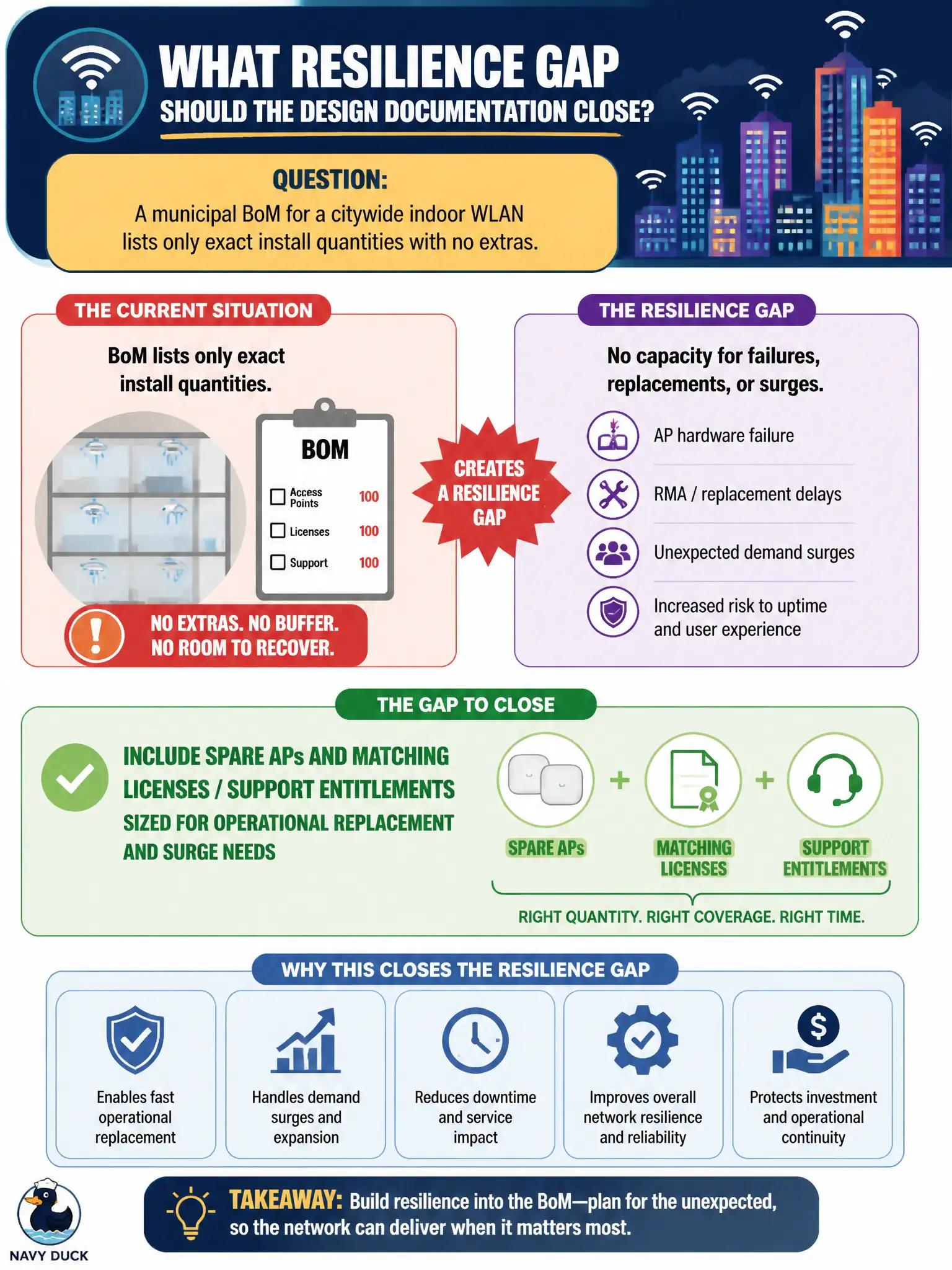
A municipal BoM for a citywide indoor WLAN lists only exact install quantities with no extras. What resilience gap should the design documentation close?
Select an answer to reveal the explanation.
Short Explanation
Cities can’t wait six weeks for a truck when a lobby AP dies before election week. Put spare APs—and the licenses that make them useful—in the BoM like spare tires. Cloud dashboards don’t conjure hardware from thin air.
Full Explanation
A citywide indoor WLAN bill of materials that lists only exact install quantities with no spares creates an operational fragility when APs fail, get damaged, or surge events need rapid adds. Design documentation should include spare APs plus matching licenses and support entitlements sized for replacement and surge so municipal operations are not waiting on emergency purchases during an outage. Public services that depend on Wi-Fi for permitting, inspections, and staff mobility need that buffer planned up front.
Removing licenses so spare APs can join without entitlement checks may violate licensing and leave spares unmanageable. Relying on next-fiscal-year emergency purchases externalizes risk onto outage duration. Shipping zero spares because cloud management “eliminates hardware failures” confuses orchestration with mean time between failures.
Exam caveat: spare quantities should reflect lead times, critical sites, and homogeneous AP models—not an arbitrary warehouse full of mismatched gear. Operational check: confirm the BoM and design appendix list spare AP counts and corresponding license/support SKUs, and verify spares can be adopted into the management system under a tested RMA drill.