
Before a city declares a new permitting-office WLAN accepted, what belongs in the validation plan?
Select an answer to reveal the explanation.
Short Explanation
“Looks green on the map” is not a finish line—numbers are. Bake retries, roam times, and a voice-quality proxy into the validation plan so acceptance is a scoreboard, not a vibe check. Purchase-order AP counts don’t prove users can work.
Full Explanation
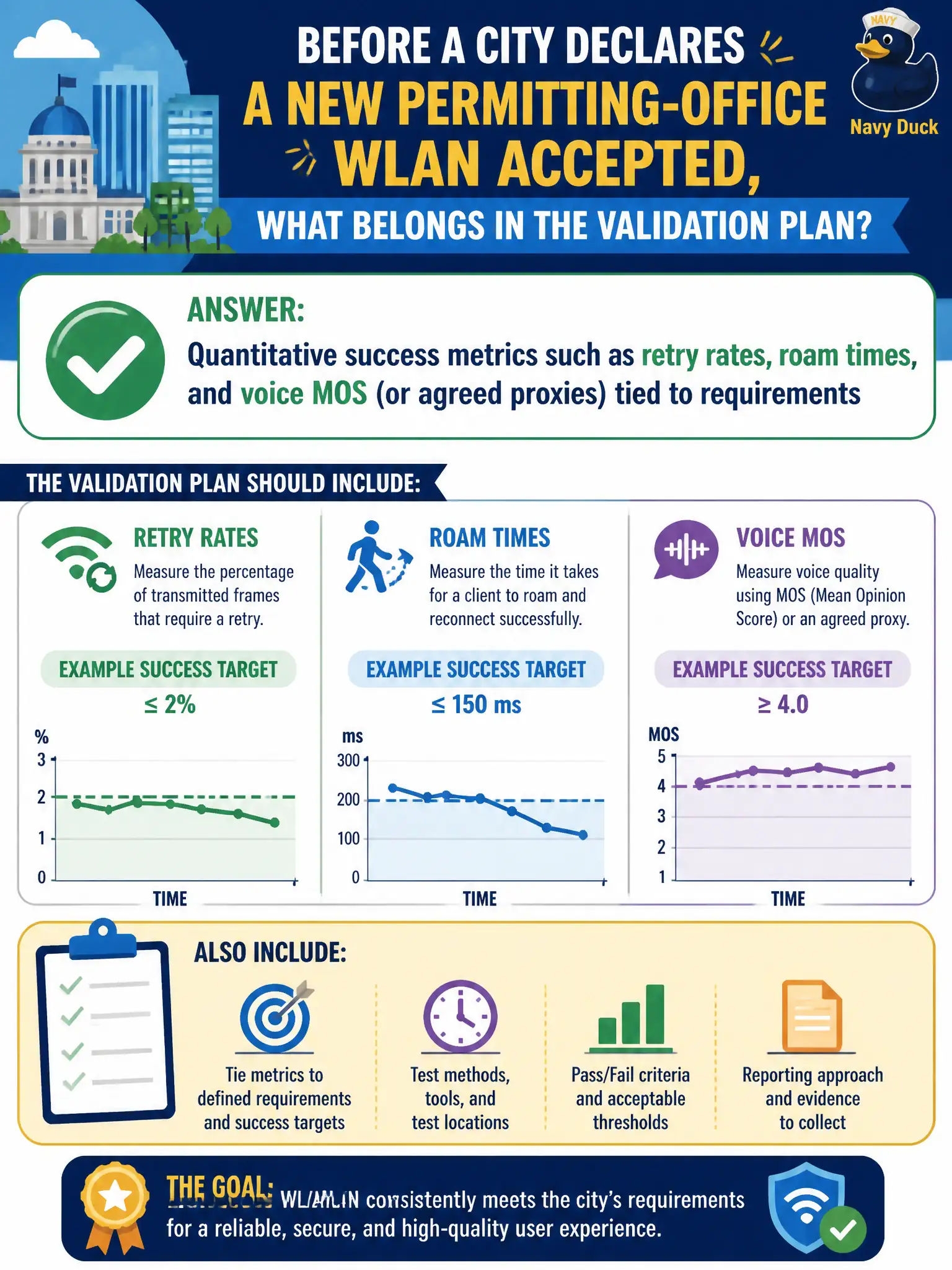
Declaring a permitting-office WLAN accepted requires a validation plan with quantitative success metrics—retry rates, roam times, and voice MOS or agreed proxies—tied back to the stated requirements. Those metrics turn political “it feels fine” moments into evidence a city can defend when counters open and inspectors bring tablets onto the floor. Acceptance without numbers leaves no baseline for later degradation complaints and makes warranty or integrator disputes harder to settle.
A screenshot of green predictive heatmaps with no client tests validates a model, not the installed network under real devices. A verbal “feels fine” from one inspector is anecdote, not acceptance. Matching AP count to the purchase order proves procurement occurred, not that RF or application performance met civic service levels.
Exam caveat: choose metrics that map to the office’s real apps (permitting tablets, scanners, softphones); vanity throughput alone can pass while roam or retry goals fail. Operational check: execute the validation plan’s test cases on representative client devices, record retry/roam/MOS (or proxies) against thresholds, and archive results with the acceptance package before go-live.