
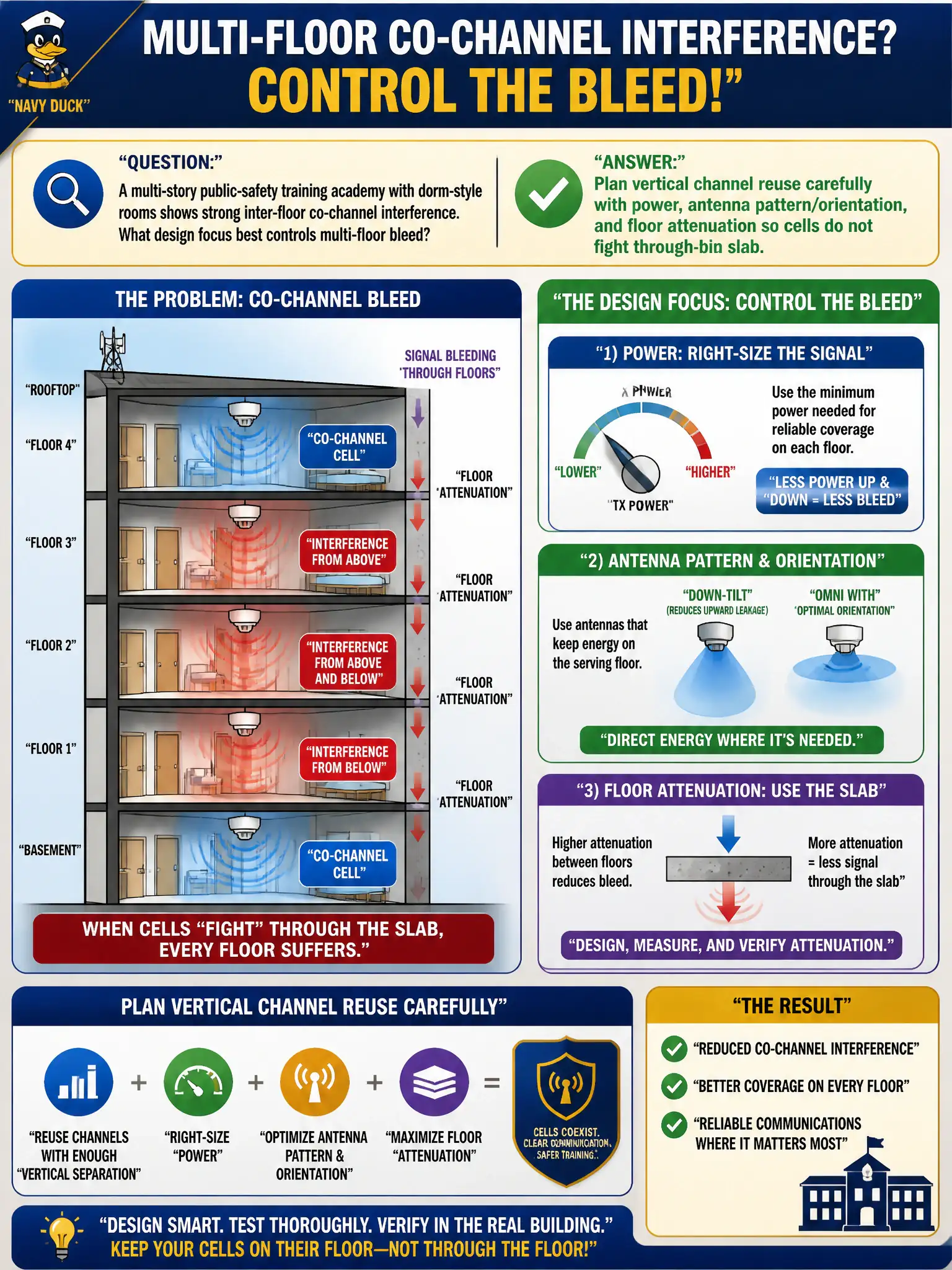
A multi-story public-safety training academy with dorm-style rooms shows strong inter-floor co-channel interference. What design focus best controls multi-floor bleed?
Select an answer to reveal the explanation.
Short Explanation
Floors are not Faraday cages—signals punch through slabs like neighbors arguing through thin apartments. Stagger channels vertically, mind power and antenna aiming, and respect how much the floor really attenuates. Same channel stacked floor-on-floor is a CCI sandwich.
Full Explanation
Multi-story public-safety academies with dorm-style rooms often suffer vertical co-channel interference when floor stacks reuse channels carelessly. Planning vertical channel reuse with deliberate power levels, antenna pattern/orientation, and floor attenuation keeps cells from fighting through the slab while still serving dense rooms. Vertical RF is a first-class design dimension in civic dormitory and training housing, not an afterthought to the horizontal floor plan.
Using identical channels on every floor stacked directly above each other maximizes bleed and airtime contention. Disabling all 5 GHz radios to rely on 2.4 GHz for “better penetration” concentrates clients on the most crowded band and worsens inter-floor interference. Raising every AP to maximum power so each floor overwhelms the one above is the opposite of controlled cell sizing.
Exam caveat: slab attenuation varies widely—measure or validate rather than assuming a textbook dB loss for every municipal building. Operational check: with proposed channels and power applied, survey inter-floor RSSI of same-channel APs in dorm rooms and confirm co-channel neighbors stay within the design’s reuse/SNR constraints before housing students.