
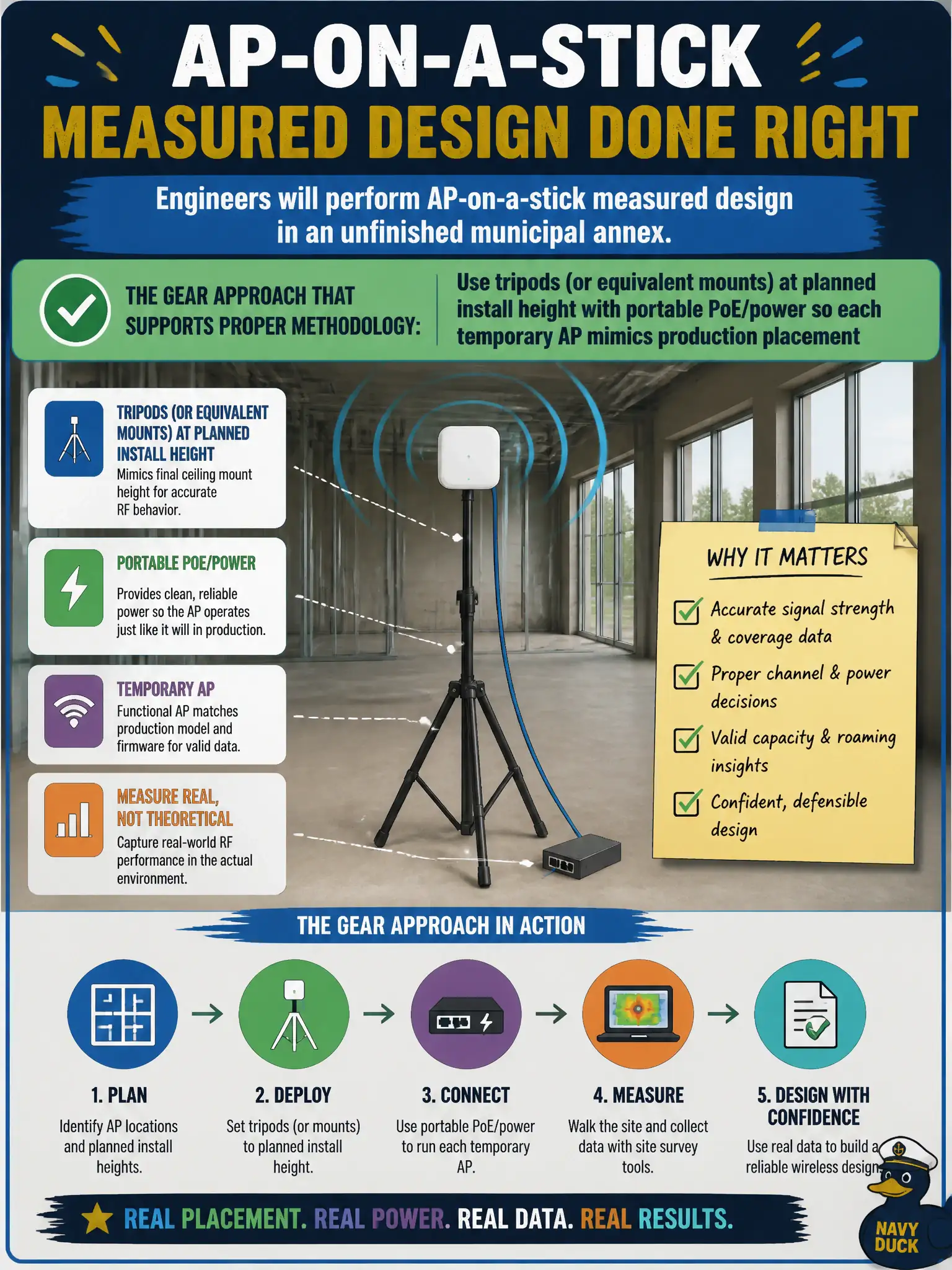
Engineers will perform AP-on-a-stick measured design in an unfinished municipal annex. What gear approach supports proper methodology?
Select an answer to reveal the explanation.
Short Explanation
AP-on-a-stick isn’t a circus act—it’s a dress rehearsal at the real height with real power. Tripods and portable PoE keep the radio where the finished mount will be so your survey isn’t a floor-level fairy tale. Hands and cardboard boxes measure a different building.
Full Explanation
AP-on-a-stick measured design in an unfinished municipal annex only mirrors production RF when temporary APs sit at planned install height with realistic mounting and power. Tripods or equivalent mounts plus portable PoE/power let each survey AP approximate production placement so coverage, bleed, and roam observations transfer to the final install. Floor-level or hand-held placements systematically misrepresent cell edges in multi-story civic buildings.
Holding APs by hand at random heights while walking with a laptop only produces non-repeatable data. Powering APs from wall warts that will not exist at install height skews both placement and sometimes radio behavior relative to PoE installs. Mounting survey APs on cardboard boxes at floor level for convenience measures the wrong plane entirely.
Exam caveat: “mimic production placement” includes orientation and antenna pattern, not only height—tilts and wall mounts matter in annex corridors. Operational check: set survey AP height to the planned mount elevation, power via the intended PoE class where practical, record each stick location against the design grid, and compare a sample of stick results to the predictive model before freezing the BOM.