
Public-safety VoWLAN handsets on a dedicated SSID drop calls when aggressive AP load balancing and band steering are enabled campus-wide. What design adjustment is most appropriate?
Select an answer to reveal the explanation.
Short Explanation
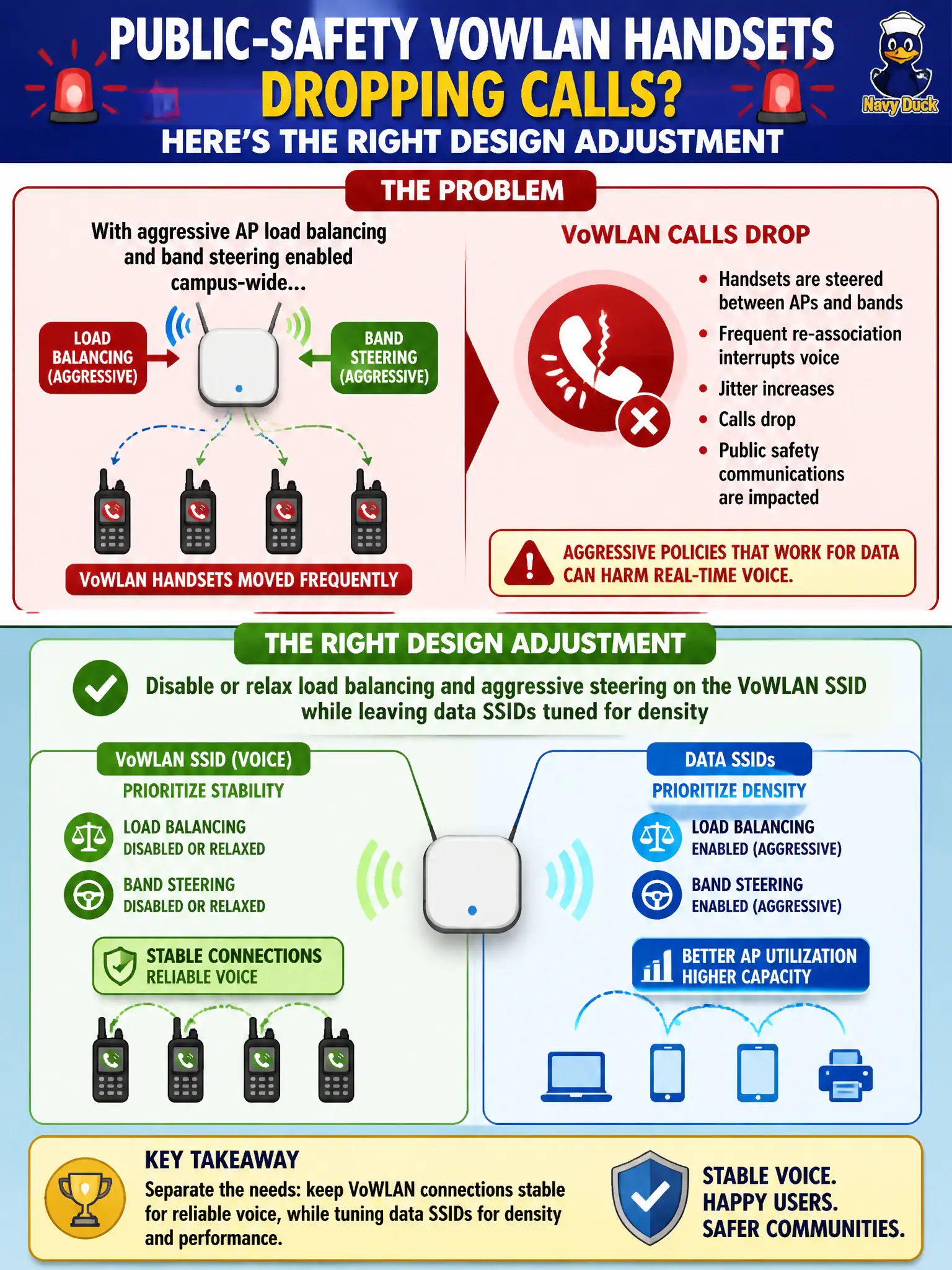
Voice hates being shoved mid-sentence to another AP “for balance.” Treat the VoWLAN SSID like a VIP lane: turn down the shove-y load-balance and steering knobs there, even if data SSIDs keep them. One policy for every SSID is how you get dropped emergency calls.
Full Explanation
Public-safety VoWLAN handsets are latency- and roam-sensitive; campus-wide aggressive AP load balancing and band steering that help dense data SSIDs can yank voice clients mid-call or park them on suboptimal radios. Disabling or relaxing those features on the dedicated VoWLAN SSID—while leaving data SSIDs tuned for density—preserves voice stability without abandoning capacity tools everywhere. Profile-scoped RF feature sets are a standard way to honor both public-safety call quality and civic data density on the same campus.
Forcing all voice handsets onto 2.4 GHz only ignores often-better 5 GHz voice designs and can overload a crowded band. Increasing steering aggression until handsets “stop sticking” typically worsens drops. Removing QoS markings so voice competes equally with bulk transfers attacks the wrong layer and increases jitter under load.
Exam caveat: the fix is SSID- or profile-specific tuning, not a global ban on steering for every WLAN in the city. Operational check: with balancing/steering relaxed on the voice SSID only, place test calls while walking known roam boundaries and confirm MOS/roam metrics against the voice acceptance gates while data SSIDs retain their density settings.