
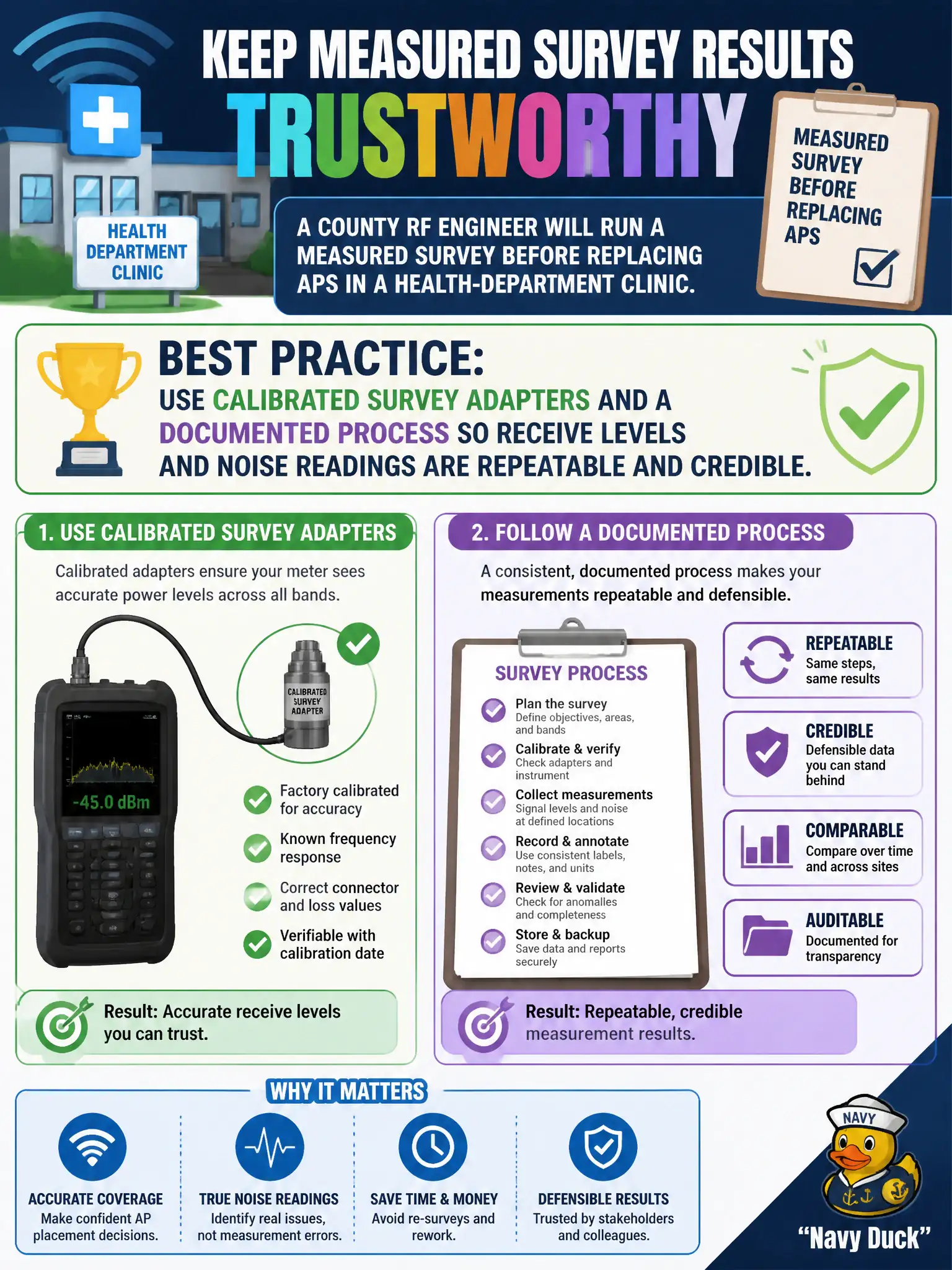
A county RF engineer will run a measured survey before replacing APs in a health-department clinic. What practice best keeps the measured results trustworthy?
Select an answer to reveal the explanation.
Short Explanation
Survey adapters are like bathroom scales—if they’re off by five pounds, every diet plan lies. Calibrate (or use known-good calibrated gear) and stick to a written walk process so dBm and noise numbers mean the same thing tomorrow. Pretty predictive maps don’t excuse sloppy meters.
Full Explanation
Measured surveys for a health-department clinic replacement only support trustworthy design decisions when adapters and process are calibrated and documented. Using known-good survey adapters with a recorded methodology makes receive levels, noise floor, and roam observations repeatable so two engineers—or an auditor—can trust comparisons between pre- and post-cutover datasets. Clinics also mix medical and administrative clients, so credibility of the survey underpins both clinical workflow and RF remediation spend.
Uncalibrated USB adapters “corrected by eye” inject systematic error that looks like expert judgment but is not reproducible. Surveying only 2.4 GHz because “calibration is unnecessary” ignores that modern clinic clients and capacity often live on 5/6 GHz. Skipping adapter checks because the predictive model already looks green confuses a model with ground truth.
Exam caveat: calibration and process discipline matter more than owning the newest survey laptop; undocumented tools undermine even carefully walked floors. Operational check: before the clinic survey, verify adapter/tool calibration status against the team’s procedure, record serials and software versions in the survey package, and spot-check a known reference location for expected RSSI consistency.