
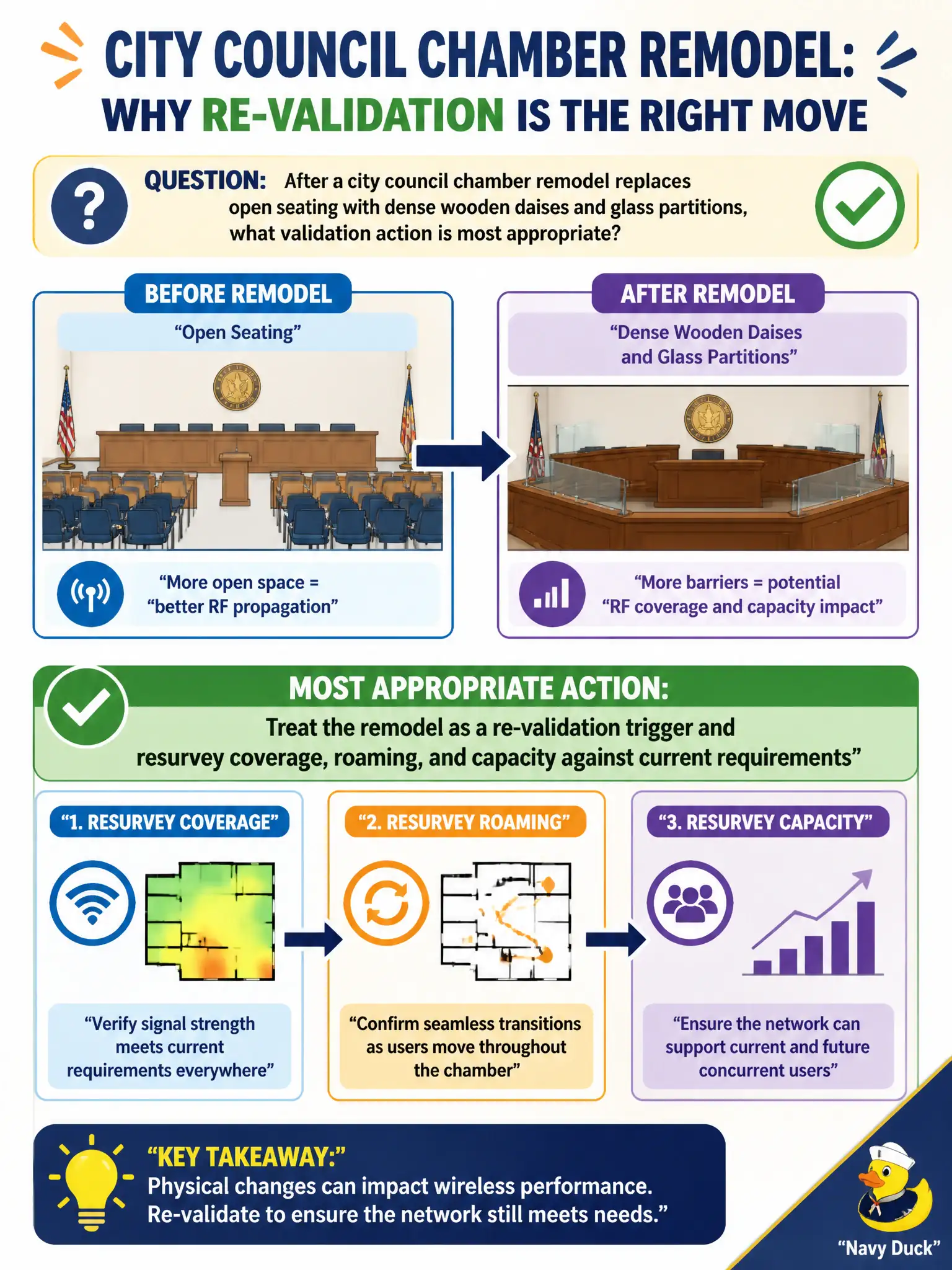
After a city council chamber remodel replaces open seating with dense wooden daises and glass partitions, what validation action is most appropriate?
Select an answer to reveal the explanation.
Short Explanation
Move the furniture, move the RF—wood and glass are not invisible to Wi-Fi. A chamber remodel that changes attenuation and seating density means the old survey is a history book, not a contract. Walk it again and check roam and capacity against today’s requirements.
Full Explanation
Remodels that replace open seating with dense wooden daises and glass partitions change attenuation, reflection, and client density—so prior validation for a city council chamber cannot be assumed to remain true. Treating the remodel as a re-validation trigger and resurveying coverage, roaming, and capacity against current requirements is the disciplined response: measure what the new geometry does to cells, sticky clients, and voice or video sessions used in public meetings.
Assuming the old survey remains valid because SSID names did not change confuses Layer-2 branding with RF physics. Raising every AP to maximum transmit power without re-measurement often worsens co-channel interference and does not prove capacity. Disabling validation until the next budget year leaves elected officials and staff on an unverified WLAN after a known environmental change.
Exam caveat: not every furniture move needs a full redesign, but material and seating density changes of this scale are classic re-validation triggers in CWNE-style design practice. Operational check: after the remodel, run a measured survey (or AP-on-a-stick checks) on primary seating and dais areas, compare results to the requirements’ SNR/roam/capacity gates, and update as-builts before declaring the chamber ready for session.