
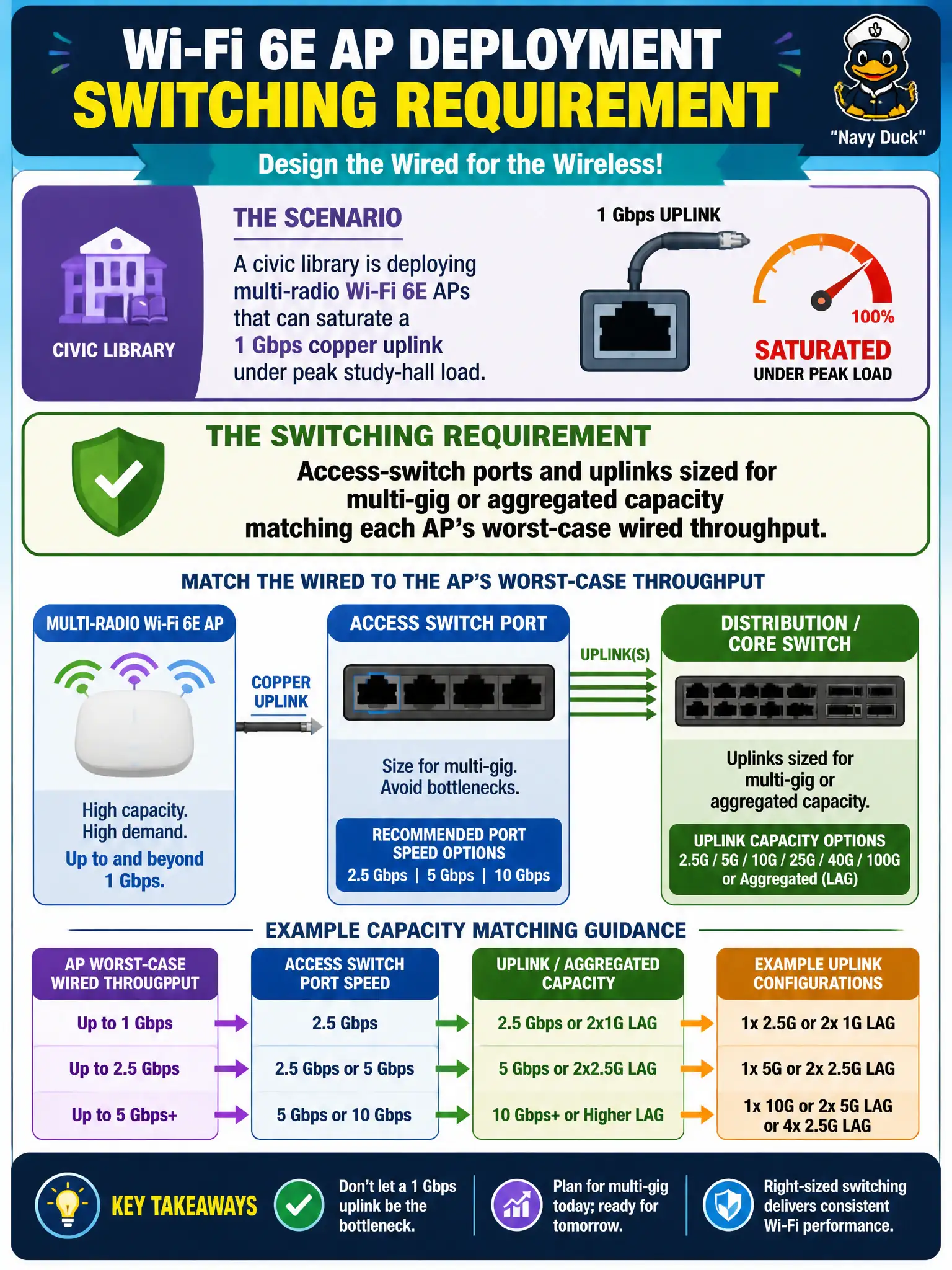
A civic library is deploying multi-radio Wi-Fi 6E APs that can saturate a 1 Gbps copper uplink under peak study-hall load. What switching requirement should the RF design call out?
Select an answer to reveal the explanation.
Short Explanation
Picture pouring three garden hoses into a drinking straw—the straw wins, and not in a good way. Multi-radio APs can push more airtime than a lonely 1 Gbps drop can carry. Spec access ports (and the path upstream) so the wire keeps up with the radios you just paid for.
Full Explanation
Multi-radio Wi-Fi 6E access points in a busy civic library can aggregate client throughput that exceeds a single 1 Gbps copper drop under concurrent 5 GHz and 6 GHz study-hall load. The RF design must therefore call out access-switch ports and uplinks sized for multi-gig or appropriately aggregated capacity that matches each AP’s worst-case wired throughput, along with PoE class and oversubscription assumptions. Otherwise the air looks healthy while the Ethernet side silently caps sessions—an especially damaging failure mode for public computing and exam-prep peaks.
Assuming any Fast Ethernet PoE port is fine because “clients are the bottleneck” ignores modern AP datasheets and multi-user MIMO/OFDMA capacity. Keeping only the core at 10 Gbps while leaving access at 100 Mbps creates the bottleneck at the edge where APs attach. Disabling capable 6 GHz radios solely to protect an undersized switch wastes spectrum investment and still leaves the wrong engineering trade.
Exam caveat: uplink sizing is a design input tied to predicted peak concurrent load and AP radio count, not a purchasing afterthought after heatmaps look green. Operational check: under a controlled peak or synthetic load, measure AP uplink utilization and client goodput; if the copper link saturates while airtime remains available, the switching requirement in the design package was underspecified.