
A city hall WLAN must go live for permitting counters in eight weeks, but full-campus AP installs will take five months. How should the design support phased deployment without stranding interim users?
Select an answer to reveal the explanation.
Short Explanation
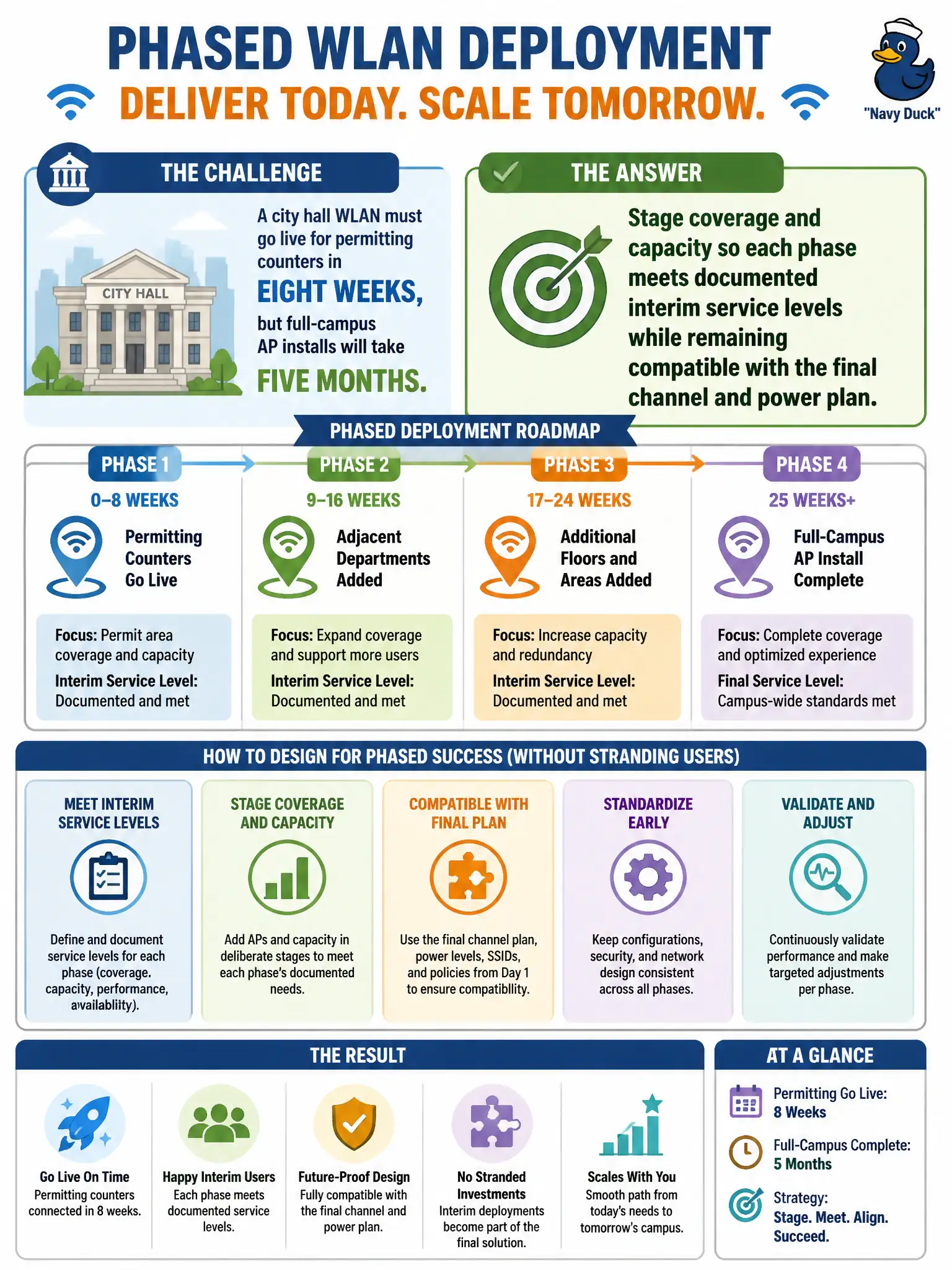
Think of a road rebuild that still needs one lane open—traffic can’t wait for the last mile of asphalt. Phase the WLAN so each cutover still hits the interim SLAs you wrote down, and keep that temporary layout on the same channel/power roadmap as the finished design. That way early floors work now without forcing a rip-and-replace later.
Full Explanation
Phased municipal WLAN rollouts succeed when each cutover is engineered as a first-class design deliverable, not a temporary inconvenience. Staging coverage and capacity so permitting counters and other early-occupancy areas meet documented interim SNR, retry, and density targets—while remaining compatible with the final channel, power, and SSID/security plan—lets the city open services in eight weeks without stranding staff on ad hoc workarounds. Interim cells should reuse the same RF and uplink assumptions the as-built design will keep, so later expansion is additive rather than a rip-and-replace.
Deferring all RF planning until a single campus-wide weekend install leaves counters offline for months and ignores how municipal programs actually fund and occupy space. Designing only for final density and telling interim users to tether to cellular abandons SLA ownership and creates unmanaged shadow IT. Temporary consumer mesh with no channel plan injects unmanaged interference, weak security, and acceptance gaps that are expensive to unwind.
Exam caveat: “compatible with the final plan” does not mean overbuilding every floor on day one; it means interim AP counts, channels, and power levels are recorded so they fold cleanly into the completed design. Operational check: for each phase gate, walk the occupied floors with the acceptance metrics from the requirements doc, confirm interim AP placements appear on the as-built channel plan, and verify that removing or relocating temporary units later will not strand the SSID/security architecture.