
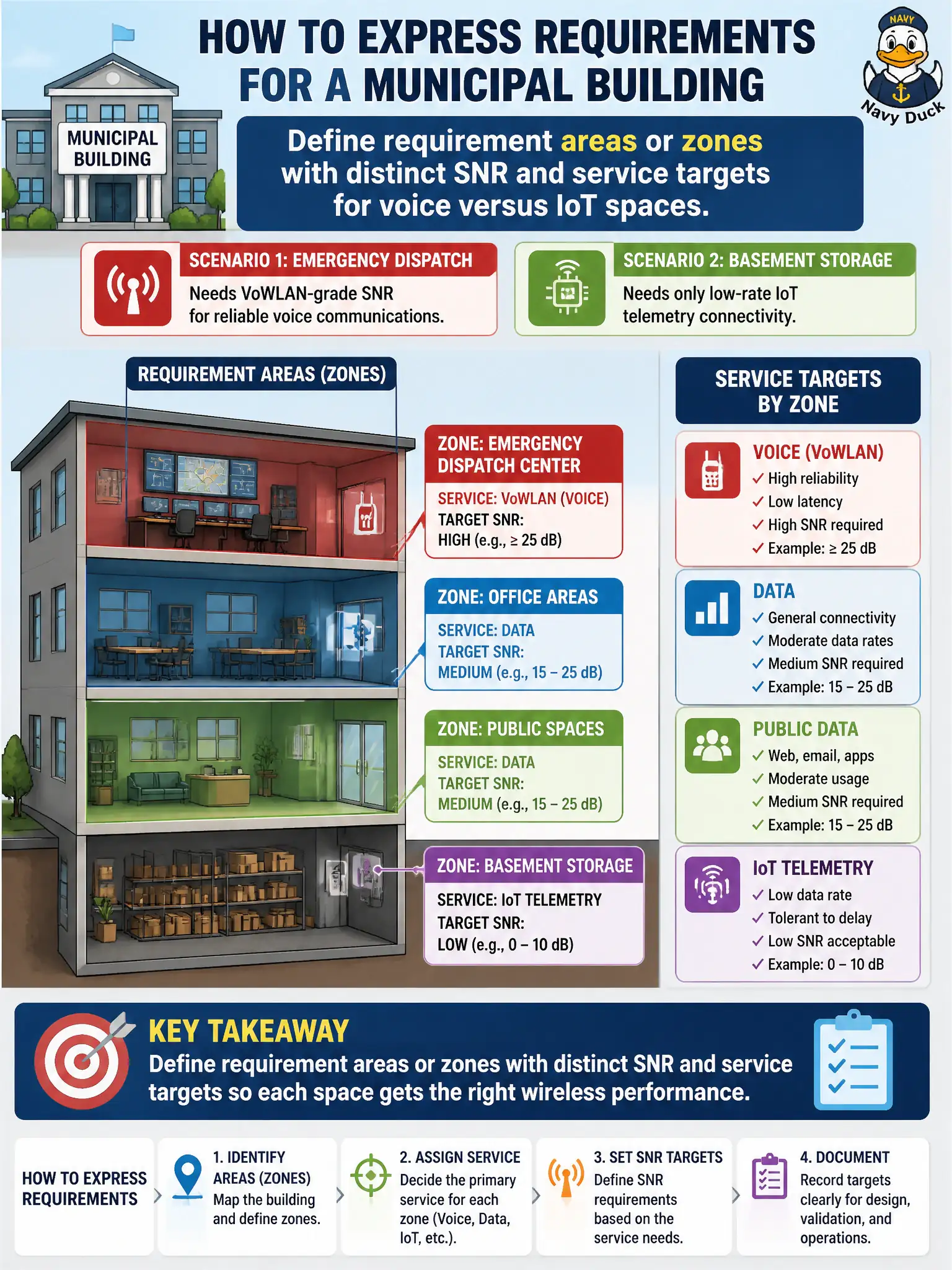
A municipal building needs VoWLAN-grade SNR in emergency dispatch and only low-rate IoT telemetry in basement storage. How should requirements be expressed?
Select an answer to reveal the explanation.
Short Explanation
Dispatch and a storage basement are not the same WLAN problem. Zone the building—voice SNR where it matters, IoT targets where it does not—and stop chasing one lazy global heatmap.
Full Explanation
Different municipal spaces need different RF service definitions. When a building needs VoWLAN-grade SNR in emergency dispatch and only low-rate IoT telemetry in basement storage, requirements should define requirement areas or zones with distinct SNR and service targets for voice versus IoT spaces. One weak global heatmap goal either overbuilds storage or under-serves dispatch where life-safety voice matters.
Using one global −80 dBm heatmap goal for every room regardless of application fails by concept: voice and IoT do not share the same SNR and service bar. Using identical voice SNR targets in storage rooms with no voice users fails by concept: that wastes density where telemetry-only service suffices. Omitting application metrics and accepting any association as success fails by concept: association is not voice-grade performance.
Exam caveat: CWNE requirements zoning ties RF targets to application criticality by area in civic facilities.
Operational check: Draw zone maps for dispatch versus basement storage with distinct RSSI, SNR, and capacity targets, design AP density per zone, and validate each zone against its own acceptance criteria. In municipal CWNE practice for item q149, document the decision, tie it to the civic service impact, and re-test after change so operations can defend the design to stakeholders with evidence rather than opinion.