
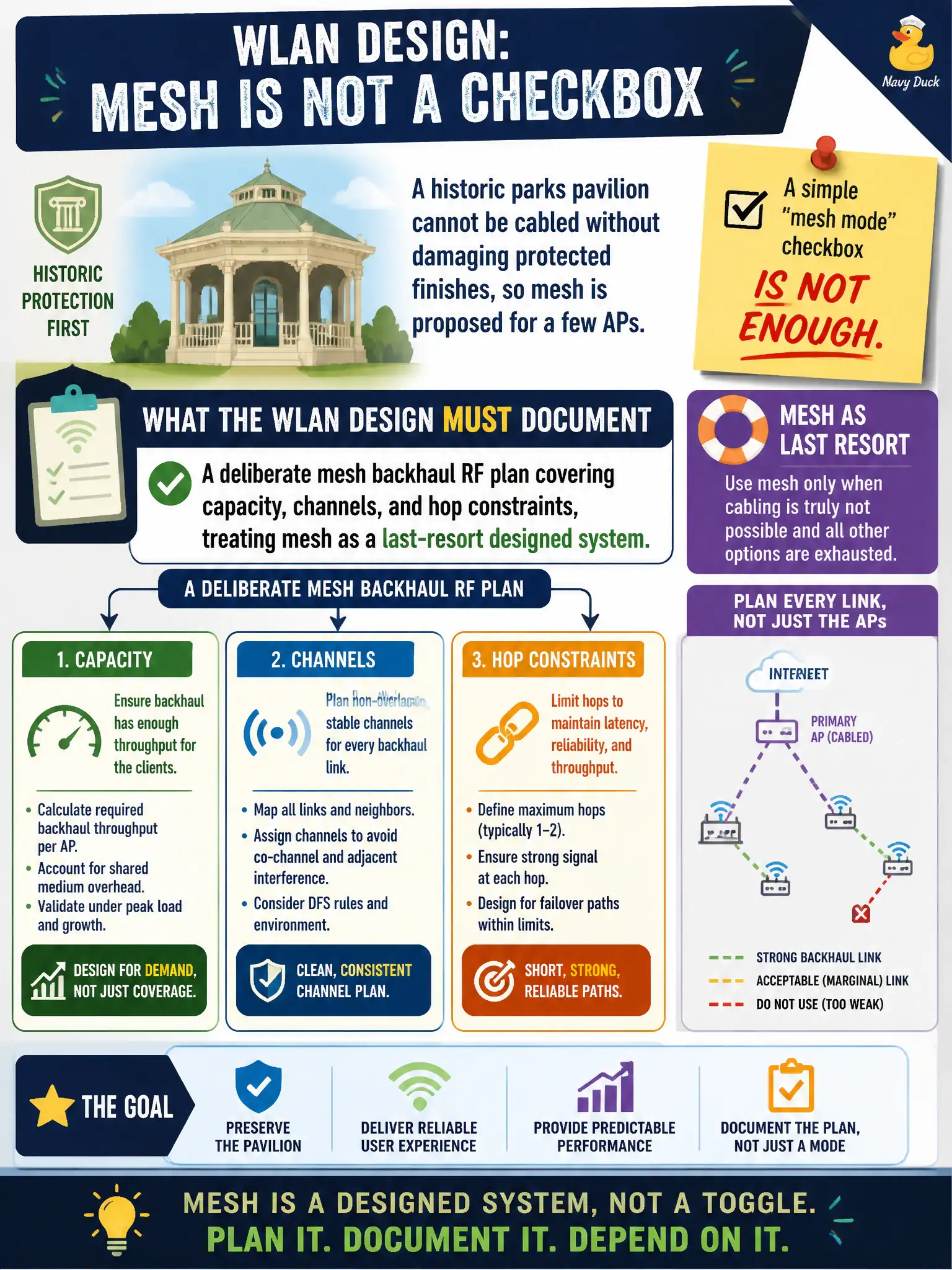
A historic parks pavilion cannot be cabled without damaging protected finishes, so mesh is proposed for a few APs. What must the WLAN design document that a simple 'mesh mode' checkbox does not provide?
Select an answer to reveal the explanation.
Short Explanation
Mesh is not a checkbox miracle. If cabling is impossible, design the backhaul RF—capacity, channels, hops—like the critical path it is.
Full Explanation
Mesh is a designed backhaul system, not a checkbox that magically yields campus-grade capacity. When a historic parks pavilion cannot be cabled without damaging protected finishes and mesh is proposed for a few APs, the WLAN design must document a deliberate mesh backhaul RF plan covering capacity, channels, and hop constraints, treating mesh as a last-resort designed system. Without that plan, enabling mesh mode alone under-delivers for pavilion services.
Claiming nothing additional is needed because enabling mesh automatically guarantees campus-grade backhaul fails by concept: mesh capacity and hops require RF engineering. Documenting only a guest splash page theme for mesh SSIDs fails by concept: captive branding is unrelated to backhaul RF planning. Requiring mesh on every indoor office AP even where Ethernet exists fails by concept: mesh should remain last resort where cabling is impossible, not a default.
Exam caveat: CWNE mesh items demand explicit backhaul RF and capacity design beyond enabling a feature flag.
Operational check: Design mesh root and leaf roles, dedicated backhaul channels where supported, hop limits, and capacity budgets for the pavilion; validate throughput to the Ethernet root before production use.