
A city hall atrium has very high ceilings; omni APs at full power paint the atrium but bleed badly onto adjacent office floors. What design approach is most appropriate?
Select an answer to reveal the explanation.
Short Explanation
High atriums punish lazy omnis. Pick patterns and power that paint the floor you care about without raining CCI onto the offices next door.
Full Explanation
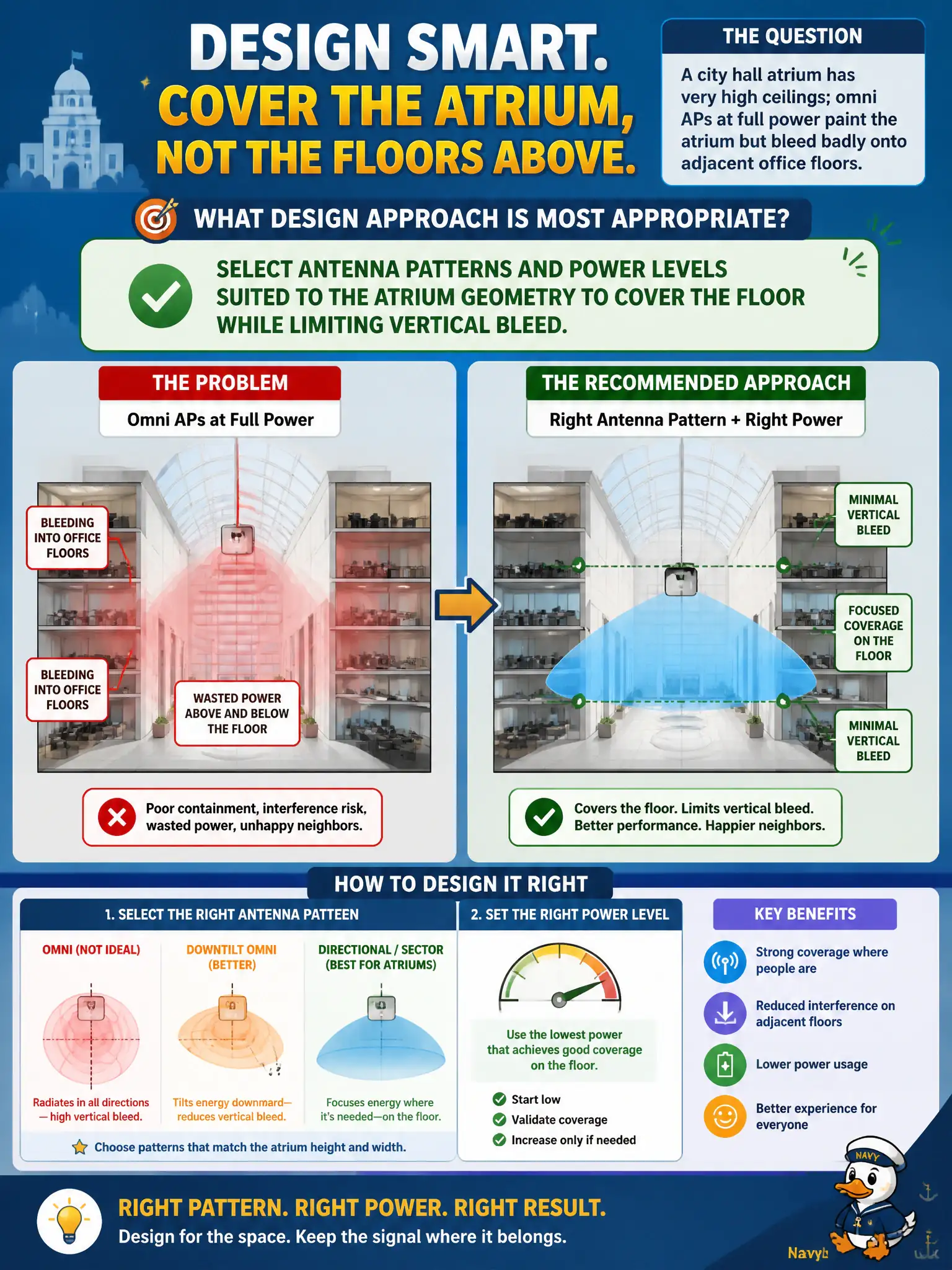
High atrium ceilings with full-power omnis often create floor coverage at the cost of vertical bleed into offices. The appropriate design approach for a city hall atrium is to select antenna patterns and power levels suited to the atrium geometry to cover the floor while limiting vertical bleed—downtilted or directional patterns and restrained power beat brute-force omnis. Geometry-aware antennas solve what SSID count cannot.
Keeping full-power omnis and accepting floor bleed as unavoidable fails by concept: antenna and power choices can reduce bleed. Fixing bleed by adding more SSIDs rather than changing antennas or power fails by concept: more SSIDs increase overhead and do not reshape vertical RF. Raising power further so atrium clients never roam fails by concept: more power worsens bleed and CCI onto adjacent floors.
Exam caveat: CWNE atrium designs emphasize antenna pattern and power control for three-dimensional civic spaces.
Operational check: Model or measure atrium coverage with downtilted or directional antennas at moderated power, confirm floor RSSI targets, and survey adjacent offices for reduced bleed before install. In municipal CWNE practice for item q147, document the decision, tie it to the civic service impact, and re-test after change so operations can defend the design to stakeholders with evidence rather than opinion.